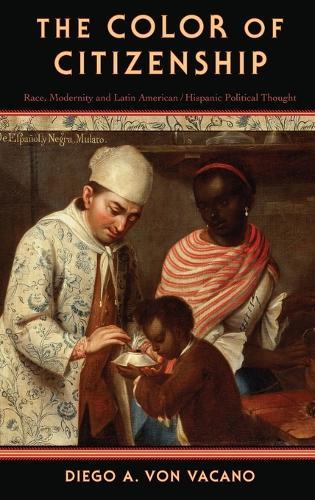
Full Product Details
Author: Diego Von Vacano (Assistant Professor of Political Science, Assistant Professor of Political Science, Texas A&M University)
Publisher: Oxford University Press Inc
Imprint: Oxford University Press Inc
Dimensions:
Width: 23.90cm
, Height: 2.30cm
, Length: 16.30cm
Weight: 0.454kg
ISBN: 9780199746668
ISBN 10: 0199746664
Pages: 240
Publication Date: 16 February 2012
Audience:
College/higher education
,
Postgraduate, Research & Scholarly
Format: Hardback
Publisher's Status: Active
Availability: Manufactured on demand

We will order this item for you from a manufactured on demand supplier.
Reviews
<br> Diego von Vacano puts Latin American and Hispanic political thought in the forefront as he examines, with originality and precision, the role that race has played and can play in both political thought and theory. As a central factor of the lived experience of individuals in the modern world, race as a synthetic concept illuminates the workings of politics, power, and citizenship and challenges the ways in which race has traditionally been elided in Western political thought. --Henry Louis Gates, Jr., Alphonse Fletcher University Professor, Harvard University<p><br> Diego von Vacano's important new book forces us to rethink central assumptions about modernity and race that have long been part of European and North American intellectual traditions. Through the writings of four major Spanish American intellectuals, spanning fully 400 years, The Color ofCitizenship explores the evolution of racial ideas based on mixture and fluidity rather than purity and stability. With The Color o
Diego von Vacano puts Latin American and Hispanic political thought in the forefront as he examines, with originality and precision, the role that race has played and can play in both political thought and theory. As a central factor of the lived experience of individuals in the modern world, race as a synthetic concept illuminates the workings of politics, power, and citizenship and challenges the ways in which race has traditionally been elided in Western political thought. --Henry Louis Gates, Jr., Alphonse Fletcher University Professor, Harvard University Diego von Vacano's important new book forces us to rethink central assumptions about modernity and race that have long been part of European and North American intellectual traditions. Through the writings of four major Spanish American intellectuals, spanning fully 400 years, The Color ofCitizenship explores the evolution of racial ideas based on mixture and fluidity rather than purity and stability. With The Color of Citizenship, the important contributions of Latin Americans to thinking about race can no longer be ignored. --Edward Telles, Professor of Sociology, Princeton University The Color of Citizenship is an excellent genealogy of racial thinking and post-colonial states in the Americas. Scholars of philosophy, political theory, and race will better understand the complicated and 'synthetic' nature of racial discourse in the Americas from reading this book. --Mark Q. Sawyer, Professor of Political Science & African American Studies, UCLA By examining what a selected number of Spanish American thinkers had to say about race, regardless of their politics, Diego von Vacano's book is a most valuable contribution on various fronts. It offers a fruitful and exceptional interdisciplinary engagement between political philosophy and the history of ideas, which is also an invitation to take more seriously Latin American political thinkers. More substantially, it traces a 'par
<br> Diego von Vacano puts Latin American and Hispanic political thought in the forefront as he examines, with originality and precision, the role that race has played and can play in both political thought and theory. As a central factor of the lived experience of individuals in the modern world, race as a synthetic concept illuminates the workings of politics, power, and citizenship and challenges the ways in which race has traditionally been elided in Western political thought. --Henry Louis Gates, Jr., Alphonse Fletcher University Professor, Harvard University<p><br> Diego von Vacano's important new book forces us to rethink central assumptions about modernity and race that have long been part of European and North American intellectual traditions. Through the writings of four major Spanish American intellectuals, spanning fully 400 years, The Color ofCitizenship explores the evolution of racial ideas based on mixture and fluidity rather than purity and stability. With The Color of Citizenship, the important contributions of Latin Americans to thinking about race can no longer be ignored. <br>--Edward Telles, Professor of Sociology, Princeton University<p><br> The Color of Citizenship is an excellent genealogy of racial thinking and post-colonial states in the Americas. Scholars of philosophy, political theory, and race will better understand the complicated and 'synthetic' nature of racial discourse in the Americas from reading this book. --Mark Q. Sawyer, Professor of Political Science & African American Studies, UCLA <br><p><br> By examining what a selected number of Spanish American thinkers had to say about race, regardless of their politics, Diego von Vacano's book is a most valuable contribution on various fronts. It offers a fruitful and exceptional interdisciplinary engagement between political philosophy and the history of ideas, which is also an invitation to take more seriously Latin American political thinkers. More substantially, it traces a 'par
Author Information
Diego A. von Vacano is Assistant Professor of Political Science at Texas A&M University and Fellow at the Center for Advanced Study in the Behavioral Sciences at Stanford University. He was previously a Fellow at the Institute for Advanced Study in Princeton, and is the author of The Art of Power.