Overview
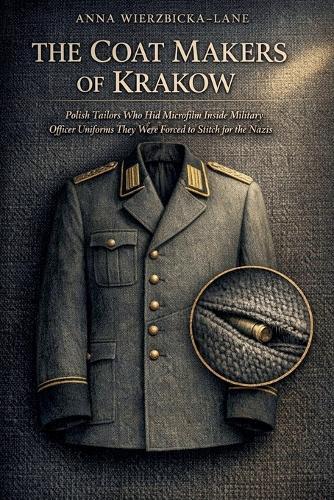
Inside the left chest panel of a German officer's uniform coat, between the wool outer layer and the silk lining, sewn shut with a thread that matched the factory stitching exactly, was a roll of microfilm no larger than a fingertip. The officer who wore the coat never knew it was there. The people who put it there were Jewish tailors working in German-requisitioned workshops in occupied Krakow. They were forced to stitch the uniforms of the men who were destroying their community. They chose to use those uniforms as carriers of intelligence that reached the Polish government in exile in London. They did this forty-seven times between 1941 and 1944. The Coat Makers of Krakow is the fully documented story of one of the most ingenious resistance operations of the Second World War. Drawing on survivor testimony held at Yad Vashem in Jerusalem and the Institute of National Remembrance in Warsaw, on Armia Krajowa intelligence records declassified after 1989, on British intelligence assessments now at the National Archives in Kew, and on a private family archive discovered in Lodz in 2009, Anna Wierzbicka-Lane has reconstructed fifteen years of research into a narrative of extraordinary human detail. At the centre of the story are the people of the Mordechai workshop on Szeroka Street in Kazimierz: Shmuel Mordechai, the master tailor whose Vienna training in military construction gave the operation its technical foundation; Henryk Szpilman, the head presser and Bund activist who identified the concealment opportunity in a floating chest panel one afternoon in September 1941; Chaim Ferber, whose diary survived and whose account of the workshop's daily moral complexity is one of the most important documents of Jewish resistance in occupied Poland; and Hanna Lipska, seventeen years old when the operation began, whose ability to sew a hinge seam invisible to German inspection was the technical heart of forty-seven intelligence operations. The microfilm they concealed documented German administrative planning for the deportation of Krakow's Jews to the Belzec extermination camp. It reached London. It was read by British intelligence. It did not stop the deportations. The tailors knew this was a possible outcome and continued the operation anyway. This is a book about craft, courage, and the specific form of resistance available to people who have been given needles instead of weapons. It is also a book about what intelligence costs to produce and what it is worth when it arrives, and about the people who paid the cost and never learned the answer. They could not refuse the work. They could not stop the trains. What they could do was make sure that someone, somewhere, knew what the trains were for. They did that forty-seven times, with their hands, in a seam no wider than a finger, inside the coats of the men who were killing them.
Full Product Details
Author: Anna Wierzbicka-Lane
Publisher: Abdul Ahad Ansari
Imprint: Abdul Ahad Ansari
Dimensions:
Width: 15.20cm
, Height: 1.00cm
, Length: 22.90cm
Weight: 0.227kg
ISBN: 9798232908270
Pages: 164
Publication Date: 05 May 2026
Audience:
General/trade
,
General
Format: Paperback
Publisher's Status: Active
Availability: Available To Order

We have confirmation that this item is in stock with the supplier. It will be ordered in for you and dispatched immediately.