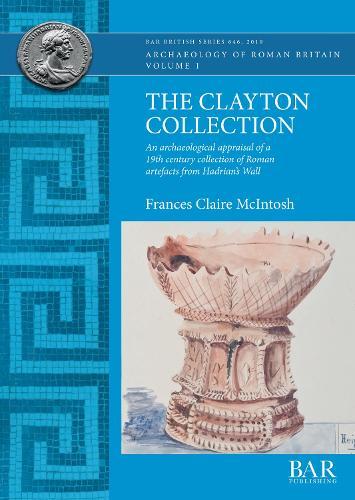
The Clayton Collection: An archaeological appraisal of a 19th century collection of Roman artefacts from Hadrian's Wall

Author:   Frances Roberts-Wood
Publisher:   BAR Publishing
ISBN:  

9781407321479


Pages:   206
Publication Date:   29 March 2019
Format:   Paperback
Availability:   Available To Order   Availability explained
We have confirmation that this item is in stock with the supplier. It will be ordered in for you and dispatched immediately.

Our Price $113.85 Quantity:  
Add to Cart

Share |

The Clayton Collection: An archaeological appraisal of a 19th century collection of Roman artefacts from Hadrian's Wall


Overview

This book examines the archaeological material from Hadrian's Wall within the significant Clayton Collection. The Collection was formed through the work of John Clayton, antiquarian and landowner, in the 19th century. His work took place at a pivotal time in the study of Hadrian's Wall, as public interest was growing, access was improving, and the discipline of archaeology was developing. As part of a large network of antiquarians, Clayton excavated, studied and published his discoveries. After his death, his archaeological estate was retained, and the Collection was moved into a museum in 1896. Despite being in the public domain for so long, the material has never been studied as a whole, or in the light of its 19th century creation. This work is the first to bring together the history and development of the collection alongside the material itself. It offers an insight into how important antiquarian collections can provide valuable information about Roman life.

Full Product Details

Author:   Frances Roberts-Wood
Publisher:   BAR Publishing
Imprint:   British Archaeological Reports
Weight:   0.822kg
ISBN:  

9781407321479


ISBN 10:   1407321471
Pages:   206
Publication Date:   29 March 2019
Audience:   Professional and scholarly ,  Professional & Vocational
Format:   Paperback
Publisher's Status:   Active
Availability:   Available To Order   Availability explained
We have confirmation that this item is in stock with the supplier. It will be ordered in for you and dispatched immediately.

Table of Contents

List of Figures List of Graphs List of Tables Abbreviations Abstract Chapter 1. Introduction 1.1. Introduction 1.2. Aims and Objectives 1.3. The Collection: An Overview 1.3.1. Provenance of Material 1.3.2. Missing Material 1.4. Chapter Outline Chapter 2. Sources and Methodology 2.1. Introduction 2.2. History of the Collection and Museum 2.2.1. The Clayton Trustees 2.3. Previous Work on the Collection 2.4. Cataloguing and Understanding the Collection 2.5. Archival Work to Contextualise the Collection 2.6. Summary Chapter 3. John Clayton, Antiquarianism and Intellectual Exchange 3.1. Introduction 3.2. Personal Life 3.3. Professional Life 3.4. Antiquarianism- A History 3.5. Clayton as Antiquary 3.5.1. Fellow Antiquarians 3.5.2. Land-owner: Conservation and Excavation 3.6. Clayton as Collector 3.7. Coins - Revealing Curation and Gift Exchange Networks in the 19th Century 3.7.1. Excavated Coins 3.7.2. Acquisition of Coins 3.7.3. Loss of Coins 3.7.3.1. House Sale 3.7.3.2. Gifts/Donations 3.7.3.3. Coventina's Well 3.8. Summary Chapter 4. Cilurnum 4.1. Introduction 4.2. Roman Cilurnum 4.3. Post-Roman Cilurnum 4.4. The John Clayton Era at Cilurnum 4.4.1. Material Discovered before Clayton 4.5. Cilurnum after Clayton 4.6. Case Studies of Cilurnum Material 4.6.1. Querns 4.6.2. Pottery 4.6.3. Glass 4.7. Conclusion Chapter 5. Personal Adornment 5.1. Introduction 5.2. Items of Personal Adornment Excluding Brooches 5.2.1. Pins 5.2.2. Finger Rings and Intaglios 5.2.3. Bracelets, Necklaces and Ear-rings 5.2.4. Beads 5.3. Brooches 5.3.1. Brooches in Roman Britain 5.3.2. Consumption: Distribution and Identity 5.3.3. Analysis 5.3.4. Bow, Plate and Penannular 5.3.5. Cilurnum 5.3.5.1. Enamel - Design and Choice 5.3.5.2. Status/Wealth 5.3.5.3. Plate Brooches 5.3.5.4. Penannular Brooches 5.3.5.5. Knee Brooches 5.4. Conclusion Chapter 6. Militaria 6.1. Introduction 6.1.1. What Constitutes Militaria? 6.1.2. The Clayton Militaria 6.2. General Discussion 6.2.1. Arms and Armour 6.2.2. Spears 6.2.3. Horse Harness 6.2.4. Beads 6.3. Late Roman Material in the Clayton Collection 6.4. Identities 6.4.1. Ethnicity 6.4.2. Military/Civilian 6.4.2.1. Belts and their Fittings 6.4.2.2. Rank 6.4.2.3. Military Brooches 6.4.3. Wealth/Status 6.5. Uniformity 6.5.1. Sculpture 6.5.2. Adoption of Ideas, or Barbarization 6.5.3. Production Methods and Supply 6.6. Conclusion Chapter 7. Craft and Industry 7.1. Introduction 7.1.1. Tools and Their Study 7.1.2. Preservation 7.2. Crafts 7.2.1. Blacksmiths and Smiths 7.2.2. Carpenters 7.2.3. Quarrying and Stone-masons 7.2.4. Antler- and Bone-working 7.2.5. Agriculture 7.2.6. Plasterers 7.2.7. Textile- and Leather-working 7.2.8. Glass Production 7.2.9. Jet-working 7.2.10. Knives 7.2.11. Unidentified Tools 7.3. Conclusion Chapter 8. Conclusion 8.1. Introduction 8.2. Impact 8.3. Future Research Bibliography Appendix A. Collection Items Sold in the 1930 Sale. Mon 6th- Tuesday 14th January Appendix B. Relevant Excerpts from John Clayton's Will Appendix C. Letter N.G. Clayton to Blair Regarding the Museum Appendix D. Hall and Budge Catalogue Queries Appendix E. Hall and Budge Provenance Inconsistencies Appendix F. Excerpts from the Will of Nathaniel Clayton Snr. (1760-1832) Appendix G. Letters from Sarah Ann Clayton and John Bell Appendix H. Letters from Clayton to Roach Smith Appendix I. Excerpts of letters from John Collingwood Bruce which mention the Collection or Clayton to Charles Roach Smith Appendix J. Letters from Clayton to John Bell Appendix K. Wills of Nathaniel Clayton Jnr. and Michael Clayton Appendix L. Antiquarian or Archaeological Books in the Clayton Library (Taken from the Sale Catalogue. Hampton and Sons 1930) Appendix M. Letter written by young Bridget Clayton to her grandmother Bridget Atkinson (ZAL 96/3/10) Appendix N. Items from collection illustrated within the Blair Sketchbooks

Reviews

{\rtf1\fbidis\ansi\ansicpg1252\deff0\deflang2057{\fonttbl{\f0\fswiss\fprq2\fcharset0 Calibri;}{\f1\fswiss\fcharset0 AdvTT5843c571+20;}{\f2\fnil\fcharset0 Verdana;}} \viewkind4\uc1\pard\ltrpar\lang1033\f0\fs22\lquote This volume is a foundation reference book for the Clayton Collection and represents a monumental hidden curatorial effort (of a type that is increasingly hard for museums to devote time to or fund) to document and reconcile the collection\f1\rquote\f0 s objects and records\rquote Elsa Price, Britannia Vol 52, December 2021\par \lang2057\par \pard\ltrpar\sa160\sl252\slmult1\lquote The Clayton Collection is an important and old collection, but one which is not widely understood. This work corrects that, providing a needed reference [that is] essential to understanding the historiography of the Wall. \'85 This volume will make a lasting contribution to Hadrian\rquote s Wall studies.\rquote Dr Rob Collins, Newcastle University\par \lquote This is a thorough and insightful survey of a really important archaeological collection. \'85 There is a substantial body of new data and interpretation in this volume that [will make it] vitally important to the subject area of Roman military frontiers/Hadrian\rquote s Wall.\rquote Prof. Richard Hingley, Durham University\par \pard\ltrpar\lquote The research presented is of the highest standard. The inclusion of the collecting histories and collection artefact type syntheses in a single volume is complementary and adds to the considerable significance of both elements.\rquote Dr Mark Lewis, Senior Curator (Roman), National Roman Legion Museum, Caerleon\par \f2\fs17\par }


'The Clayton Collection is an important and old collection, but one which is not widely understood. This work corrects that, providing a needed reference [that is] essential to understanding the historiography of the Wall. . This volume will make a lasting contribution to Hadrian's Wall studies.' Dr Rob Collins, Newcastle University 'This is a thorough and insightful survey of a really important archaeological collection. . There is a substantial body of new data and interpretation in this volume that [will make it] vitally important to the subject area of Roman military frontiers/Hadrian's Wall.' Prof. Richard Hingley, Durham University 'The research presented is of the highest standard. The inclusion of the collecting histories and collection artefact type syntheses in a single volume is complementary and adds to the considerable significance of both elements.' Dr Mark Lewis, Senior Curator (Roman), National Roman Legion Museum, Caerleon


Author Information

Dr Frances McIntosh received her BA in Archaeology from Durham University. She worked for the Portable Antiquities Scheme before researching Wirral brooches at Newcastle University for her MLitt. She completed her PhD on the Clayton Collection in 2017. Her research interests include Roman material culture and 19th century antiquarianism. She currently works as a Collections Curator for English Heritage on Hadrian's Wall and the North East.

Tab Content 6

Author Website:  

Countries Available

All regions
Latest Reading Guide

April RG 26_2


Shopping Cart
Your cart is empty
Shopping cart
Mailing List