Overview
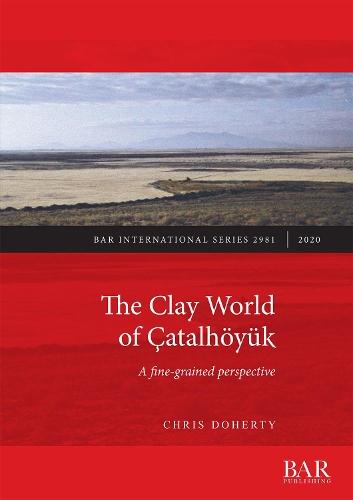
This book addresses a paradox concerning the role of clay at Çatalhöyük that arises from conflicting material culture and landscape views of what clay truly afforded this early agricultural community. The highly-developed and artistically rich clay-based material culture points to clay being a major contributor to the site's success. However, the underlying thick, impermeable clay beds are also thought to have impeded the drainage of seasonal floods, periodically isolating the community in extensive wetlands and clearly hostile to early agriculture. A landscape re-appraisal is made based on the recognition that the heavier clay artifacts must have been locally sourced and can therefore be read as direct samples of the local Neolithic landscape. The result is a revised landscape interpretation that no longer conflicts with the observed patterns of clay use or broader subsistence practice at Çatalhöyük. Clay's role is re-examined in this revised landscape context to demonstrate a fuller and more complex picture than previously thought.
Full Product Details
Author: Chris Doherty
Publisher: BAR Publishing
Imprint: BAR Publishing
Weight: 0.550kg
ISBN: 9781407354224
ISBN 10: 1407354221
Pages: 138
Publication Date: 30 April 2020
Audience:
Professional and scholarly
,
Professional & Vocational
Format: Paperback
Publisher's Status: Active
Availability: Available To Order

We have confirmation that this item is in stock with the supplier. It will be ordered in for you and dispatched immediately.
Reviews
{\rtf1\fbidis\ansi\ansicpg1252\deff0\deflang2057{\fonttbl{\f0\fswiss\fprq2\fcharset0 Calibri;}{\f1\fnil\fcharset0 Calibri;}{\f2\fnil\fcharset238 Calibri;}{\f3\fnil\fcharset0 Verdana;}} \viewkind4\uc1\pard\ltrpar\sa160\sl252\slmult1\f0\fs22\lquote Doherty has achieved what many of \'c7atalh\'f6y\'fck\rquote s clay researchers have longed to do: situate clay-based material assemblages within the greater landscape and construct an argument from the ground up. The book is an excellent synthesis of the previous works on \'c7atalh\'f6y\'fck by clay and environmental specialists, and Doherty offers valid revisions and critiques of this research.\rquote Serena Love, Journal of Near Eastern Studies 81(2), October 2022\par \pard\ltrpar\lang1033\f1\par \lang2057\f0\lquote\lang1033\f1 Doherty's book is an interesting multidisciplinary view of clay, clay material culture, and landscape, as well as the different variations that bind them. (\'85) it is a well-researched, well-documented, thought-provoking, and inspiring book for any researcher dealing with clay raw materials, pottery, and landscape studies.\lang2057\f0\rquote\lang1033\f1 \f2 Andreja \'8eibrat Ga\'9apari\'e8\f1 , Documenta Praehistorica, Vol XLVII, 2020\f0\par \lang2057\par \pard\ltrpar\sa160\sl252\slmult1\lquote This is an excellent, stimulating, well written and extremely interesting study that will have a wide readership.\rquote Professor Douglas Baird, University of Liverpool\par \lquote The originality of the methodology lies in the multidisciplinary evaluation of the clay taskscape, which lies at the interface of ethnography, geoarchaeology, geomorphology and materials science.\rquote Professor John Wainwright, Durham University\par \lquote This is a bold piece of work. It makes an important contribution to our knowledge of clay use and of the environmental setting of \'c7atalh\'f6y\'fck. I suspect this book will be much cited.\rquote Dr Emma Jenkins, Bournemouth University \par \pard\ltrpar\f3\fs17\par }
{\rtf1\fbidis\ansi\ansicpg1252\deff0\deflang2057{\fonttbl{\f0\fswiss\fprq2\fcharset0 Calibri;}{\f1\fnil\fcharset0 Verdana;}} \viewkind4\uc1\pard\ltrpar\sa160\sl252\slmult1\f0\fs22\lquote This is an excellent, stimulating, well written and extremely interesting study that will have a wide readership.\rquote Professor Douglas Baird, University of Liverpool\par \lquote The originality of the methodology lies in the multidisciplinary evaluation of the clay taskscape, which lies at the interface of ethnography, geoarchaeology, geomorphology and materials science.\rquote Professor John Wainwright, Durham University\par \lquote This is a bold piece of work. It makes an important contribution to our knowledge of clay use and of the environmental setting of \'c7atalh\'f6y\'fck. I suspect this book will be much cited.\rquote Dr Emma Jenkins, Bournemouth University \par \pard\ltrpar\f1\fs17\par }
{\rtf1\fbidis\ansi\ansicpg1252\deff0\deflang2057{\fonttbl{\f0\fnil\fcharset0 Calibri;}{\f1\fnil\fcharset238 Calibri;}{\f2\fswiss\fprq2\fcharset0 Calibri;}{\f3\fnil\fcharset0 Verdana;}} \viewkind4\uc1\pard\ltrpar\lang1033\f0\fs22 `Doherty's book is an interesting multidisciplinary view of clay, clay material culture, and landscape, as well as the different variations that bind them. (\'85) it is a well-researched, well-documented, thought-provoking, and inspiring book for any researcher dealing with clay raw materials, pottery, and landscape studies.` \f1 Andreja \'8eibrat Ga\'9apari\'e8\f0 , Documenta Praehistorica, Vol XLVII, 2020\f2\par \lang2057\par \pard\ltrpar\sa160\sl252\slmult1\lquote This is an excellent, stimulating, well written and extremely interesting study that will have a wide readership.\rquote Professor Douglas Baird, University of Liverpool\par \lquote The originality of the methodology lies in the multidisciplinary evaluation of the clay taskscape, which lies at the interface of ethnography, geoarchaeology, geomorphology and materials science.\rquote Professor John Wainwright, Durham University\par \lquote This is a bold piece of work. It makes an important contribution to our knowledge of clay use and of the environmental setting of \'c7atalh\'f6y\'fck. I suspect this book will be much cited.\rquote Dr Emma Jenkins, Bournemouth University \par \pard\ltrpar\f3\fs17\par }
Author Information
Chris Doherty is a geoarchaeologist and ceramics specialist at the Research Laboratory for Archaeology, Oxford University. He has a long-standing interest in the raw materials of ancient technologies and the interpretation of their use.