Overview
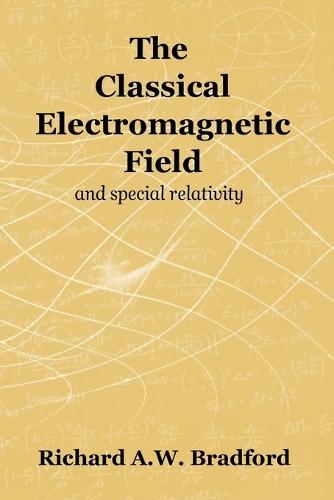
There are already many texts on classical electromagnetism at the undergraduate level. Why another? Every such text carries its author's idiosyncrasies. Some approaches to key topics may appeal more than others and acquaintance with a variety of methods is generally helpful to the student. More prosaically, despite the considerable commonality that is inevitable in a mature subject, every text should offer some novel content. Here the central feature of objectivity is to the fore from the start, and relativity theory is the crowning example. In addition to the standard exposition of Maxwell's equations and essential solutions and applications, students may expect to learn the following which are less often addressed in texts, (i) Why the field momentum of even static e/m fields is essential for the conservation of momentum and angular momentum. (ii) The derivation of the laws of geometrical optics from Maxwell's equations and their boundary conditions. (iii) The safety of human exposure to e/m radiation. (iv) Why Earnshaw's theorem does not prevent levitating frogs. (v) Circuit theory is actually an approximate effective theory which derives from field theory. (vi) Electrical power does not flow in wires. The chapters on this are perhaps the book's most important, and least often addressed, topic. (viii) Electrical power generation and transmission, the significance of MegaVars and grid stability issues associated with inverted-based sources with no intrinsic inertia. (ix) The theory of e/m wave modes in optic fibres including deriving the cutoff frequency and the conditions for a ""single mode"" fibre. (x) The equivalence of inertial observers, the Lorentz transformation, 4-vectors and tensors in Minkowski spacetime. (xi) The Lagrangian method and the proof of the conservation of energy, momentum and angular momentum via Noether's theorem. (xii) How Maxwell's equations can be written in terms of (bi)quaternionsreducing them to just one equation: . (xiii) An elementary account of the exterior derivative, exterior algebra and the Cartan-Stokes theorem. Green's theorem, Stokes's theorem and Gauss's theorem are all special cases of the Cartan-Stokes theorem.
Full Product Details
Author: Richard A W Bradford
Publisher: Principia Publications Unlimited
Imprint: Principia Publications Unlimited
Dimensions:
Width: 15.60cm
, Height: 2.60cm
, Length: 23.40cm
Weight: 0.712kg
ISBN: 9781838021658
ISBN 10: 1838021655
Pages: 514
Publication Date: 20 May 2026
Audience:
General/trade
,
General
Format: Paperback
Publisher's Status: Active
Availability: Available To Order

We have confirmation that this item is in stock with the supplier. It will be ordered in for you and dispatched immediately.