|
|
|||
|
||||
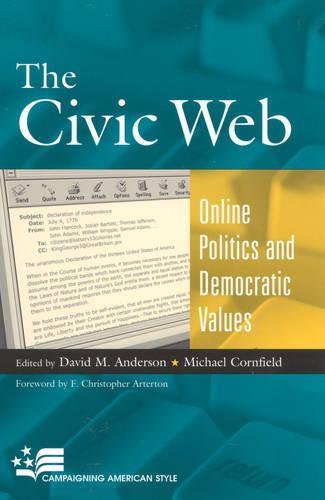
OverviewPolitical web sites and e-mail lists were novelties in 1996. By 2000, they were a news trend. By 2004, they will be a part of every electoral and policy campaign. News-seekers, activists, and decision-makers increasingly turn to the Net as a matter of course. The Civic Web delineates the basic issues, opportunities, and dilemmas posed by the introduction of computer-networked communications into U.S. national politics. Leading scholars from several academic disciplines join pioneer practitioners of online advocacy, discussion, and law in considering how the Internet can host, and even advance, enlightened self-government by a free people in a constitutional republic. Visit our website for sample chapters! Full Product DetailsAuthor: David M. Anderson , Michael Cornfield , F. Christopher Arterton , F Christopher ArtertonPublisher: Bloomsbury Publishing Plc Imprint: Rowman & Littlefield Dimensions: Width: 15.40cm , Height: 1.70cm , Length: 23.10cm Weight: 0.358kg ISBN: 9780742501942ISBN 10: 0742501949 Pages: 192 Publication Date: 27 August 2002 Audience: General/trade , General Format: Paperback Publisher's Status: Out of Print Availability: In Print Limited stock is available. It will be ordered for you and shipped pending supplier's limited stock. Table of ContentsPart 1 I The Internet and Politics: Framing the Issues Chapter 2 1 Reflections on Campaign Politics, The Internet, and Ethics Chapter 3 2 Cautious Optimism about Online Politics and Citizenship Chapter 4 3 If Political Fragmentation is the Problem, Is the Internet the Solution? Part 5 II The Current State of Online Politics Chapter 6 4 Online Campaigning and the Public Interest Chapter 7 5 Election Law and the Internet Chapter 8 6 Digital Grassroots: Issue Advocacy in the Age of the Internet Part 9 III Citizen Participation and the Internet Chapter 10 7 Adding in the Net: Making Citizenship Count in the Digital Age Chapter 11 8 Civic Participation and Technology Inequality: The Killer Application Is Education Chapter 12 9 The Internet and an Informed Citizenry Part 13 IV The Internet, Democracy, and the Future Chapter 14 10 E-Democracy: Lessons from Minnesota Chapter 15 11 The Internet and Dreams of Democratic Renewal Chapter 16 12 The Politics of a Network World: A SpeculationReviewsI'm an avid grassroots politician and I highly recommend this book. It helps every citizen think about what a civic space on the Internet should look like and whether Internet connections are an adequate replacement for grassroots.--Pat Schroeder Author InformationDavid M. Anderson is associate research professor at The George Washington University's Graduate School of Political Management. He directs the Democracy Online Project's national task force, and contributes op-eds frequently to the Baltimore Sun. Michael Cornfield is associate research professor at The George Washington University's Graduate School of Political Management. He directs research for the Democracy Online Project, and writes a monthly column on online politics for Campaigns and Elections magazine. Tab Content 6Author Website:Countries AvailableAll regions |
||||