Awards
- Winner of Wadsworth Prize for Business History 1999
- Winner of Wadsworth Prize for Business History 1999.
Overview
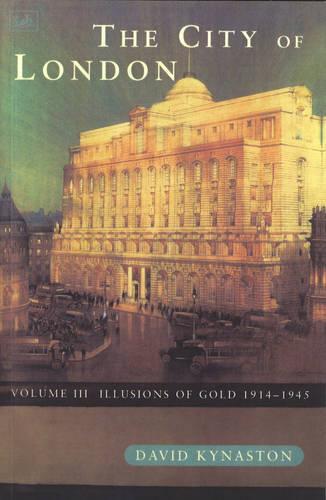
Illusions of Gold, the third volume of David Kynaston's magnificent quartet, The City of London, sweeps us from 1914 to 1945, through years of fluctuating fortunes that began with the City at an all-time high, and ended with the 'Square Mile' ravaged by bombs, at its lowest ebb ever. With unerring judgement and story-telling verve, Kynaston takes us through the City's vain attempt to recover the glory days before the First World War, in the return to the Gold Standard. He follows its tussles with government over control of monetary policy, investigates its increasingly important links with British industry and gives a pioneering account of its controversial role in the politics of appeasement. Kynaston's great strength is his combination of vivid narrative with meticulous scholarship, based on an unparalleled variety of unpublished sources. The City of London is now hailed as one of the most ambitious and rewarding historical projects of recent times.
Full Product Details
Author: David Kynaston
Publisher: Vintage
Imprint: Pimlico
Edition: New edition
Dimensions:
Width: 15.40cm
, Height: 4.40cm
, Length: 23.40cm
Weight: 0.799kg
ISBN: 9780712662765
ISBN 10: 0712662766
Pages: 608
Publication Date: 01 June 2000
Audience:
General/trade
,
Professional and scholarly
,
General
,
Professional & Vocational
Format: Paperback
Publisher's Status: Active
Availability: Manufactured on demand

We will order this item for you from a manufactured on demand supplier.
Reviews
Economic history at its most glittering. - The Times <p> Altogether exceptional. - Guardian
A fascinating book, deeply researched and admirably written by an author who is a master of his subject and also of the light touch Evening Standard A splendidly entertaining history... This book is both immensely readable and an invaluable guide to a set of institutions whose role in British political and economic history is imperfectly understood Sunday Telegraph David Kynaston's achievement... is to make the whole thing read like a novel... An altogether exceptional book -- D. J. Taylor Guardian The City has never been good at justifying or explaining itself to the wider world, but in David Kynaston it has found a wonderfully gifted and diligent interpreter Daily Telegraph A magnificent book Sunday Times
In the third volume of his ambitious four-volume history of the City of London, David Kynaston focuses on what might be called The Age of Montagu Norman. Norman was the Governor of the Bank of England for a quarter of a century, during some very rocky periods - notably the General Strike in 1926 and the nervous years leading up to the Second World War. Norman paints a splendidly vivid picture of an extraordinary man - whose qualifications for his job might be exemplified in the fact that he always emerged from the London Underground at Bank rather than Mansion House station, walking the extra length of street because it saved him a halfpenny in fare. If Norman, who ruled his staff, his advisors, his bank - in some senses the Government - with a rod of iron, emerges as the central figure of the story, there are many other extraordinary men who also race through the pages of this book - buccaneers dealing in enormous sums of money, spending a million here, a million there, one day beating up a Jewish trader just for a lark, or saluting Fascists (in a very British but not unenthusiastic way). Despite all that, here is the first hint of the modern age of banking, with the Bank taking an increased interest in the affairs of industry (those dreadful Trades Unions!), and after much blustering finally accepting the fact that the public was not always and necessarily going to agree with its attitudes, opinions or actions. Norman left his job complaining about vote-grubbing politicians and nationalist demagogues. Months later much of the city lay in ruins, the war was swallowing money like water, and the world of finance and commerce was never to be the same again. (Kirkus UK)
Author Information
David Kynaston was born in Aldershot in 1951. After graduating from New College Oxford, he studied at the London School of Economics. A professional historian, in addition to the four-volume The City of London, his works include King Labour: A History of the British Working Class, 1850-1914, histories of the Financial Times and the stockbrokers Cazenove & co., and the first two volumes in a planned history of Britain between 1945 and 1979, Austerity Britain, 1945-51 and Family Britain, 1951-57.