|
|
|||
|
||||
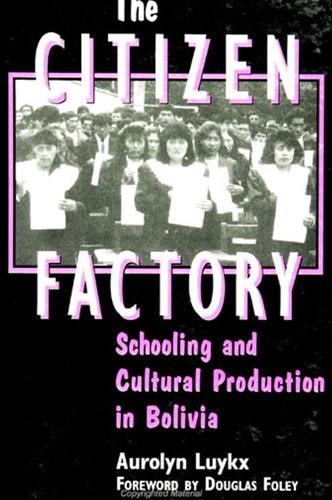
OverviewFull Product DetailsAuthor: Aurolyn Luykx , Douglas FoleyPublisher: State University of New York Press Imprint: State University of New York Press Dimensions: Width: 15.20cm , Height: 2.50cm , Length: 22.90cm Weight: 0.617kg ISBN: 9780791440384ISBN 10: 0791440389 Pages: 399 Publication Date: 03 December 1998 Audience: College/higher education , Professional and scholarly , Undergraduate , Postgraduate, Research & Scholarly Format: Paperback Publisher's Status: Active Availability: In Print This item will be ordered in for you from one of our suppliers. Upon receipt, we will promptly dispatch it out to you. For in store availability, please contact us. Table of Contents"Foreword by Douglas Foley Preface Acknowledgments Introduction Educational Theory and School Ethnography Indigenous Peoples, Schools, and the Nation-State 1 Ethnicity and the Construction of Nationhood From Conquest to Crisis: An Overview of Bolivia's Political Development The Indigenous Metropolis: Urban Aymarasin La Paz Popular Culture and ""The Language Problem"" Obstacles to the Construction of a Unified and Unifying Bolivian Nationalism Race and Class in the Nationalist Project Official History and Popular Humor: Public Tropes of Ethnic and International Conflict Finding a ""We"": Defining Lo Boliviano against a Hostile World 2 Rural Schooling in Bolivia Roots of Aymara Education: The Struggle for Land and Literacy Rural Education in the Twentieth Century: Government Takes up the Reins Reverence and Resentment: Teachers and Rural Communities On the Threshold of Reform 3 Student Life at the Normal School ""Peor que nada es quedarse ..."": Career Choices and the Lack Thereof Students as Regulated Subjects Dormitory Life 4 Curriculum and Identity The Reproduction of Ideology in Schools: Socialization as the Interpellation of Student-Subjects The Citizen in the Nation, the Nation in the World Proletarian Professionals: The Ambiguous Class Identity of Bolivian Teachers The Teacher in the Rural Community: Solidarity and Social Distance Uneasy Positionings on the Field of Race-or, ""We Have Met El Hermano Campesino and His Is (not?) Us"" Gender Ideology in the Normal School: Frozen Images and Structured Silences Conclusion: Rural Education and the Race/Class Intersection 5 Commodified Language and Alienated Exchange in the Normal School Pedagogical Praxis and ""School Knowledge"" The Capitalist Mode of Symbolic Production: Schoolwork as Alienated Labor 6 Student Resistance to Commodification and Alienation: Silence, Satire, and the Academic Black Market Resistance in the Classroom The Linguistic Black Market: Illicit Exchange in the Academic Economy Student Resistance through Expressive Practices 7 An Alternative Vision: Notes toward a Transformative Bolivian Pedagogy Dia del Indio , Los Pozos (August 1, 1993) Socialization and the Multiple Subject Political Practice and Popular Culture Rehabilitating Marx: Hegemonic Subject Positions as Alienated Use Values Building a Democratic Pedagogy Schooling as Cultural Critique Directions for Future Research Structural Pessimism vs. Strategic Optimism Appendix: Interviewed Students Notes Bibliography Index"ReviewsThe Citizen Factory is a testimony to the organic character of all ethnographic interpretation...This study of a Bolivian Normal School will challenge comparative politics and comparative education scholars to rethink their studies of political socialization. Moreover, fellow anthropologists will be drawn to [the author's] theoretical model for studying ideological hegemony and identity construction. In short, Luykx has produced an 'educational ethnography' that extends the genre itself. - Douglas Foley, from the Foreword The ethnographic descriptions are rich, and well embedded in history and in the broader social context. The author has done a very thorough study. The book shows the links between the larger social structure and day-to-day life. In fact, it shows the work people do to create (and sometimes contest) the larger social structure-in this case, gender, ethnic, and class identities. - Kathryn M. Anderson-Levitt, University of Michigan, Dearborn Author InformationAurolyn Luykx teaches in the Linguistic and in the Pedagogy departments at the Universidad Mayor de San Simon (UMSS), Cochabamba, Bolivia. Tab Content 6Author Website:Countries AvailableAll regions |
||||