Overview
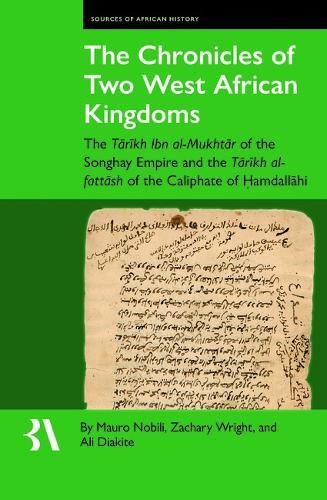
The Chronicles of Two West African Kingdoms presents a new reading of West African history from the fifteenth to the nineteenth centuries. Based on close analysis of Arabic manuscripts from Timbuktu and other regions, this volume provides key historical context from the Songhay Empire through the Caliphate of Ḥamdallāhi, along with translations and Arabic editions of the long-obscured Tārīkh Ibn al-Mukhtār in parallel with the later production known as the Tārīkh al-fattāsh. The central observation that emerges from these texts is that Muslim scholars in premodern West Africa, who saw themselves as constitutive to the powerful kingdoms in the Western Sudan, claimed almost unprecedented authority to shape reality through narration.
Full Product Details
Author: Mauro Nobili ,
Zachary V. Wright ,
H. Ali Diakité
Publisher: Liverpool University Press
Imprint: The British Academy
Volume: 26
ISBN: 9781836245698
ISBN 10: 1836245696
Pages: 422
Publication Date: 21 October 2025
Audience:
General/trade
,
General
Format: Hardback
Publisher's Status: Active
Availability: In Print

This item will be ordered in for you from one of our suppliers. Upon receipt, we will promptly dispatch it out to you. For in store availability, please contact us.
Author Information
Mauro Nobili is a historian of pre-colonial and early colonial West Africa. His research examines the political and intellectual history of Muslim societies in the region from the late Middle Ages to the early colonial period, focusing specifically but not exclusively on modern-day Republic of Mali. Through his research, he has worked in several archives of Arabic manuscripts in West Africa (Mauritania, Mali, Senegal, Nigeria, Ghana, and Côte d’Ivoire), in Europe (France and Denmark), and in the United States, as well as in colonial archives in Britain (Foreign Office, the National Archives) and Germany (Staatsbibliothek, Hamburg). Zachary Wright is associate dean for faculty affairs at Northwestern University in Qatar and professor in residence in the Liberal Arts Program, with joint appointments in History and Religious Studies. Wright received his PhD in history from Northwestern University, his MA in Arabic studies/Middle East history from the American University in Cairo, and his BA in history from Stanford University. He teaches classes on Islam in Africa, Islamic Intellectual History, African history, and Middle East history. His research focuses on Islamic intellectual history in West and North Africa, from the 15th century to the present. Most of Wright’s field research has been conducted in Senegal, Morocco, and Mauritania, with Arabic, French, and Wolof language sources. Ali Diakité is a Cataloguer for West African Manuscripts. He joined the Hill Museum (HMML) in 2019. A native of Burkina Faso, he holds a MA from the Université de Bamako Department of Arabic Studies, Bamako, Mali, and a MA and PhD from the École Normale Supérieure, Lyon, France. Prior to joining HMML, Diakite was at the University of Illinois at Urbana-Champaign working on a postdoctoral fellowship financed by the Gerda Henkel Foundation, Germany.