Overview
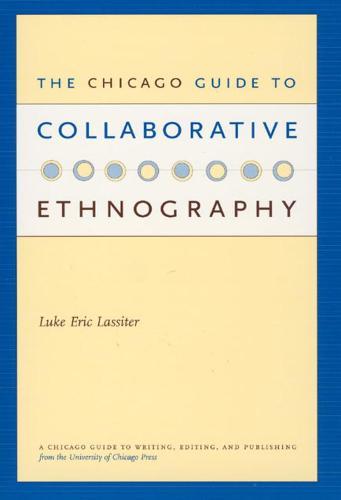
Collaboration between ethnographers and subjects has long been a product of the close, intimate relationships that define ethnographic research. But increasingly, collaboration is no longer viewed as merely a consequence of fieldwork; instead collaboration now preconditions and shapes research design as well as its dissemination. As a result, ethnographic subjects are shifting from being informants to being consultants. The emergence of collaborative ethnography highlights this relationship between consultant and ethnographer, moving it to center stage as a calculated part not only of fieldwork but also of the writing process itself. The Chicago Guide to Collaborative Ethnography presents a historical, theoretical, and practice-oriented road map for this shift from incidental collaboration to a more conscious and explicit collaborative strategy. Luke Eric Lassiter charts the history of collaborative ethnography from its earliest implementation to its contemporary emergence in fields such as feminism, humanistic anthropology, and critical ethnography. On this historical and theoretical base, Lassiter outlines concrete steps for achieving a more deliberate and overt collaborative practice throughout the processes of fieldwork and writing. As a participatory action situated in the ethical commitments between ethnographers and consultants and focused on the co-construction of texts, collaborative ethnography, argues Lassiter, is among the most powerful ways to press ethnographic fieldwork and writing into the service of an applied and public scholarship. A comprehensive and highly accessible handbook for ethnographers of all stripes, The Chicago Guide to Collaborative Ethnography will become a fixture in the development of a critical practice of anthropology, invaluable to both undergraduates, graduate students, and faculty alike.
Full Product Details
Author: Luke Eric Lassiter (Marshall University, USA)
Publisher: The University of Chicago Press
Imprint: University of Chicago Press
Dimensions:
Width: 1.60cm
, Height: 0.20cm
, Length: 2.30cm
Weight: 0.397kg
ISBN: 9780226468891
ISBN 10: 0226468895
Pages: 216
Publication Date: 15 September 2005
Audience:
Professional and scholarly
,
Professional & Vocational
Format: Hardback
Publisher's Status: Active
Availability: Out of stock

The supplier is temporarily out of stock of this item. It will be ordered for you on backorder and shipped when it becomes available.
Reviews
[The book] promises to provide essential classroom material for budding anthropologists. Not only does Lassiter articulate the epistemological basis for cutting-edge ethnography, he also provides concrete examples of anthropological praxis that seeks to empower real people.--Samuel R. Cook Journal of the Royal Anthropological Institute (6/1/2005 12:00:00 AM) Compulsory reading for all budding ethnographers.--Ian S. McIntosh Australian Journal of Anthropology (6/1/2005 12:00:00 AM) I declare myself greatly satisfied by this book. It is a welcome reminder that in the pursuit of knowledge those who possess and are custodians of it should be rightly acknowledged.--Susan Young Anthropological Forum (6/1/2005 12:00:00 AM) This is a user friendly, accessible, and highly effective treatment of the practice of collaborative ethnography. Because of the changing politics and circumstances for doing fieldwork anywhere in the world, collaboration has needed to become an even more conscious component of method rather than just an awareness of mere critical sensitivity. The Chicago Guide to Collaborative Ethnography is the first work to tackle the problem of shifting collaboration as part of the ideology of fieldwork. Here, Luke Eric Lassiter makes it part of the norms and forms of practice rather than its secret or unspoken condition. He thus recuperates collaboration and brings it from the ideology of fieldwork to an integral and explicit form of method. --George Marcus, Rice University --George Marcus George Marcus (5/15/2005 12:00:00 AM) A clear, comprehensive, and forceful description of the history, theory, and practice of collaborative ethnography, The Chicago Guide to Collaborative Ethnography propels anthropological practice into the social and political vortex of twenty-first-century social life. Luke Eric Lassiter complements long-standing discussions of the ethics of fieldwork practice with an insightful description of the complex and varied practices of collaborative reading and writing. Artfully filled with illustrative examples of the impact of collaboration on ethnographic research, this important and timely book is a must read for any scholar who plans to conduct social research. --Paul Stoller, West Chester University and Temple University --Paul Stoller Paul Stoller (6/1/2005 12:00:00 AM)
[The book] promises to provide essential classroom material for budding anthropologists. Not only does Lassiter articulate the epistemological basis for cutting-edge ethnography, he also provides concrete examples of anthropological praxis that seeks to empower real people. -Samuel R. Cook, Journal of the Royal Anthropological Society -- Samuel R. Cook Journal of the Royal Anthropological Institute
""[The book] promises to provide essential classroom material for budding anthropologists. Not only does Lassiter articulate the epistemological basis for cutting-edge ethnography, he also provides concrete examples of anthropological praxis that seeks to empower real people.""--Samuel R. Cook ""Journal of the Royal Anthropological Institute"" ""Compulsory reading for all budding ethnographers.""--Ian S. McIntosh ""Australian Journal of Anthropology"" ""I declare myself greatly satisfied by this book. It is a welcome reminder that in the pursuit of knowledge those who possess and are custodians of it should be rightly acknowledged.""--Susan Young ""Anthropological Forum"" ""A clear, comprehensive, and forceful description of the history, theory, and practice of collaborative ethnography, The Chicago Guide to Collaborative Ethnography propels anthropological practice into the social and political vortex of twenty-first-century social life. Luke Eric Lassiter complements long-standing discussions of the ethics of fieldwork practice with an insightful description of the complex and varied practices of collaborative reading and writing. Artfully filled with illustrative examples of the impact of collaboration on ethnographic research, this important and timely book is a must read for any scholar who plans to conduct social research.""--Paul Stoller, West Chester University and Temple University --Paul Stoller ""Paul Stoller"" (6/1/2005 12:00:00 AM) ""This is a user friendly, accessible, and highly effective treatment of the practice of collaborative ethnography. Because of the changing politics and circumstances for doing fieldwork anywhere in the world, collaboration has needed to become an even more conscious component of method rather than just an awareness of mere critical sensitivity. The Chicago Guide to Collaborative Ethnography is the first work to tackle the problem of shifting collaboration as part of the ideology of fieldwork. Here, Luke Eric Lassiter makes it part of the norms and forms of practice rather than its secret or unspoken condition. He thus recuperates collaboration and brings it from the ideology of fieldwork to an integral and explicit form of method.""--George Marcus, Rice University --George Marcus ""George Marcus"" (5/15/2005 12:00:00 AM)
Compulsory reading for all budding ethnographers. --Ian S. McIntosh Australian Journal of Anthropology I declare myself greatly satisfied by this book. It is a welcome reminder that in the pursuit of knowledge those who possess and are custodians of it should be rightly acknowledged. --Susan Young Anthropological Forum [The book] promises to provide essential classroom material for budding anthropologists. Not only does Lassiter articulate the epistemological basis for cutting-edge ethnography, he also provides concrete examples of anthropological praxis that seeks to empower real people. --Samuel R. Cook Journal of the Royal Anthropological Institute A clear, comprehensive, and forceful description of the history, theory, and practice of collaborative ethnography, The Chicago Guide to Collaborative Ethnography propels anthropological practice into the social and political vortex of twenty-first-century social life. Luke Eric Lassiter complements long-standing discussions of the ethics of fieldwork practice with an insightful description of the complex and varied practices of collaborative reading and writing. Artfully filled with illustrative examples of the impact of collaboration on ethnographic research, this important and timely book is a must read for any scholar who plans to conduct social research. --;br>--Paul Stoller Paul Stoller (06/01/2005) This is a user friendly, accessible, and highly effective treatment of the practice of collaborative ethnography. Because of the changing politics and circumstances for doing fieldwork anywhere in the world, collaboration has needed to become an even more conscious component of method rather than just an awareness of mere critical sensitivity. The Chicago Guide to Collaborative Ethnography is the first work to tackle the problem of shifting collaboration as part of the ideology of fieldwork. Here, Luke Eric Lassiter makes it part of the norms and forms of practice rather than its secret or unspoken condition. He thus recuperates collaboration and brings it from the ideology of fieldwork to an integral and explicit form of method. --;br>--George Marcus George Marcus (05/15/2005) A clear, comprehensive, and forceful description of the history, theory, and practice of collaborative ethnography , The Chicago Guide to Collaborative Ethnography propels anthropological practice into the social and political vortex of twenty-first-century social life. Luke Eric Lassiter complements long-standing discussions of the ethics of fieldwork practice with an insightful description of the complex and varied practices of collaborative reading and writing. Artfully filled with illustrative examples of the impact of collaboration on ethnographic research, this important and timely book is a must read for any scholar who plans to conduct social research. --;br> --Paul Stoller Paul Stoller (06/01/2005) This is a user friendly, accessible, and highly effective treatment of the practice of collaborative ethnography. Because of the changing politics and circumstances for doing fieldwork anywhere in the world, collaboration has needed to become an even more conscious component of method rather than just an awareness of mere critical sensitivity. The Chicago Guide to Collaborative Ethnography is the first work to tackle the problem of shifting collaboration as part of the ideology of fieldwork. Here, Luke Eric Lassiter makes it part of the norms and forms of practice rather than its secret or unspoken condition. He thus recuperates collaboration and brings it from the ideology of fieldwork to an integral and explicit form of method. --;br> --George Marcus George Marcus (05/15/2005) A clear, comprehensive, and forceful description of the history, theory, and practice of collaborative ethnography , The Chicago Guide to Collaborative Ethnography propels anthropological practice into the social and political vortex of twenty-first-century social life. Luke Eric Lassiter complements long-standing discussions of the ethics of fieldwork practice with an insightful description of the complex and varied practices of collaborative reading and writing. Artfully filled with illustrative examples of the impact of collaboration on ethnographic research, this important and timely book is a must read for any scholar who plans to conduct social research. -- --Paul Stoller Paul Stoller (06/01/2005) This is a user friendly, accessible, and highly effective treatment of the practice of collaborative ethnography. Because of the changing politics and circumstances for doing fieldwork anywhere in the world, collaboration has needed to become an even more conscious component of method rather than just an awareness of mere critical sensitivity. The Chicago Guide to Collaborative Ethnography is the first work to tackle the problem of shifting collaboration as part of the ideology of fieldwork. Here, Luke Eric Lassiter makes it part of the norms and forms of practice rather than its secret or unspoken condition. He thus recuperates collaboration and brings it from the ideology of fieldwork to an integral and explicit form of method. -- --George Marcus George Marcus (05/15/2005)
Author Information
Luke Eric Lassiter is associate professor of anthropology at Ball State University. He is the author or coauthor of four previous books, including Invitation to Anthropology.