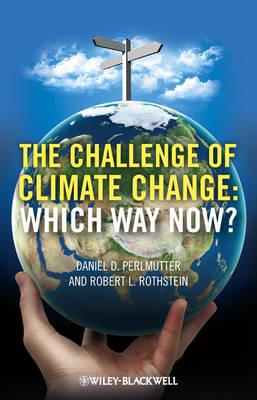
The Challenge of Climate Change: Which Way Now?

Author:   Daniel P. Perlmutter (University of Pennsylvania) ,  Robert L. Rothstein (Colgate University)
Publisher:   John Wiley and Sons Ltd
ISBN:  

9780470654972


Pages:   248
Publication Date:   23 November 2010
Format:   Paperback
Availability:   Out of stock   Availability explained
The supplier is temporarily out of stock of this item. It will be ordered for you on backorder and shipped when it becomes available.

Our Price $65.95 Quantity:  
Add to Cart

Share |

The Challenge of Climate Change: Which Way Now?


Overview

Global warming and climate change present complex interlocking issues of public policy, multilateral negotiation, and technological advancement.  This book explores both the problems and the opportunities presented by international agreements, and examines the technological developments and policy goals that can be pursued to effect the changes necessary.  Specific steps are proposed in the form of a list of priorities. This book represents a cooperative enterprise between two authors of different backgrounds - engineering and international relations  - and is directed  to an educated but non-professional lay audience without any formal training in either science or international relations. The points of view of negotiators from both developed and developing nations are presented and compared.  Each topic is presented from both technical and policy perspectives as a means to evaluate the variety of proposals that have been offered as remedies to global warming. The text is supported by illustrations and tables where appropriate, including a list of References at the end of each chapter.

Full Product Details

Author:   Daniel P. Perlmutter (University of Pennsylvania) ,  Robert L. Rothstein (Colgate University)
Publisher:   John Wiley and Sons Ltd
Imprint:   Wiley-Blackwell
Dimensions:   Width: 15.20cm , Height: 1.40cm , Length: 23.00cm
Weight:   0.445kg
ISBN:  

9780470654972


ISBN 10:   047065497
Pages:   248
Publication Date:   23 November 2010
Audience:   General/trade ,  General
Format:   Paperback
Publisher's Status:   Active
Availability:   Out of stock   Availability explained
The supplier is temporarily out of stock of this item. It will be ordered for you on backorder and shipped when it becomes available.

Table of Contents

Preface. Acknowledgments. 1 In the Beginning. Introduction. 1.1 The Viewpoint Taken. 1.2 What is Your Problem? 1.3 The Challenges We Face. Notes and References. 2 A View of Geopolitics. Introduction. 2.1 Are There Limits to Growth? 2.2 Public Goods and Public “Bads”. 2.3 Policymaking and Negotiations. Notes and References. 3 Surveying the Field. Introduction. 3.1 A History of Change. 3.2 Measuring Energy. 3.3 Supply: Where Do We Get It? 3.4 Demand: How Do We Use It? 3.5 Will We Run Out of Oil? Or Gas? 3.6 Forms of Energy. Notes and References. 4 Global Warming. Introduction. 4.1 Temperature of the Planet. 4.2 Greenhouse Gases. 4.3 Is Global Warming Our Fault? 4.4 The RF Index. 4.5 Air Pollution Revisited. 4.6 Immediate or Short-Term Remedies. 4.7 Limits to Growth and the Commons Revisited. 4.8 Sequestration. Notes and References. 5 Renewable Energy. Introduction. 5.1 Hydroelectric Power. 5.2 Biofuels. 5.3 Wind Power. 5.4 Power from Tides and Waves. 5.5 Direct Use of Solar Energy. 5.6 Nuclear Energy. 5.7 Geothermal Energy. 5.8 Indirect Emissions and Hidden Costs. Notes and References. 6 Energy Storage. Introduction. 6.1 Batteries and Fuel Cells. 6.2 Syngas and Liquid Fuels. 6.3 Hydrogen Gas. 6.4 Pumped Water or Compressed Air. 6.5 Hot Water or Molten Salt. 6.6 Flywheels. Notes and References. 7 The Negotiating Process. Introduction. 7.1 A Period of Transition. 7.2 Our Worst Fears. 7.3 Guidance from a Theory of Bargaining. 7.4 Useful Lessons from the Past. 7.5 What Should a Treaty Accomplish? 7.6 Where We are Heading. Notes and References. 8 From Theory to Practice. Introduction. 8.1 Different Regimes and Perspectives. 8.2 Improving the Prospects. 8.3 The Debate on Venues. 8.4 Bargaining Strategies: Domestic and International. 8.5 Big Bang or Accelerated Incrementalism? 8.6 Choices in the Context of Risk. Notes and References. 9 Where Do We Go from Here? Introduction. 9.1 Is the Feasible Insufficient? 9.2 Fiscal Measures. 9.3 A Complicated Question. 9.4 An Overall Assessment. 9.5 Choices and Priorities. 9.6 Caveats. 9.7 A To-Do List. Notes and References. 10 A List of Priorities. Introduction. 10.1 Short-Term Gains: Less than 10 Years. 10.2 Medium-Term Improvements: 10–20 Years. 10.3 Long-Term Solutions: More than 20 Years. 10.4 Plan A and Plan B, Simultaneously. Notes and References. 11 Prospects After Copenhagen. Introduction. 11.1 Costly Failure or Small Success? 11.2 Reframing the Debate. 11.3 The Good News and the Bad News. 11.4 The China Problem. 11.5 Third World Dilemmas. 11.6 Polarized Politics. Notes and References. Index.

Reviews

. ..Provides a good list of priorities for the next two decades and beyond, including both measures that countries can pursue unilaterally - from energy efficiency to cap-and-trade legislation - and measures that require international cooperation, such as information sharing about carbon capture and storage, and a global agreement on emissions-reduction targets, monitoring and enforcement. The Environmentalist , January 2011


Author Information

DANIEL D. PERLMUTTER is Professor of Chemical Engineering at the University of Pennsylvania, and has served as Chair of the Chemical Engineering Department at the University and as University Ombudsman. His contributions were recognized by a Lindbach Award for excellence in teaching, a Guggenheim Foundation Award for research, two Fulbright Fellowships, and the Lectureship Award of the American Association for Engineering Education. His research focused on the dynamics and control of chemical reaction systems, yielded three books and many publications in professional journals. ROBERT L. ROTHSTEIN was the Harvey Picker Distinguished Professor of International Relations at Colgate University. He has published widely on the international negotiating process and peace processes in protracted conflicts and has been awarded a variety of prestigious fellowships, including the Rockefeller Foundation, the Carnegie Foundation, the Woodrow Wilson International Center for Scholars, and the U.S. Institute of Peace. He has also been a consultant to the Department of State and a number of foundations and international institutions.

Tab Content 6

Author Website:  

Countries Available

All regions
Latest Reading Guide

NOV RG 20252


Shopping Cart
Your cart is empty
Shopping cart
Mailing List