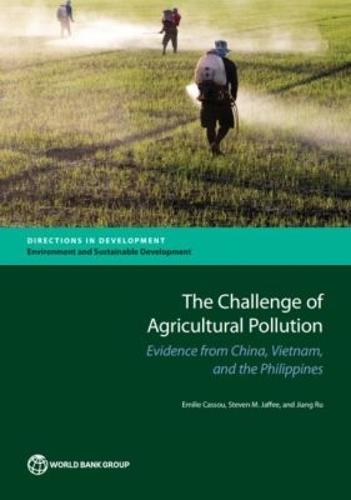
Overview
In emerging East Asia, agricultural output has expanded dramatically over recent decades, primarily as a result of successful efforts to stimulate yield growth. This achievement has increased the availability of food and raw materials in the region, drastically diminished hunger, and more generally provided solid ground for economic development. The intensification of agriculture that has made this possible, however, has also led to serious pollution problems that have adversely affected human and ecosystem health, as well as the productivity of agriculture itself. In the region that currently owes the largest proportion of deaths to the environment, agriculture is often portrayed as a victim of industrial and urban pollution, and this is indeed the case. Yet agriculture is taking a growing toll on economic resources and sometimes becoming a victim of its own success. In parts of China, Vietnam, and the Philippines—the countries studied in The Challenge of Agricultural Pollution—this pattern of highly productive yet highly polluting agriculture has been unfolding with consequences that remain poorly understood. With large numbers of pollutants and sources, agricultural pollution is often undetected and unmeasured. When assessments do occur, they tend to take place within technical silos, and so the different ecological and socioeconomic risks are seldom considered as a whole, while some escape study entirely. However, when agricultural pollution is considered in its entirety, both the significance of its impacts and the relative neglect of them become clear. Meanwhile, growing recognition that a “pollute now, treat later” approach is unsustainable—from both a human health and an agroindustry perspective—has led public and private sector actors to seek solutions to this problem. Yet public intervention has tended to be more reactive than preventive and often inadequate in scale. In some instances, the implementation of sound pollution control programs has also been confronted with incentive structures that do not rank environmental outcomes prominently. Significant potential does exist, however, to reduce the footprint of farms through existing technical solutions, and with adequate and well-crafted government support, its realization is well within reach.
Full Product Details
Author: Emilie Cassou ,
Steven M. Jaffee ,
Jiang Ru ,
Jiang Ru
Publisher: World Bank Publications
Imprint: World Bank Publications
Dimensions:
Width: 17.50cm
, Height: 1.00cm
, Length: 25.10cm
Weight: 0.325kg
ISBN: 9781464812019
ISBN 10: 1464812012
Pages: 168
Publication Date: 30 March 2018
Audience:
Professional and scholarly
,
Professional & Vocational
Format: Paperback
Publisher's Status: Active
Availability: Manufactured on demand

We will order this item for you from a manufactured on demand supplier.
Author Information
The World Bank came into formal existence in 1945 following the international ratification of the Bretton Woods agreements. It is a vital source of financial and technical assistance to developing countries around the world. The organization's activities are focused on education, health, agriculture and rural development, environmental protection, establishing and enforcing regulations, infrastructure development, governance and legal institutions development. The World Bank is made up of two unique development institutions owned by its 185 Member Countries. The International Bank for Reconstruction and Development (IBRD) focuses on middle income and creditworthy poor countries and the International Development Association (IDA), which focuses on the poorest countries in the world.