Overview
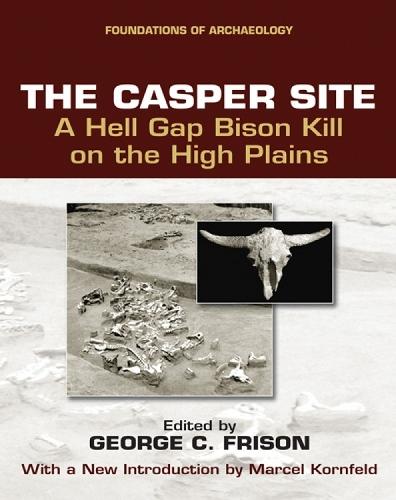
George Frison’s report on the 10,000-year-old Casper Site helped establish how large animal communal kill sites should be excavated, analyzed, and reported. With his background in ranching and hunting, Frison knows more about large animals than any other archaeologist. In The Casper Site Frison began to share that knowledge as well as the techniques of bone bed excavation; that, and the book’s interdisciplinary approach, make it a landmark in paleoindian archaeology and faunal analysis. As Marcel Kornfeld writes in his new introduction, 'One of Frison’s outstanding contributions to Great Plains prehistory has been in the arena of bison studies and bone beds in particular, and Casper is one of its finest examples.' The first edition of this book was published by Academic Press in 1975, and has been out of print for some years.
Full Product Details
Author: George C. Frison ,
Marcel Kornfeld
Publisher: Eliot Werner Publications Inc
Imprint: Eliot Werner Publications Inc
Edition: Revised edition
Dimensions:
Width: 18.40cm
, Height: 1.50cm
, Length: 23.50cm
Weight: 0.621kg
ISBN: 9780975273845
ISBN 10: 0975273841
Pages: 296
Publication Date: 01 January 2014
Audience:
College/higher education
,
Tertiary & Higher Education
Format: Paperback
Publisher's Status: Active
Availability: Available To Order

We have confirmation that this item is in stock with the supplier. It will be ordered in for you and dispatched immediately.
Reviews
'The Casper site is one in a long tradition of bison procurement site studies by George Frison. This site typifies the use of the parabolic sand dune for bison trapping. The suite of analyses employed set the standard for kill site archaeology on the Plains and around the globe.' (Leland C. Bement, Oklahoma Archeological Survey) 'With astonishing fidelity the events of an ancient bison kill are uncovered from the rolling sands of Wyoming. That these remarkable events happened 10,000 years ago, and yet we see them so clearly today, is testimony to the skill of Frison and his team of researchers. A landmark publication.' (Jack W. Brink, Royal Alberta Museum) 'The brainchild of a remarkable archaeologist and a benchmark in integrative archaeological science, putting to work innovations in spatial analysis, experiments in technology and vertebrate taphonomy, hunter-gatherer ethnoarchaeology, geology, and zooarchaeology. One cannot help but sense the squeak of sand churned by desperate hooves when reading this classic study.' (Mary C. Stiner, University of Arizona)
The Casper site is one in a long tradition of bison procurement site studies by George Frison. This site typifies the use of the parabolic sand dune for bison trapping. The suite of analyses employed set the standard for kill site archaeology on the Plains and around the globe. Leland C. Bement, Oklahoma Archeological Survey With astonishing fidelity the events of an ancient bison kill are uncovered from the rolling sands of Wyoming. That these remarkable events happened 10,000 years ago, and yet we see them so clearly today, is testimony to the skill of Frison and his team of researchers. A landmark publication. Jack W. Brink, Royal Alberta Museum The brainchild of a remarkable archaeologist and a benchmark in integrative archaeological science, putting to work innovations in spatial analysis, experiments in technology and vertebrate taphonomy, hunter-gatherer ethnoarchaeology, geology, and zooarchaeology. One cannot help but sense the squeak of sand churned by desperate hooves when reading this classic study. Mary C. Stiner, University of Arizona
Author Information
George C. Frison, University of Wyoming, Laramie, Wyoming Marcel Kornfeld, University of Wyoming, Laramie, Wyoming