|
|
|||
|
||||
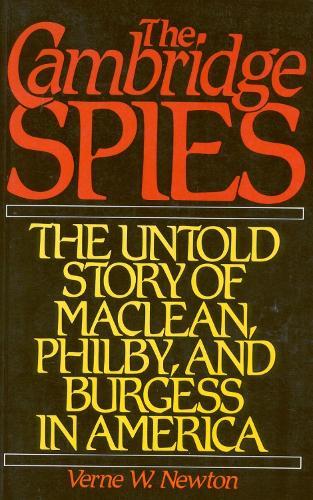
OverviewThree British diplomats and spies, Donald Maclean, Kim Philby, and Guy Burgess, did everything in their power to see to it that the Soviet Union prevailed in post-WWII clashes with the United States. Full Product DetailsAuthor: Verne W. NewtonPublisher: Madison Books Imprint: Madison Books Dimensions: Width: 14.00cm , Height: 2.80cm , Length: 22.20cm Weight: 0.662kg ISBN: 9781568330068ISBN 10: 1568330065 Pages: 486 Publication Date: 04 August 1993 Audience: General/trade , General Format: Paperback Publisher's Status: Active Availability: In Print This item will be ordered in for you from one of our suppliers. Upon receipt, we will promptly dispatch it out to you. For in store availability, please contact us. Table of ContentsReviewsIt is remarkable that, as the publisher claims, no comprehensive assessment - utilizing information derived under the Freedom of Information Act - of the espionage activities in the US of British spies Maclean, Philby, and Burgess has appeared from an American source until the publication of this book. It is all the more remarkable, even for those who have followed the story closely, in that this account by Newton, a former State Department executive, calls for a considerable revision in our understanding of the period following WW II. For more than four years, Newton reports, Donald Maclean, regarded as one of the stars or the British Foreign Office, was at the center of Anglo-American efforts to coordinate opposition to Stalin. At critical moments - during the period when the Soviet Union was acting with almost inexplicable boldness in Eastern Europe - he was thus in a position to assure Stalin that the US had virtually no atomic bombs in its arsenal. During the Korean War, be passed on the information that the US had taken the decision not to use atomic weapons except in the most extreme circumstances - information that could have been critical in China's decision to intervene. By comparison, the damage done by Philby and Burgess was much less important. Nobody emerges well from this narrative: as Newton notes, in the cover-up the British withheld information from the Americans, the CIA from the FBI, the FBI from the State Department, and the Atomic Energy Commission from all the others and from Congress as well. We are inevitably left with questions that may never be answered - for example, why the Soviets allowed Burgess, a drunken, indiscreet, promiscuous homosexual, to blow Philby's cover - but this account provides us with the fullest and most perceptive analysis of an important phase in Soviet espionage. (Kirkus Reviews) Author InformationTab Content 6Author Website:Countries AvailableAll regions |
||||