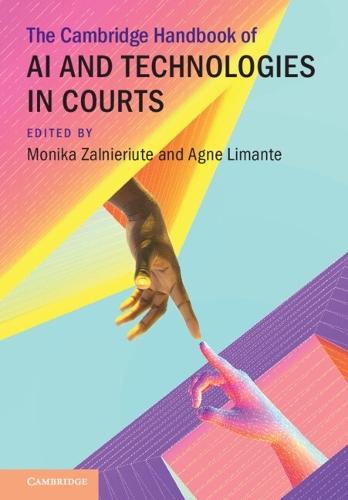
The Cambridge Handbook of AI and Technologies in Courts

Author:   Monika Zalnieriute (Law Institute of the Lithuanian Centre for Social Sciences) ,  Agne Limante (Law Institute of the Lithuanian Centre for Social Sciences)
Publisher:   Cambridge University Press
ISBN:  

9781009744201


Pages:   650
Publication Date:   30 April 2026
Format:   Hardback
Availability:   Not yet available, will be POD   Availability explained
This item is yet to be released. You can pre-order this item and we will dispatch it to you upon it's release. This is a print on demand item which is still yet to be released.

Our Price $517.50 Quantity:  
Pre-Order

Share |

The Cambridge Handbook of AI and Technologies in Courts


Overview

This Handbook is the first global comparative volume that examines the use of AI and digital technologies in courts. With contributions from over seventy academics, judges, and other professionals from over twenty-five countries, it provides an interdisciplinary and cross-jurisdictional perspective on how judicial institutions are responding to the opportunities and risks posed by AI. Covering judicial use of AI across domestic and regional jurisdictions in Europe, North and South America, Asia-Pacific and Africa, this Handbook begins with the premise that introducing AI into courts is not merely a technical upgrade but a constitutional reckoning and fresh call for judicial accountability. Each chapter examines not just what AI can do for courts, but what courts must do to ensure that AI tools enhance, rather than erode judicial values, justice and the rule of law.

Full Product Details

Author:   Monika Zalnieriute (Law Institute of the Lithuanian Centre for Social Sciences) ,  Agne Limante (Law Institute of the Lithuanian Centre for Social Sciences)
Publisher:   Cambridge University Press
Imprint:   Cambridge University Press
Weight:   0.500kg
ISBN:  

9781009744201


ISBN 10:   1009744208
Pages:   650
Publication Date:   30 April 2026
Audience:   Professional and scholarly ,  Professional & Vocational
Format:   Hardback
Publisher's Status:   Forthcoming
Availability:   Not yet available, will be POD   Availability explained
This item is yet to be released. You can pre-order this item and we will dispatch it to you upon it's release. This is a print on demand item which is still yet to be released.

Table of Contents

Foreword; 1. AI in Courtrooms Across the Globe Part I. Courts and AI: Context and Normative Positions; 2. AI and Courts: Challenges and Opportunities 3. The History and Developments of AI in Courts: A Legal Informatics Perspective; 4. Judging and Limits on Legal Automation; 5. Chief Justice Robots; 6. The Rule of AI and the Rule of Law; 7. Artificial Intelligence in the Judiciary: A Threat to the Rule of Law?; 8. Anticipatory Governance and AI in Courts; Part II. Courts and AI: Disciplinary Perspectives; 9. The Internalisation and Externalisation of Judicial Functions in the Age of AI; 10. AI Generated Evidence Used in European Criminal Courtrooms; 11. Courts and AI: An Administrative Law Perspective; 12. Criminal Courts and AI: On the Role and Use of Algorithms at Sentencing; 13. AI in Criminal Justice: Against the Trade Secret Privilege; 14. Public Perceptions of Judicial Use of AI: A Legal and Psychological Perspective; Part III. AI and Tech Challenges to Judicial Values; 15. AI and Judicial Transparency; 16. Judicial Independence: Impact of AI on Courts; 17. Judicial Impartiality: AI in Courts; 18. Procedural Fairness, AI and Courts; 19. AI and the Judicial Duty to State Reasons; 20. Balancing Legal Certainty and Judicial Discretion in AI-Assisted Adjudication; 21. AI and the Efficiency of Courts; 22. AI, Judicial Diversity, and Representativeness; 23. Judicial Competence and AI; 24. AI and Judicial Accountability; Part IV. AI in Courts Across the Globe: Jurisdictional Perspectives; International and Regional Jurisdictions; 25. AI and Courts: An International Human Rights Perspective; 26. AI at the European Court of Human Rights; 27. The Right to a Fair Trial & the 'AI-Equipped-Judges' of the Future; 28. EU AI Act and Courts; 29. AI Literacy and the Judiciary under the EU AI Act; AI and Courts in Europe; 30. Generative AI and Courts in the UK: A Candle in a Hurricane; 31. AI and the Courts in Germany; 32. Digital Justice in Estonia; 33. AI in Courts in Eastern Europe: Lithuania & Poland; 34. AI and Courts in Central Europe: Croatia and Slovenia; 35. AI and Courts in Spain; 36. Courts and the Use of Technologies and Artificial Intelligence in Türkiye; AI and Courts in the Americas; 37. Generative AI and Courts in the United States; 38. The Regulation of Judicial Use of Artificial Intelligence in Colombia from the Perspective of Legal Field Theory; 39. Courting AI: How Brazilian Courts are Using AI; AI and Courts in Other Parts of the World; 40. Application of Technologies and AI in the Nigerian Court System: Challenges and Prospects; 41. AI and India's Judicial System: Lessons from POCSO; 42. Algorithmic Justice: AI Sentencing Tools in Taiwan ; 43. AI and Courts in Japan; 44. Courts and AI: A View from Australia and New Zealand; 45. The Future of Courts and AI.

Reviews

Author Information

Monika Zalnieriute's is a co-editor of Money, Power and AI (2023) and The Cambridge Handbook of Facial Recognition in the Modern State (2024). Her research has influenced policy in international organisations such as the Council of Europe, World Bank, European Parliament and WHO, is translated into Mandarin, Russian and German, and has appeared in BBC and The Guardian. Agne Limante is a scholar at the Lithuanian Centre for Social Sciences. She specialises in human rights and emerging technologies. With over fifty publications and extensive editorial experience, since 2025, Agne has been serving at the European AI Office, where she contributes to shaping AI regulation and policy.

Tab Content 6

Author Website:  

Countries Available

All regions
Latest Reading Guide

April RG 26_2


Shopping Cart
Your cart is empty
Shopping cart
Mailing List