Overview
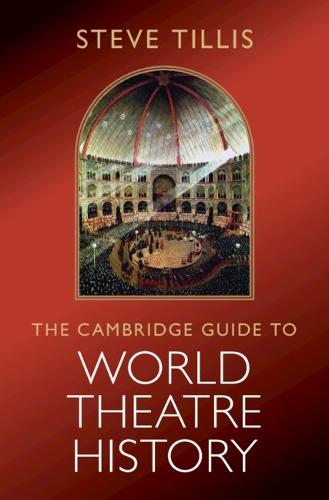
Presenting a panoramic, world-ranging view of history, this Guide identifies theatre's most important moments of widespread change from 50,000 BCE to modernity, across Eurasia, Africa, the Americas, and Australasia. It explains why those moments came about and examines how they found expression in distinctive theatre practices. Its global perspective complements more localized perspectives and foregrounds the importance of sometimes trivialized and overlooked traditions. The Guide provides students, scholars, and all who are interested in theatre with a fresh, lively, and compelling understanding of world theatre history.
Full Product Details
Author: Steve Tillis (Saint Mary's College of California)
Publisher: Cambridge University Press
Imprint: Cambridge University Press
ISBN: 9781009703444
ISBN 10: 1009703447
Pages: 354
Publication Date: 05 March 2026
Audience:
General/trade
,
General
Format: Hardback
Publisher's Status: Forthcoming
Availability: Not yet available, will be POD

This item is yet to be released. You can pre-order this item and we will dispatch it to you upon it's release. This is a print on demand item which is still yet to be released.
Reviews
'Steve Tillis provides a crucial antidote to the Standard Western Approach teaching of theatre history in this book. Unraveling the global scope of the historiographical processes underlying theatre's evolution is a significant achievement. Tillis does so with care and candor about his specific historical location and blind spots. This should be an essential text for graduate students, the future educators in our field.' Arnab Banerji, Associate Professor of Theatre History, Dramatic Literature, and Dramaturgy, Loyola Marymount University, Tovaangar 'Asking questions of what constitutes 'the world', Steve Tillis' ambitious book offers a distinctive way of looking at theatre history, merging persuasive studies of theatre regions, states and theatre forms with broader global discussions that articulate how particular metanarratives are constructed and why it matters to challenge standardised Western approaches to historical narratives. The result is a bold and highly readable study that focusses on connections, integrations, and interactions, identifying the moments of change that give form to the global theatre history/ies he narrates.' Maria Delgado, Professor of Theatre and Screen Arts, The Royal Central School of Speech and Drama, University of London 'This is a refreshingly different way of narrating theatre history: it looks beyond the national borders that have traditionally determined how we document and categorise theatre. This book marks the ways theatre travels through and across global cultures, which enables the reader to make very different connections than western-focused theatre histories generally allow.' Joanne Tompkins, Professor Emerita in Theatre, University of Queensland 'Instead of a story of progress from ritual to realism that dominates so many theatre history texts, Steve Tillis expands the scope of what is covered as 'theatre history,' thus avoiding the West and the rest"" approach. He gives careful consideration to multiple histories, cultures, and geographies, while also looking for places that stories and conventions intersect. By focusing on the emergence of theatre forms, inflection points, Tillis creates a structure that will compel further development and expansion. Throughout – Tillis doesn't just report history, but motivates the reader to think about why history is told the way it is… and how to understand that telling. This book is a must read for anyone who teaches or thinks about the history of theatre: I predict it will compel a reconsideration of what and how we study and teach global theatre history.' Jennifer Goodlander, Associate Professor of Theatre, Indiana University, Bloomington
Author Information
Steve Tillis is the author of The Challenge of World Theatre History (2020), Rethinking Folk Drama (1999), and Toward an Aesthetics of the Puppet (1992). He has taught theatre at Stanford University and the University of California, Berkeley, and currently teaches at Saint Mary's College of California.