Awards
- Winner of Honorable mention, Stuart L. Bernath Book Prize gi.
Overview
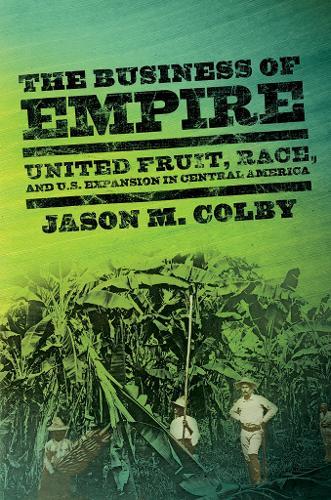
The link between private corporations and U.S. world power has a much longer history than most people realize. Transnational firms such as the United Fruit Company represent an earlier stage of the economic and cultural globalization now taking place throughout the world. Drawing on a wide range of archival sources in the United States, Great Britain, Costa Rica, and Guatemala, Colby combines ""top-down"" and ""bottom-up"" approaches to provide new insight into the role of transnational capital, labor migration, and racial nationalism in shaping U.S. expansion into Central America and the greater Caribbean. The Business of Empire places corporate power and local context at the heart of U.S. imperial history. In the early twentieth century, U.S. influence in Central America came primarily in the form of private enterprise, above all United Fruit. Founded amid the U.S. leap into overseas empire, the company initially depended upon British West Indian laborers. When its black workforce resisted white American authority, the firm adopted a strategy of labor division by recruiting Hispanic migrants. This labor system drew the company into increased conflict with its host nations, as Central American nationalists denounced not only U.S. military interventions in the region but also American employment of black immigrants. By the 1930s, just as Washington renounced military intervention in Latin America, United Fruit pursued its own Good Neighbor Policy, which brought a reduction in its corporate colonial power and a ban on the hiring of black immigrants. The end of the company's system of labor division in turn pointed the way to the transformation of United Fruit as well as the broader U.S. empire.
Full Product Details
Author: Jason M. Colby
Publisher: Cornell University Press
Imprint: Cornell University Press
Dimensions:
Width: 15.20cm
, Height: 2.10cm
, Length: 22.90cm
Weight: 0.454kg
ISBN: 9780801478994
ISBN 10: 0801478995
Pages: 288
Publication Date: 07 November 2013
Audience:
College/higher education
,
Undergraduate
,
Postgraduate, Research & Scholarly
Format: Paperback
Publisher's Status: Active
Availability: Manufactured on demand

We will order this item for you from a manufactured on demand supplier.
Reviews
Jason Colby's close attention to the United Fruit Company and his deft analysis of the interplay among Central American nationalism, West Indian migration, and UFC labor regimes remap the histories of Caribbean people in the networks of corporate capital. Jana K. Lipman, Tulane University, author of Guantanamo: A Working-Class History between Empire and Revolution
<p> Jason Colby's close attention to the United Fruit Company and his deft analysis of the interplay among Central American nationalism, West Indian migration, and UFC labor regimes remap the histories of Caribbean people in the networks of corporate capital. Jana K. Lipman, Tulane University, author of Guantanamo: A Working-Class History between Empire and Revolution
Author Information
Jason M. Colby is Associate Professor of History at the University of Victoria, British Columbia.