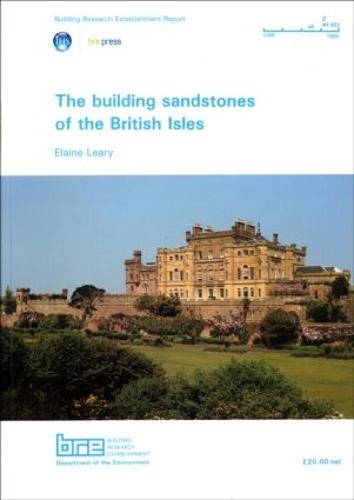
Overview
This book is the third in a series on sedimentary stone used for building purposes in the British Isles. The first, ""The Building Limestones of France"", was published in 1982, the second, ""The Building Limestones of the British Isles"", was published in 1983. These three books provide designers and architects of new buildings, and others involved in restoration work, with a guide to the currently available building stones. Sandstone, the subject of this book, is traditionally regarded as the stone of the North. However, sandstone can be seen throughout the country from the Weald of Sussex, the Forest of Dean in Gloucestershire up through Cheshire, Lancashire, Yorkshire, Cumbria and Northumberland right up to Caithness in Scotland. Sandstone has been used to construct great cathedrals like those of Durham, Hereford and Edinburgh, and historic houses like Chatsworth in Derbyshire, Attingham Park in Shropshire, and Wallington in Northumberland. Sandstone quarries now provide stone for repairs to historic buildings as well as for all present-day building applications such as cladding, paving, dressings and walling. The book comprises three chapters. Chapter 1, on geology, describes the way in which sandstones were formed, the terms associated with quarrying and some design considerations in the use of sandstones in buildings. Chapter 2 discusses the selection and durability of sandstones and assesses the results of tests carried out in the laboratory. The information comprising the greater part of this book can be found in Chapter 3. It was collected during visits to the quarries which began towards the end of 1982. The visits yielded information on the size of block available and details of recent contracts, and representative samples of stone were collected for laboratory testing. There are 78 quarries reviewed in this report and all were visited except for six, most of which opened after the programme of visits had been completed. Only quarries which supply stone for building applications are included; those which supply solely crushed stone, rockery stone or stone for fireplaces have been omitted. The following information on each quarry is given: exact location together with an Ordnance Survey grid reference for the quarries in Great Britain; size of the quarry and an indication of the potential stone reserves for future exploitation; geological details; description of the stone and the sizes available; description of the applications for which the stone has been used and reference buildings where it can be seen; and results of the testing programme. The inset of coloured photographs includes pictures from the main beds for most of the quarries. The sets of reference buildings were compiled from information provided by each quarry and by reference to books listed in the Bibliography. The Stone Federation helpfully agreed to circulate to their members a questionnaire seeking information on buildings constructed from sandstone. The catalogue of reference buildings held by the Geological Survey at the Geological Museum, now part of the Natural History Museum, was also consulted. Reference buildings for sandstones are less well documented than those for limestones. There are no sandstone equivalents of the books ""Cambridge Stone"" and ""OXford Stone"". Whilst it was possible to discover that buildings were constructed with a particular stone, it was often difficult to determine the date of construction. Nevertheless, undated reference buildings have been included in this guide because they will still be of interest to readers and because some of the reference lists would otherwise be very short. The best places to see a particular stone may be local churches or local housing developments. Quarries themselves may be able to provide additional details of their latest contracts. The ""Natural Stone Directory"" contains up-to-date information on the active quarries.
Full Product Details
Author: Elaine Leary
Publisher: IHS BRE Press
Imprint: IHS BRE Press
Volume: 84
Weight: 0.390kg
ISBN: 9780851252032
ISBN 10: 0851252036
Pages: 120
Publication Date: 01 January 1986
Audience:
Professional and scholarly
,
Professional & Vocational
Format: Paperback
Publisher's Status: Active
Availability: In Print

This item will be ordered in for you from one of our suppliers. Upon receipt, we will promptly dispatch it out to you. For in store availability, please contact us.