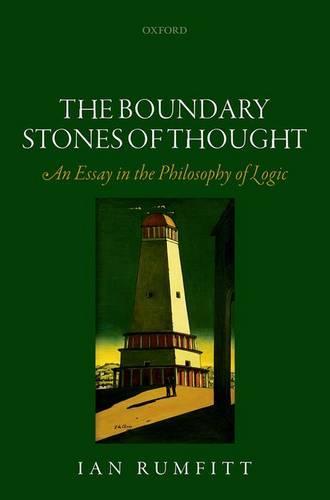
Full Product Details
Author: Ian Rumfitt (University of Oxford)
Publisher: Oxford University Press
Imprint: Oxford University Press
Dimensions:
Width: 16.40cm
, Height: 2.60cm
, Length: 24.10cm
Weight: 0.692kg
ISBN: 9780198733638
ISBN 10: 0198733631
Pages: 362
Publication Date: 26 March 2015
Audience:
College/higher education
,
Undergraduate
,
Postgraduate, Research & Scholarly
Format: Hardback
Publisher's Status: Active
Availability: To order

Stock availability from the supplier is unknown. We will order it for you and ship this item to you once it is received by us.
Reviews
The Boundary Stones of Thought exemplifies the breadth and depth involved in contemporary debates in the philosophy of logic. It is therefore a must read for those interested in this area. John Wigglesworth, Philosophical Quarterly
The Boundary Stones of Thought exemplifies the breadth and depth involved in contemporary debates in the philosophy of logic. It is therefore a must read for those interested in this area. * John Wigglesworth, Philosophical Quarterly * The book is careful, insightful, and imaginative. I, for one, learned much from it. * Graham Priest, Journal of Philosophy * Rumfitt's book is dense and rich. There is no doubt that it makes an important contribution to the debate between intuitionistic and classical logicians. ... Although the book defends classical logic, Rumfitt clearly takes the challenges posed by intuitionists seriously; this makes for a very engaging read. The Boundary Stones of Thought has much to offer to anyone interested in the philosophy of logic or philosophical logic, such as a sophisticated methodology for advancing a debate between competing logics, a novel account of the nature of logic, and several promising semantic theories. It is to be hoped that it finds a wide readership among philosophers and logicians, within but also beyond the debate about intuitionistic logic. * Peter Fritz, Mind *
Rumfitt's book is dense and rich. There is no doubt that it makes an important contribution to the debate between intuitionistic and classical logicians. ... Although the book defends classical logic, Rumfitt clearly takes the challenges posed by intuitionists seriously; this makes for a very engaging read. The Boundary Stones of Thought has much to offer to anyone interested in the philosophy of logic or philosophical logic, such as a sophisticated methodology for advancing a debate between competing logics, a novel account of the nature of logic, and several promising semantic theories. It is to be hoped that it finds a wide readership among philosophers and logicians, within but also beyond the debate about intuitionistic logic. * Peter Fritz, Mind * The book is careful, insightful, and imaginative. I, for one, learned much from it. * Graham Priest, Journal of Philosophy * The Boundary Stones of Thought exemplifies the breadth and depth involved in contemporary debates in the philosophy of logic. It is therefore a must read for those interested in this area. * John Wigglesworth, Philosophical Quarterly *
Author Information
Ian Rumfitt studied philosophy at Balliol College, Oxford and at Princeton University. He has taught the subject at Keele University, the University of Michigan at Ann Arbor, University College, Oxford (where he was a Tutorial Fellow for seven years), and at Birkbeck College, London (where he was Professor of Philosophy from 2005 until 2013). He is now Professor of Philosophy at the University of Birmingham. He has published many articles in philosophical logic, in the philosophy of language, and in metaphysics.