Overview
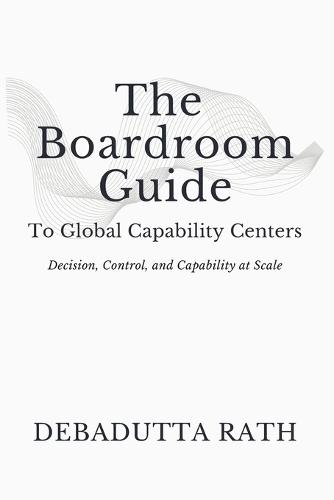
For decades, global capability centers were built on a simple promise: scale, efficiency, and control. That promise held-until intelligence stopped behaving the way organizations were designed to manage it. This book is not about outsourcing versus insourcing, nor is it a guide to building the ""right"" operating model. It is an examination of what actually changes inside enterprises when cost arbitrage loses power, when execution scales faster than judgment, and when artificial intelligence collapses long-standing assumptions about proximity, supervision, and control. Drawing on observed patterns across global organizations, the book traces how boards make structural decisions without fully naming what they are deciding; why many Global Capability Centers struggle even after the ""right"" choice is made; how governance, risk, and power quietly reorganize themselves; and why the next evolution of the GCC is not a delivery engine at all-but a strategic nerve center. This is not a playbook. There are no frameworks to implement, no maturity models to adopt, and no predictions dressed up as certainty. Instead, the book offers clarity: about judgment, authority, coherence, and what it means to govern complex enterprises in an age where intelligence is ambient rather than centralized. Written for board members, senior executives, GCC leaders, and operators navigating complexity at scale, this book does not argue for a future. It helps you recognize the one that is already unfolding-and decide how deliberately you intend to govern it. What emerges is a reframing of the Global Capability Center itself-not as a cost construct, a talent pool, or a location strategy, but as an institutional decision about where judgment lives, how authority is exercised, and how organizations remain coherent as intelligence becomes distributed across humans, machines, and systems. The book examines why many enterprises continue to invest in structural answers to fundamentally cognitive problems; why governance models designed for stable, hierarchical work fail under conditions of continuous learning and algorithmic intervention; and why ""scaling execution"" without rethinking decision rights often amplifies risk rather than reducing it. Rather than prescribing what boards should do, the book surfaces what boards are already doing, often implicitly: relocating power, redefining accountability, and renegotiating trust between headquarters, capability centers, and increasingly autonomous systems. It explores the quiet tensions between efficiency and discretion, transparency and control, speed and legitimacy-tensions that no operating model can resolve on its own. This is a book for leaders who have already built, expanded, or inherited Global Capability Centers-and sense that something fundamental has shifted, even if it has not yet been named. It will resonate with readers who are less interested in best practices and more concerned with first principles; less focused on transformation roadmaps and more on institutional consequences. It is not written to persuade. It is written to help leaders see more clearly: how decisions compound, how structures think on behalf of organizations, and why the future of the GCC is less about where work is done-and more about how judgment is governed when intelligence no longer sits still.
Full Product Details
Author: Debadutta Rath
Publisher: Independently Published
Imprint: Independently Published
Dimensions:
Width: 15.20cm
, Height: 3.20cm
, Length: 22.90cm
Weight: 0.821kg
ISBN: 9798241340870
Pages: 622
Publication Date: 26 December 2025
Audience:
General/trade
,
General
Format: Paperback
Publisher's Status: Active
Availability: Available To Order

We have confirmation that this item is in stock with the supplier. It will be ordered in for you and dispatched immediately.