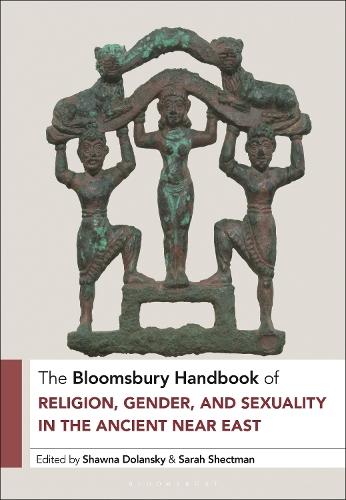
Overview
Cutting across disciplinary boundaries and challenging traditional understandings of historical cultures, this handbook examines the ways in which gender, sexuality, and religion were mutually constructed and negotiated in ancient Near Eastern societies. Chapters look at ritual and ceremonial practices, iconographic representations, mythological and divinatory texts, personal beliefs, and piety. The book explores these topics by adopting religion as a category of inquiry to understand gender roles and the intersections of sexualities with religious worldviews. With a focus on particular case studies, this volume provides a broad and interdisciplinary overview of key areas and issues across the study of religions, genders, and sexualities in the ancient Near East. Each section is introduced by the editors with a discussion of relevant terminology, as well as convergences and divergences of rituals, beliefs, practices, and themes among the contributions. Ranging from in-depth discussions of single texts to cross-cultural anthropological and sociological comparisons, the international contributions showcase the latest work of established scholars as well as emerging voices.
Full Product Details
Author: Shawna Dolansky (Carleton University, Canada) , Sarah Shectman (independent scholar, US)
Publisher: Bloomsbury Publishing PLC
Imprint: Bloomsbury Academic
Dimensions:
Width: 17.60cm
, Height: 3.40cm
, Length: 24.60cm
Weight: 0.974kg
ISBN: 9781350382015
ISBN 10: 1350382019
Pages: 496
Publication Date: 10 July 2025
Audience:
Professional and scholarly
,
College/higher education
,
Professional & Vocational
,
Postgraduate, Research & Scholarly
Format: Hardback
Publisher's Status: Active
Availability: Manufactured on demand 
We will order this item for you from a manufactured on demand supplier.
Table of Contents
Introduction Shawna Dolansky (Carleton University, Canada) and Sarah Shectman (Independent scholar, USA) Part 1: Gender Roles and Attributions 1. Stephanie Budin (Independent scholar, UK), “Why Is Ishtar a Fertility Goddess?” 2. Noam Cohen (Muhlenberg College, USA), “A Married Woman’s Right to Intercourse: Schoolboys, Law, and Female Sexuality” 3. Joanna Töyräänvuori (University of Helsinki, Finland), “Divine Sexuality in the Ugaritic Texts” 4. Omar N’Shea (University of Malta, Malta), “Gender Benders in the Temple of the Goddess Ištar: The Case of the Assinnu” 5. Dorothea Erbele-Küster (Johannes Gutenberg-Universität Mainz, Germany), “Sexuality and Food” Part II: Ritual and Body 6. Adi Marili (Bar Ilan University, Israel), “The Human Body in Ritual Worship: Performance and Meaning” 7. Jonathan Stökl (King’s College London, UK), “Priestly Masculinity in the First Millennium BCE: Fragile Hegemonies” 8. Céline Debourse (Harvard University, USA), “Women in Cultic Functions in Late Achaemenid and Hellenistic Babylon” 9. Gioele Zisa (The University of Palermo, Italy), “‘Rear up, Make Love to Me! Rear up, Bleat for Me!’: Heteronormative Male Sexuality in the Mesopotamian Therapies for the Recovery of Sexual Desire” 10. Joseph Scales (Independent scholar, UK) and Laura Quick (University of Oxford, UK), “The Emergence of Submergence: Women’s Bathing Rituals in Ancient Judaism” 11. Amelia Brownridge (University of Toronto, Canada), “The Dual Feminine: An Exploration of the Pregnancy Metaphor in 1QHa 1(?)–18” 12. Sarah Cook (The University of Georgia, USA), “No Body, No Crime: Dressing Yahweh-as-Tabernacle in Exodus 35–40” Part III: Violence and Power 13. Chontel Syfox (University of Wisconsin, Madison, USA), “Rewriting the Rape of Dinah: The Endogamous Exchange of Women and Reproductive Futurism in Genesis 34 and Jubilees 30” 14. Jennifer Lehmann (Graduate Theological Union, USA), “Joseph and the Amazing Technicolor HR Violation: Sexual Violence and Masculinity in Genesis 39” 15. Anne Katrine de Hemmer Gudme (University of Oslo, Norway), “Beauty, Power, and Gender in the Hebrew Bible” 16. Carmen Palmer (Stetson University, USA), “‘The Woman Was Very Beautiful’: Beautiful Women in Scripture as Purveyors of Tradition” 17. R. Gillian Glass (Aarhus University, Denmark), “Inverted Pathways to Power: Heavenly Knowledge and Authority in the Book of the Watchers and Aseneth” 18. Kelly J. Murphy (Central Michigan University, USA), “‘And Aaron was Silent’: Priests, Power, and Masculinities”
Reviews
Dolansky and Shectman have brought together a talented group of international scholars to highlight the absolute centrality of gendered historiography, namely combining gender studies with traditional historical critical methods. The essays use current theories—but without unnecessary jargon—to suggest new, clever, and provocative readings, opening up broader interpretive possibilities for many ancient texts. * Marc Zvi Brettler, Duke University, USA * I challenge anyone to peruse Dolansky and Shectman’s Handbook of Religion, Gender and Sexuality in the Ancient Near East without delight. Authors’ voices shine through, including a wide array of world-class specialists across numerous approaches. This handbook fills longstanding gaps and gifts pedagogues with clear, robust definitions and accessible methodology. Researchers far beyond ANE studies will benefit from taking the editors’ contribution of ‘gendered historiography’ as a model for teaching and research in any historical period. * Sara Parks, St. Francis Xavier University, Canada * The discipline of biblical studies can feel overrun with handbooks – do we really need another? In the case of the Bloomsbury Handbook of Religion, Gender and Sexuality in the Ancient Near East, the answer is a resounding YES. This is a remarkable volume in its breadth, depth, and quality of scholarship. Shawna Dolansky and Sarah Shectman have curated an excellent resource for scholars and students alike, and I cannot wait to use this handbook in class. * Rhiannon Graybill, University of Richmond, USA * Employing diverse methodological approaches to the material culture of the ancient Near East, the authors demonstrate how gender, sexuality, and religion were mutually constructed and negotiated at all levels of ancient societies. These cutting-edge essays offer valuable insights, and I highly recommend the volume to anyone seeking to understand the interconnections between religion, gender, and sexuality in antiquity and their relevance today. * Hanna Tervanotko, McMaster University, Canada * Though not everyone will agree with all of the conclusions and ideas presented in this volume of case studies on religion, gender and sexuality in the ancient Near East and Hebrew Bible, the contributions therein are truly stimulating examples of the current methodological shift in gender research. Therefore, It is a must read for scholars in the field. * Mark Chavalas, University of Wisconsin-La Crosse, USA *
Author Information
Shawna Dolansky is Associate Professor of Humanities at Carleton University, Canada. She is the author of Now You See It, Now You Don’t: Biblical Perspectives on the Relationship Between Magic and Religion (2008) and co-author of The Bible Now (2011). Sarah Shectman is the Managing Editor of The Posen Library of Jewish Culture and Civilization and the author of Women in the Pentateuch: A Feminist and Source-Critical Analysis (2009).
Tab Content 6
Author Website:
Countries Available
All regions
|