Overview
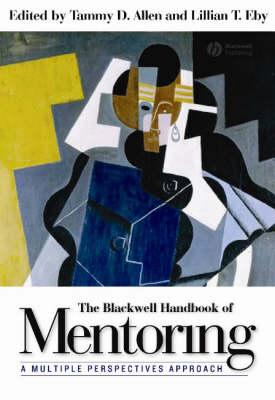
Cutting across the fields of psychology, management, education, counseling, social work, and sociology, The Blackwell Handbook of Mentoring reveals an innovative, multi-disciplinary approach to the practice and theory of mentoring. Provides a complete, multi-disciplinary look at the practice and theory of mentoring and demonstrates its advantages Brings together, for the first time, expert researchers from the three primary areas of mentoring: workplace, academy, and community Leading scholars provide critical analysis on important literature concerning theoretical approaches and methodological issues in the field Final section presents an integrated perspective on mentoring relationships and projects a future agenda for the field
Full Product Details
Author: Tammy D. Allen (University of South Florida) , Lillian T. Eby (University of Georgia)
Publisher: John Wiley and Sons Ltd
Imprint: Wiley-Blackwell
Dimensions:
Width: 18.00cm
, Height: 3.20cm
, Length: 25.50cm
Weight: 1.052kg
ISBN: 9781405133739
ISBN 10: 1405133732
Pages: 520
Publication Date: 10 May 2007
Audience:
Professional and scholarly
,
Professional & Vocational
Format: Hardback
Publisher's Status: Active
Availability: Out of stock 
The supplier is temporarily out of stock of this item. It will be ordered for you on backorder and shipped when it becomes available.
Table of Contents
Notes on Contributors. Foreword. Acknowledgments. Part I: Introduction:. 1. Overview and Introduction: Tammy D. Allen (University of South Florida), Lillian T. Eby (University of Georgia). 2. Definition and Evolution of Mentoring: Lillian T. Eby (University of Georgia), Jean E. Rhodes (University of Massachusetts, Boston), Tammy D. Allen (University of South Florida). Part II: Theoretical Approaches and Methodological Issues:. 3. Youth Mentoring: Theoretical Approaches and Methodological Issues: Thomas E. Keller (Portland State University). 4. Student–Faculty Mentoring: Theoretical Approaches and Methodological Issues: W. Brad Johnson (U.S. Naval Academy), Gail Rose (University of Vermont), Lewis Z. Schlosser (Seton Hall University). 5. Workplace Mentoring: Theoretical Approaches and Methodological Issues: Terri A. Scandura (University of Miami), Ekin K. Pellegrini (University of Missouri-St. Louis). 6. Reflections on the Theoretical Approaches and Methodological Issues in Mentoring Relationships: Marcus M. Butts (University of Georgia), Jaime R. Durley (University of Georgia), Lillian T. Eby (University of Georgia). Part III: Naturally Occurring Mentoring Relationships:. 7. Naturally Occurring Mentoring Relationships Involving Youth: Renée Spencer (Boston University School of Social Work). 8. Naturally Occurring Student–Faculty Mentoring Relationships: A Literature Review: Carol A. Mullen (University of South Florida). 9. Naturally Occurring Mentoring Relationships Involving Workplace Employees: Thomas W. Dougherty (University of Missouri-Columbia), Daniel B. Turban (University of Missouri-Columbia), Dana L. Haggard (University of Missouri-Columbia). 10. Reflections on Naturally Occurring Mentoring Relationships: Elizabeth Lentz, Tammy D. Allen (both University of South Florida). Part IV: Benefits of Mentoring:. 11. The Benefits Associated with Youth Mentoring Relationships: Lynn Blinn-Pike (Indiana University-Purdue University). 12. Student–Faculty Mentorship Outcomes: W. Brad Johnson (U.S. Naval Academy). 13. The Benefits Associated with Workplace Mentoring Relationships: Aarti Ramaswami (Indiana University-Bloomington), George F. Dreher (Indian University-Bloomington). 14. Reflections on the Benefits of Mentoring: Angie Lockwood, Sarah C. Evans, Lillian T. Eby (all University of Georgia). Part V: Diversity and Mentoring:. 15. Diversity and Youth Mentoring Relationships: Belle Liang (Boston College), Jennifer Grossman (Harvard Medical School/Massachusetts General Hospital). 16. Mentoring in Academia: Considerations for Diverse Populations: William E. Sedlacek (University of Maryland), Eric Benjamin (Montgomery College), Lewis Z. Schlosser (Seton Hall University), Hung-Bin Sheu (University of Maryland, College Park). 17. Diversity and Workplace Mentoring Relationships: A Review and Positive Social Capital Approach: Belle Rose Ragins (University of Wisconsin-Milwaukee). 18. Reflections on Diversity and Mentoring: Hazel-Anne M. Johnson, Xian Xu, Tammy D. Allen (all University of South Florida). Part VI: Best Practices for Formal Mentoring Programs:. 19. Best Practices for Formal Youth Mentoring: Andrew Miller (Middlesex University). 20. Best Practices for Student–Faculty Mentoring Programs: Clark D. Campbell (George Fox University). 21. Best Practices for Workplace Formal Mentoring Programs: Lisa M. Finkelstein (Northern Illinois University), Mark. L. Poteet (Organizational Research & Solutions). 22. Reflections on the Best Practices for Formal Mentoring Programs: Kimberley E. O’Brien, Ozgun B. Rodopman, Tammy D. Allen (all University of South Florida). Part VII: Integrating Multiple Mentoring Perspectives:. 23: New Directions in Mentoring: Steve Bearman (University of California, Santa Cruz), Stacy Blake-Beard (Simmons College), Laurie Hunt (Laurie Hunt & Associates/Simmons College), Faye J. Crosby. 24. Common Bonds: An Integrative View of Mentoring Relationships: Tammy D. Allen (University of South Florida), Lillian T. Eby (University of Georgia). Bibliography. Name Index. Subject Index
Reviews
I have no doubt that those interested in youth mentoring would find the specific chapters useful. It is then an extra bonus to have available similarly fine articles on mentoring of students in academia and mentoring in the workplace. (The Prevention Researcher, 1 December 2011) This book provides up-to-date review and synthesis of research and theory on the antecedents, correlates, and consequences of mentoring. It also provides critical analyses of the literature and then reflection on the appraisals. This account organizes and critiques the mentoring literature in a way that identifies key issues and prompts heuristic hypotheses. (Neopoprealism Journal, 24 November 2011) An integrative view of mentoring [is presented] in the last chapter?[it] does a great job in pulling together the three perspectives. (PsycCritiques) The definitive work on mentoring.... All contributors draw on existing knowledge to present best practices for each category.... Essential. (Choice) Allen and Eby's vision to integrate the fragmented literature on mentoring employees, students, and youth has produced a masterful volume that will be immensely helpful to researchers and practitioners. ?Jeffrey H. Greenhaus, Drexel University By juxtapositioning parallel articles on youth, academic, and workplace mentoring on a various of topics ? theory, practice, outcomes ? this handbook spurs researchers in all three areas to broaden their thinking and challenge their current perspectives. I particularly enjoyed thinking about what was unique and what was common across the theoretical pathways through which mentoring benefits the protege. Each type of mentoring has its unique features, but I found more commonality than I had expected before reading this book. The summary chapters at the end of each section were a particularly useful feature of the book. ?Jean B. Grossman, Princeton University This volume is truly ground-breaking in its integrative treatment of heretofore largely distinct bodies of scholarship on mentoring relationships within the diverse contexts of youth programs, higher education, and the workplace. Collectively, the contributions make a compelling case for not only the theoretical, but also the practical value of taking careful stock of the commonalities as well as the uniquenesses that characterize mentoring relationships across differing critical points in the life span. This handbook does a great deal to advance our understanding of mentoring relationships and how best to unlock their potential and, undoubtedly, will stimulate many further important advances in the field. ?David DuBois, University of Illinois at Chicago
I have no doubt that those interested in youth mentoring would find the specific chapters useful. It is then an extra bonus to have available similarly fine articles on mentoring of students in academia and mentoring in the workplace. (The Prevention Researcher, 1 December 2011) This book provides up-to-date review and synthesis of research and theory on the antecedents, correlates, and consequences of mentoring. It also provides critical analyses of the literature and then reflection on the appraisals. This account organizes and critiques the mentoring literature in a way that identifies key issues and prompts heuristic hypotheses. (Neopoprealism Journal, 24 November 2011) An integrative view of mentoring [is presented] in the last chapter...[it] does a great job in pulling together the three perspectives. (PsycCritiques) The definitive work on mentoring... All contributors draw on existing knowledge to present best practices for each category... Essential. (Choice)
"""I have no doubt that those interested in youth mentoring would find the specific chapters useful. It is then an extra bonus to have available similarly fine articles on mentoring of students in academia and mentoring in the workplace."" (The Prevention Researcher, 1 December 2011) ""This book provides up-to-date review and synthesis of research and theory on the antecedents, correlates, and consequences of mentoring. It also provides critical analyses of the literature and then reflection on the appraisals. This account organizes and critiques the mentoring literature in a way that identifies key issues and prompts heuristic hypotheses."" (Neopoprealism Journal, 24 November 2011) ""An integrative view of mentoring [is presented] in the last chapter…[it] does a great job in pulling together the three perspectives."" (PsycCritiques) ""The definitive work on mentoring.... All contributors draw on existing knowledge to present best practices for each category.... Essential."" (Choice)"
Allen and Eby's vision to integrate the fragmented literature on mentoring employees, students, and youth has produced a masterful volume that will be immensely helpful to researchers and practitioners. Jeffrey H. Greenhaus, Drexel University<!--end--> By juxtapositioning parallel articles on youth, academic, and workplace mentoring on a various of topics - theory, practice, outcomes - this handbook spurs researchers in all three areas to broaden their thinking and challenge their current perspectives. I particularly enjoyed thinking about what was unique and what was common across the theoretical pathways through which mentoring benefits the protege. Each type of mentoring has its unique features, but I found more commonality than I had expected before reading this book. The summary chapters at the end of each section were a particularly useful feature of the book. Jean B. Grossman, Princeton University This volume is truly ground-breaking in its integrative treatment of heretofore largely distinct bodies of scholarship on mentoring relationships within the diverse contexts of youth programs, higher education, and the workplace. Collectively, the contributions make a compelling case for not only the theoretical, but also the practical value of taking careful stock of the commonalities as well as the uniquenesses that characterize mentoring relationships across differing critical points in the life span. This handbook does a great deal to advance our understanding of mentoring relationships and how best to unlock their potential and, undoubtedly, will stimulate many further important advances in the field. David DuBois, University of Illinois at Chicago An integrative view of mentoring [is presented] in the last chapter...[it] does a great job in pulling together the three perspectives. PsycCritiques The definitive work on mentoring ... .All contributors draw on existing knowledge to present best practices for each category ... .Essential. Choice
Author Information
Tammy D. Allen is Professor of Psychology at the University of South Florida. Her research interests include mentoring relationships, work-family issues, organizational citizenship behavior, and occupational health psychology. Her research has been published in journals such as Journal of Applied Psychology, Personnel Psychology, and Journal of Vocational Behavior. Lillian T. Eby is Associate Professor of Psychology at the University of Georgia. Her research focuses on workplace mentoring, job-related relocation, career success, the work-family interface, and gender issues in organizations. She has published over 50 research articles and book chapters and her work appears in such outlets as Personnel Psychology, Journal of Applied Psychology, and the Journal of Vocational Behavior.
Tab Content 6
Author Website:
Countries Available
All regions
|