Overview
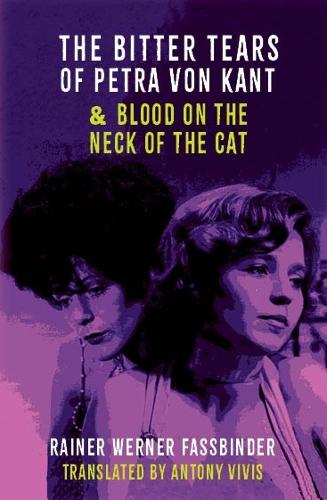
The Bitter Tears of Petra von Kant: Petra is a prominent fashion designer who lives with Marlene, her much put-upon assistant. Petra is deeply attracted to the younger Karin and asks her to move in. But Karin is married and plans on rejoining her husband later. Petra is upset by this but still gives Karin money for a flight to Frankfurt to meet her husband. Drunk on her 35th birthday, a huge row erupts between Petra, her daughter, Gaby, her mother Valerie, and her friend, Sidonie, who gives Petra a doll as a birthday present. Karin eventually telephones, but Petra declines to see her. Afterwards, Petra apologizes to Marlene suggesting they work together again. Marlene simply packs her bags, and leaves silently, taking the doll with her. This play is combined in a dual edition with: Blood on the Neck of the Cat: An alien from space named Phoebe Zeitgeist arrives at a cocktail party and learns about human beings from those attending. First the main characters deliver confessional monologues about themselves then Phoebe speaks one-on-one with the characters, picking up certain phrases and attitudes from them. Finally, Phoebe repeats some of what she has heard, with the other characters commenting that she must be either drunk or smart.
Full Product Details
Author: Rainer Werner Fassbinder ,
Anthony Vivis ,
Martin Hall
Publisher: Aurora Metro Publications
Imprint: Aurora Metro Publications
Edition: Revised edition
Dimensions:
Width: 12.90cm
, Height: 1.50cm
, Length: 19.80cm
ISBN: 9781738476947
ISBN 10: 1738476944
Pages: 136
Publication Date: 18 February 2026
Audience:
General/trade
,
General
Format: Paperback
Publisher's Status: Active
Availability: In Print

This item will be ordered in for you from one of our suppliers. Upon receipt, we will promptly dispatch it out to you. For in store availability, please contact us.
Language: German
Author Information
Openly bi-sexual and deliberately subversive, Rainer Werner Fassbinder was post-war Germany's greatest filmmaker. An auteur whose 41 films ranged across genres and styles, his critique of society included Nazism, post-war Germany's economic transformation and social and sexual constraints and hypocrisy. He began in theatre after being rejected for film school and made a name for himself as a controversial writer-director challenging social norms. He started to make films on a shoestring budget drawing together a group of stage actors and technicians and with his incredible energy and drive, produced ten films in two years. Fassbinder was inspired by French New Wave Cinema and Hollywood films, especially those by Douglas Sirk, to explore homoerotic themes in line with his queer vision of people constrained by society and tradition. He died at 37 and leaves a legacy of provocative, deeply personal films which continue to have relevance in an age when liberal values are under attack and the right is on the rise again. Fassbinder was the subject of a major retrospective at BFI Southbank in 2017. Anthony Vivis' work has been produced by the Royal National Theatre, Royal Shakespeare Company and Royal Court, as well as the Bush and Soho Poly, and many other parts of the UK. He has written for cinema and television, as well as BBC Radio 3 and 4. His literary work has been published by Bloomsbury, Cape, the CUP, the OUP and others. His reviews have appeared in several publications, including the Independent and the Times Literary Supplement. Anthony has been given several awards, including the Italia Prize, theatre translation bursaries from the Arts Council of England and twice commended in the BCLA translation Competition. Born in Sleaford, Lincs, in 1943, from 1962-65 Anthony studied Modern and Mediaeval Languages at Clare College, Cambridge. He began work was as a Dramaturgical Adviser to the theatre publisher/agent, Felix Bloch Erben, in (West) Berlin. Between 1967 and 1971 he worked for the Royal Shakespeare Company in London as Dramaturg. His work mainly consisted of reading, reporting on and translating contemporary German and French plays, as well as seeing productions of new plays in the UK and abroad. From 1977-83 he worked as Editor and Producer, mainly the Drama Department of BBC Radio, in London. Subsequently he became a freelance writer and translator, living in the Suffolk village of Westley Waterless and in Norwich, from where he continued to teach for the University of East Anglia and the Open University.