Overview
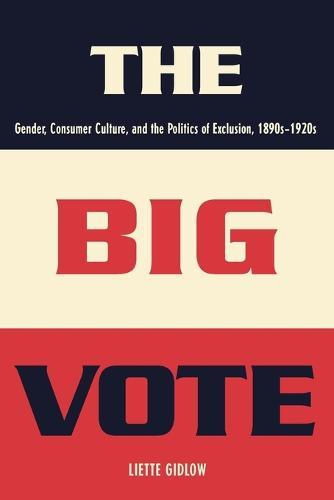
Low voter turnout is a serious problem in American politics today, but it is not a new one. Its roots lay in the 1920s when, for the first time in nearly a century, a majority of eligible Americans did not bother to cast ballots in a presidential election. Stunned by this civic failure so soon after a world war to ""make the world safe for democracy,"" reforming women and business men launched massive campaigns to ""Get Out the Vote."" By 1928, they had enlisted the enthusiastic support of more than a thousand groups in Forty-six states. In The Big Vote, historian Liette Gidlow shows that the Get-Out-the-Vote campaigns-overlooked by historians until now-were in fact part of an important transformation of political culture in the early twentieth century. Weakened political parties, ascendant consumer culture, labor unrest, Jim Crow, widespread anti-immigration sentiment, and the new woman suffrage all raised serious questions about the meanings of good citizenship. Gidlow recasts our understandings of the significance of the woman suffrage amendment and shows that it was important not only because it enfranchised women but because it also ushered in a new era of near-universal suffrage. Faced with the apparent equality of citizens before the ballot box, middle-class and elite whites in the Get-Out-the-Vote campaigns and elsewhere advanced a searing critique of the ways that workers, ethnics, and sometimes women behaved as citizens. Through techniques ranging from civic education to modern advertising, they worked in the realm of culture to undo the equality that constitutional amendments had seemed to achieve. Through their efforts, by the late 1920s, ""civic"" had become practically synonymous with ""middle class"" and ""white."" Richly documented with primary sources from political parties and civic groups, popular and ethnic periodicals, and electoral returns, The Big Vote looks closely at the national Get-Out-the-Vote campaigns and at the internal dynamics of campaigns in the case-study cities of New York, New York, Grand Rapids, Michigan, and Birmingham, Alabama. In the end, the Get-Out-the Vote campaigns shed light not only on the problem of voter turnout in the 1920s, but on some of the problems that hamper the practice of full democracy even today.
Full Product Details
Author: Liette Gidlow (Associate Professor, Wayne State University)
Publisher: Johns Hopkins University Press
Imprint: Johns Hopkins University Press
Edition: New edition
Dimensions:
Width: 15.20cm
, Height: 1.50cm
, Length: 22.90cm
Weight: 0.431kg
ISBN: 9780801886379
ISBN 10: 0801886376
Pages: 280
Publication Date: 10 May 2007
Recommended Age: From 17
Audience:
Professional and scholarly
,
Professional and scholarly
,
Professional & Vocational
,
Postgraduate, Research & Scholarly
Format: Paperback
Publisher's Status: Active
Availability: Manufactured on demand

We will order this item for you from a manufactured on demand supplier.
Reviews
Not only illuminates an aspect of the 1920s that has not received sufficient attention but, in doing so, it also propounds a provocative thesis that historians will need to address. -- Nicholas Burckel History 2005 Gidlow's topic is a timely one. Her account of the largely forgotten GOTV campaigns of the 1920s may carry lessons for the present era. -- Nikki Mandell American Historical Review 2005 Gidlow's... observations are helpful for serious students of marketing and political science. Minneapolis Star Tribune 2004 Gidlow has achieved much, giving us a new understanding of political cultures and how they are created and transformed. No one should henceforth assume that Get Out the Vote campaigns are innocuous. -- Gayle Gullett Journal of American History 2006
Not only illuminates an aspect of the 1920s that has not received sufficient attention but, in doing so, it also propounds a provocative thesis that historians will need to address. - History Gidlow's topic is a timely one. Her account of the largely forgotten GOTV campaigns of the 1920s may carry lessons for the present era. - American Historical Review Gidlow's... observations are helpful for serious students of marketing and political science. - Minneapolis Star Tribune
Author Information
Liette Gidlow is an associate professor of history at Wayne State University.