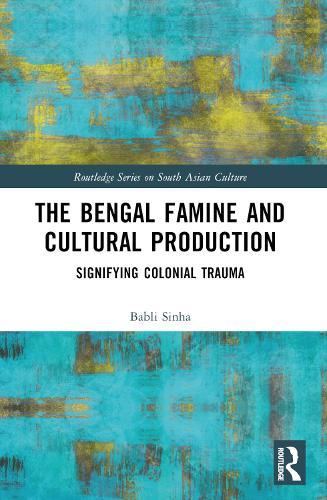
The Bengal Famine and Cultural Production: Signifying Colonial Trauma

Author:   Babli Sinha (Kalamazoo College, USA)
Publisher:   Taylor & Francis Ltd
ISBN:  

9781032370200


Pages:   156
Publication Date:   28 November 2024
Format:   Paperback
Availability:   In Print   Availability explained
This item will be ordered in for you from one of our suppliers. Upon receipt, we will promptly dispatch it out to you. For in store availability, please contact us.

Our Price $81.99 Quantity:  
Add to Cart

Share |

The Bengal Famine and Cultural Production: Signifying Colonial Trauma


Overview

The Bengal Famine and Cultural Production: Signifying Colonial Trauma analyses the various modes of representation used by Anglophone authors and artists in response to the Bengal Famine of 1943. Official imperial narratives blamed the famine on natural disaster, war, exploitation by merchants, and incompetent local officials rather than members of the imperial government and have remained dominant in the global public imaginary until recent years. The authors and artists referenced in this study appealed to elite Bengali, South Asian, and international audiences to resist imperial narratives that minimized or erased suffering and instead encouraged relief efforts, promoted nationalist movements, maintained collective memory, innovated ethical forms of representation, and prompted systemic change. They were part of an established tradition of English in the subcontinent as the language of empire and cosmopolitanism but are not accessible, widely taught, or well-known. The direct encounter with suffering was and remains insufficient for prompting systemic change or even engagement, and yet, the recognition of trauma is crucial for personal and collective well-being. The cultural production of famine writers and artists sought to integrate the suffering and agency of the destitute into narratives of Bengali and South Asian identity and of the Second World War. It is crucial to the Humanities to recognize this body of work as a cultural counter-discourse to the biopower of empire and to engage these texts as relevant to theories of trauma. The book will be of interest to researchers in the field of South Asian history, the history of the Bengal famine, South Asian Anglophone literature, twentieth century art history, and trauma theory.

Full Product Details

Author:   Babli Sinha (Kalamazoo College, USA)
Publisher:   Taylor & Francis Ltd
Imprint:   Routledge
Weight:   0.260kg
ISBN:  

9781032370200


ISBN 10:   1032370203
Pages:   156
Publication Date:   28 November 2024
Audience:   College/higher education ,  Professional and scholarly ,  Tertiary & Higher Education ,  Professional & Vocational
Format:   Paperback
Publisher's Status:   Active
Availability:   In Print   Availability explained
This item will be ordered in for you from one of our suppliers. Upon receipt, we will promptly dispatch it out to you. For in store availability, please contact us.

Table of Contents

Reviews

Author Information

Babli Sinha is Associate Professor of English and Director of Media Studies at Kalamazoo College, USA. She is the author of Cinema, Transnationalism, and Colonial India: Entertaining the Raj (2013) and editor of South Asian Transnationalisms: Cultural Exchange in the Twentieth Century (2012), also published by Routledge.

Tab Content 6

Author Website:  

Countries Available

All regions
Latest Reading Guide

RGFEB26


Shopping Cart
Your cart is empty
Shopping cart
Mailing List