Overview
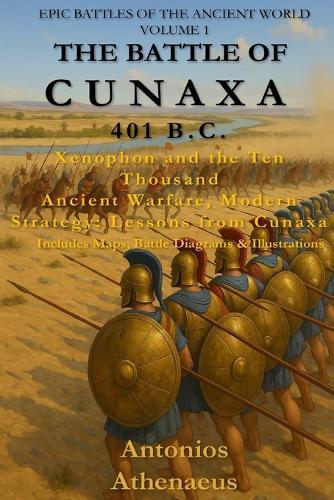
At Cunaxa, the Greeks won the battle-and lost everything else. In 401 B.C., deep inside the Persian Empire, a disciplined Greek force shattered a numerically superior enemy. Minutes later, their patron was dead, their mission collapsed, and ten thousand men stood victorious, leaderless, and surrounded. The Battle of Cunaxa is not remembered because it was clean or glorious, but because it exposed a brutal truth of warfare: tactical success means nothing if strategy fails. This book examines the Battle of Cunaxa as a decisive case study in Ancient Military History, leadership under uncertainty, and command without authority. Based on Xenophon's Anabasis, it reconstructs the campaign of Cyrus the Younger and the confrontation with Artaxerxes II, while focusing on what most narratives avoid-the consequences of victory when command collapses and survival becomes the mission. The Greek mercenaries known as the Ten Thousand are analyzed not as heroic adventurers, but as a military system under extreme stress. Their discipline, cohesion, and battlefield performance are measured against the structural weaknesses of the Persian army, revealing why Greek infantry dominated tactically-and why that dominance could not secure strategic success. Rather than retelling events, this volume breaks the battle down into decisions, formations, leadership failures, and moments of irreversible choice. Spartan hoplites, peltasts, Persian cavalry, and the Immortals are examined as operational tools, not legends. Maps, battle diagrams, and illustrations support a clear and grounded analysis of how Cunaxa unfolded and why it mattered. The aftermath-the march of the Ten Thousand across hostile territory-is treated as one of the earliest and most revealing leadership crises in recorded history. No king. No employer. No safe route home. What followed was not retreat, but adaptive command in its rawest form. Ancient events are connected to enduring strategic thought through careful comparison with thinkers such as Clausewitz, Sun Tzu, and André Beaufre. These parallels are not decorative; they clarify why Cunaxa remains relevant to modern discussions of leadership, mission command, and operational resilience. The Battle of Cunaxa is written for readers of military history, classical studies, leadership, and strategy who want more than narrative. It is for those who want to understand how wars are decided when plans collapse, leaders fall, and discipline is all that remains. This volume opens the Epic Battles of the Ancient Worldseries with a battle that proves one enduring lesson: winning is easy. Surviving the consequences is not.
Full Product Details
Author: Antonios Athenaeus
Publisher: Independently Published
Imprint: Independently Published
Dimensions:
Width: 15.20cm
, Height: 1.20cm
, Length: 22.90cm
Weight: 0.304kg
ISBN: 9798266628274
Pages: 224
Publication Date: 22 September 2025
Audience:
General/trade
,
General
Format: Paperback
Publisher's Status: Active
Availability: Available To Order

We have confirmation that this item is in stock with the supplier. It will be ordered in for you and dispatched immediately.