Overview
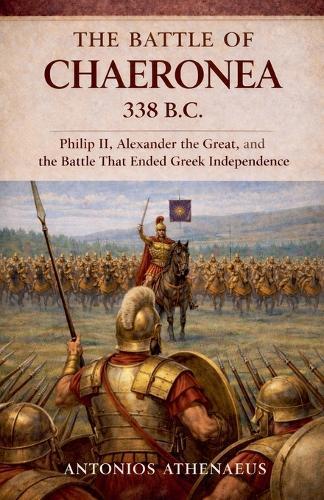
At Chaeronea, the Greek world crossed a point of no return. In 338 B.C., on the plains of Boeotia, the armies of Athens, Thebes, and their allies confronted the rising power of Macedon. The Battle of Chaeronea was not simply a clash between opposing forces, but a confrontation between two fundamentally different ways of making war. It was shaped by preparation, command structure, and the ability to control events as the battlefield fractured, rather than by chance, numbers, or raw courage alone. This book examines the Battle of Chaeronea as the decisive moment that ended the era of autonomous Greek city-states and confirmed the emergence of Macedonian hegemony. Moving beyond heroic or moralized narratives, it analyzes the battle as a problem of command and systems under stress. The Macedonian army is treated as an integrated force built for flexibility, coordination, and exploitation, while the Greek coalition is examined as a brave but structurally divided system, vulnerable once cohesion began to erode. The study explores the strategic and political conditions that led to the confrontation, including Philip II's maneuver through Thessaly and Phocis, the occupation of Elateia, and the forced alignment of Athens and Thebes in a coalition born of necessity rather than unity. Particular emphasis is placed on the challenges of coalition warfare: divided leadership, uneven operational expectations, and the difficulty of maintaining control once the tempo of battle accelerates. At the tactical level, the analysis focuses on Philip's management of space and timing on the Macedonian right, the deliberate stretching of the Athenian line, and the creation of exploitable gaps within the allied formation. The role of Alexander on the Macedonian left is examined not as legend, but as command action at a critical moment, exploiting opportunity rather than creating it in isolation. The Macedonian phalanx is analyzed as a stabilizing and fixing instrument, while the Sacred Band of Thebes is treated as a disciplined elite force whose destruction carried both tactical and symbolic weight. The battle is reconstructed step by step, showing how localized advances, misinterpretation, and loss of coordination translated into systemic collapse. Victory at Chaeronea is presented not as a sudden shock, but as the cumulative outcome of sustained pressure, initiative, and superior command coherence. The book is supported by detailed maps, battlefield diagrams, and illustrated reconstructions that clarify movements, formations, and decision points. It also places Chaeronea within a broader framework of strategic thought, drawing on theorists such as Sun Tzu, Clausewitz, Jomini, and André Beaufre to demonstrate why the battle remains relevant to discussions of leadership, deception, initiative, and command under pressure. The Battle of Chaeronea is written for readers of military history, ancient warfare, leadership, and strategy who seek analysis rather than myth. It is a study of how wars are decided not only by those who fight bravely, but by those who understand how control is gained, maintained, and ultimately lost.
Full Product Details
Author: Antonios Athenaeus
Publisher: Antonios Athenaeus
Imprint: Antonios Athenaeus
Volume: 1
Dimensions:
Width: 14.00cm
, Height: 1.20cm
, Length: 21.60cm
Weight: 0.249kg
ISBN: 9798233797576
Pages: 210
Publication Date: 10 February 2026
Audience:
General/trade
,
General
Format: Paperback
Publisher's Status: Active
Availability: Available To Order

We have confirmation that this item is in stock with the supplier. It will be ordered in for you and dispatched immediately.
Author Information
Antonis Athenaeus is a Greek military officer and author with a lifelong dedication to history and strategy. Drawing on both his professional experience and academic background, he brings ancient battles to life through vivid narrative and modern strategic analysis. He is the creator of the series Epic Battles of the Ancient World, where each volume explores a decisive clash of antiquity and the timeless lessons of leadership and resilience that still resonate today.