Overview
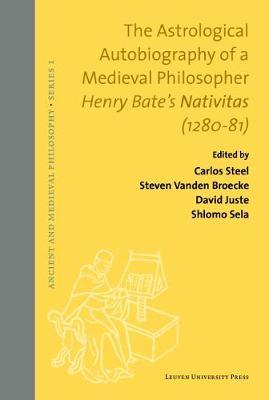
The present book reveals the riches of the earliest known astrological autobiography, authored by Henry Bate of Mechelen (1246-after 1310). Exploiting all resources of contemporary astrological science, Bate conducts in his Nativitas a profound self-analysis, revealing the peculiarities of his character and personality at a crucial moment of his life (1280). The result is an extraordinarily detailed and penetrating attempt to decode the fate of one's own life and its idiosyncrasies. The Astrological Autobiography of a Medieval Philosopher offers the first critical edition of Bate's Nativitas. An extensive introduction presents Bate's life and work and sheds new light on the reception and use of Greek, Latin, Arabic, and Hebrew texts among scholars in Paris at the end of the 13th century. The book thus provides a major new resource for scholars working on medieval science, autobiography, and notions of personhood and individuality. This publication is GPRC-labeled (Guaranteed Peer-Reviewed Content).
Full Product Details
Author: Carlos Steel ,
Steven Vanden Broecke ,
David Juste ,
Shlomo Sela
Publisher: Leuven University Press
Imprint: Leuven University Press
Volume: 17
Dimensions:
Width: 15.60cm
, Height: 2.00cm
, Length: 23.40cm
Weight: 0.585kg
ISBN: 9789462701557
ISBN 10: 9462701555
Pages: 304
Publication Date: 27 November 2018
Recommended Age: From 18 years
Audience:
College/higher education
,
Postgraduate, Research & Scholarly
Format: Hardback
Publisher's Status: Active
Availability: In Print

This item will be ordered in for you from one of our suppliers. Upon receipt, we will promptly dispatch it out to you. For in store availability, please contact us.
Language: Latin, English
Reviews
It would require an undue amount of space to list all of the aspects that make this edition of Bate’s Nativitasan arresting source for anyone interested in medieval intellectual and cultural history. Most importantly, perhaps, the book subtly undermines facile clichés about the nature of medieval astrology and in their place gives us a glimpse of the inner workings of the art, revealing an occasionally stunning degree of complexity and psychological depth. C. Philipp E. Nothaft, Journal for the History of Astronomy, Volume 50 Issue 2, May 2019, https://doi.org/10.1177/0021828619834390 This is the first complete Latin edition of Bate's Nativitas, and it is an impressive scholarly achievement whose depths can only be hinted at in this review. Not only have the editors produced the definitive edition of Bate's text, they have also written what amounts to a separate monograph to contextualize it.Justin Lake, Bryn Mawr Classical Review 2019.09.58 'The Astrological Autobiography of a Medieval Philosopher' offers the first critical edition of Bate’s 'Nativitas'. An extensive introduction presents Bate’s life and work and sheds new light on the reception and use of Greek, Latin, Arabic, and Hebrew texts among scholars in Paris at the end of the 13th century. The book thus provides a major new resource for scholars working on medieval science, autobiography, and notions of personhood and individuality.Studi Medievali 2019, II Die insgesamt äußerst sorgfältige Edition macht damit einen Text verfügbar, der eine Vielzahl von Einblicken in die Welt des späten 13. Jahrhunderts eröffnet. Auch jenseits der Forschung zur Geschichte der Astrologie ist dem Werk daher uneingeschränkt eine breite Rezeption zu wünschen. Klaus Oschema, The Medieval Review 20.04.06 Bate’s rich treatise touches on more themes than the editorial team could begin to address; I flagged several passages to which I wish to return in my own work on astrology and prophecy. For all of these reasons, 'The Astrological Autobiography of a Medieval Philosopher' is a real gift, for which scholars will long remain in the editors’ debt. Laura Ackerman Smoller, Isis—Volume 111, Number 3, September 2020 Cette publication de la Nativitas, l’autobiographie astrologique du savant et philosophe Henri Bate de Malines (1246 – après 1310), un texte unique en son genre, représente un événement attendu depuis près d’un siècle avec la publication, en 1924, d’un article du grand historien des sciences Aleksander Birkenmajer, qui résumait sa thèse sur Henri Bate, restée inédite. Le présent volume, issu de la collaboration entre quatre chercheurs de renom, vient donc combler un vide important, dont on comprend très bien qu’il ait duré si longtemps, considérant l’extrême difficulté de la matière. Jean-Patrice Boudet, Mittellateinisches Jahrbuch 56,1 (2021) Das Buch ist ein schönes Beispiel dafür, was in Kooperation erreichbar ist – es handelt sich um eine mustergültige Edition, die man sich für so manchen astrologischen Quellentext wünschen würde. Günther Oestmann, Deutsches Archiv für Erforschung des Mittelalters, 77. Jahrgang, Heft 1, 2021
Author Information
Steven Vanden Broecke is associate professor in the History Department of Ghent University. Carlos Steel is emeritus professor of ancient and medieval philosophy at KU Leuven and director of the ""Aristoteles Latinus"" project. David Juste is research leader of the project Ptolemaeus Arabus et Latinus at the Bavarian Academy of Sciences and Humanities (Munich). Shlomo Sela is emeritus professor at the department of Jewish Thought at Bar- Ilan University (Tel Aviv).