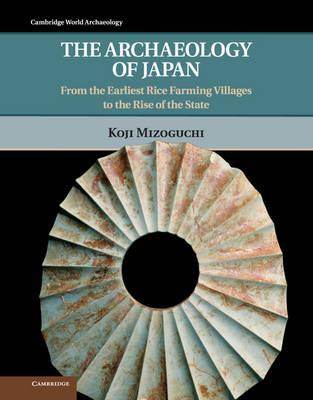
The Archaeology of Japan: From the Earliest Rice Farming Villages to the Rise of the State

Author:   Koji Mizoguchi
Publisher:   Cambridge University Press
ISBN:  

9780521884907


Pages:   392
Publication Date:   25 November 2013
Format:   Hardback
Availability:   Manufactured on demand   Availability explained
We will order this item for you from a manufactured on demand supplier.

Our Price $282.04 Quantity:  
Add to Cart

Share |

The Archaeology of Japan: From the Earliest Rice Farming Villages to the Rise of the State


Overview

This is the first book-length study of the Yayoi and Kofun periods of Japan (c.600 BC–AD 700), in which the introduction of rice paddy-field farming from the Korean peninsula ignited the rapid development of social complexity and hierarchy that culminated with the formation of the ancient Japanese state. The author traces the historical trajectory of the Yayoi and Kofun periods by employing cutting-edge sociological, anthropological and archaeological theories and methods. The book reveals a fascinating process through which sophisticated hunter-gatherer communities in an archipelago on the eastern fringe of the Eurasian continent were transformed materially and symbolically into a state.

Full Product Details

Author:   Koji Mizoguchi
Publisher:   Cambridge University Press
Imprint:   Cambridge University Press
Dimensions:   Width: 21.30cm , Height: 2.80cm , Length: 28.20cm
Weight:   1.190kg
ISBN:  

9780521884907


ISBN 10:   052188490
Pages:   392
Publication Date:   25 November 2013
Audience:   Professional and scholarly ,  College/higher education ,  Professional & Vocational ,  Tertiary & Higher Education
Format:   Hardback
Publisher's Status:   Active
Availability:   Manufactured on demand   Availability explained
We will order this item for you from a manufactured on demand supplier.

Table of Contents

1. Introduction: the beginning of everything?; 2. A tale of co-transformation: the history of modern Japan and the archaeology of the Yayoi and Kofun periods; 3. Frameworks; 4. Environment and the East Asian context; 5. Beginnings: from the Incipient Yayoi (900/600 BC) to the Late Yayoi I periods (400/200 BC); 6. An archaeology of growth: from the Final Yayoi I (400/200 BC) to the end of the Yayoi IV (AD 1/50); 7. An archaeology of hierarchisation: from the final Yayoi IV to the Yayoi V periods (AD 1/50~200); 8. An archaeology of networks: the Yayoi–Kofun transition (the Shonai pottery style and the earliest Furu pottery style phase, AD 200~250/275); 9. An archaeology of monuments: the Early Kofun (AD 275~400) and Middle Kofun periods (AD 400~500); 10. An archaeology of bureaucracy: the Later Kofun period (AD 500~600); 11. An archaeology of governance: the establishment of the Ten'no emperor (AD 600~700); 12. Conclusion.

Reviews

Author Information

Koji Mizoguchi is Professor of Social Archaeology at the Graduate School of Social and Cultural Studies, Kyushu University, Japan. He is the author of An Archaeological History of Japan: 30,000 BC to AD 700 (2002) and Archaeology, Society and Identity in Modern Japan (Cambridge, 2006). Dr Mizoguchi is regarded as a leading Japanese archaeologist, particularly in the study of the Yayoi period and mortuary archaeology. His many contributions to scholarly journals focus on the postcolonial archaeologies of East Asia with special emphasis on Japan, the relationship between modernisation and the disciplinisation of archaeology, and the study of the centralisation and hierarchisation of social relations by using formal network analysis methods.

Tab Content 6

Author Website:  

Countries Available

All regions
Latest Reading Guide

April RG 26_2


Shopping Cart
Your cart is empty
Shopping cart
Mailing List