Full Product Details
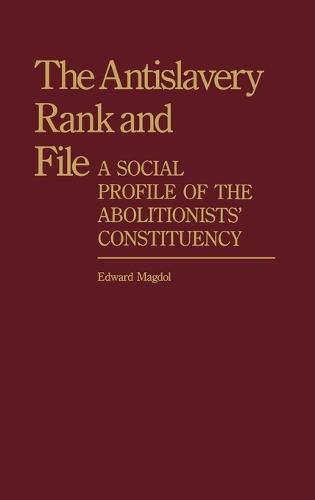
Author: Edward Magdol
Publisher: Bloomsbury Publishing Plc
Imprint: Praeger Publishers Inc
Volume: no. 117
Dimensions:
Width: 15.60cm
, Height: 1.20cm
, Length: 23.40cm
Weight: 0.446kg
ISBN: 9780313247231
ISBN 10: 0313247234
Pages: 188
Publication Date: 17 September 1986
Recommended Age: From 7 to 17 years
Audience:
College/higher education
,
General/trade
,
Undergraduate
,
General
Format: Hardback
Publisher's Status: Active
Availability: Manufactured on demand

We will order this item for you from a manufactured on demand supplier.
Reviews
Magdol, author of earlier studies of Owen Lovejoy (1967) and the freedmen's community (1977), died shortly before the completion of this study, which was readied for publication by his widow and a friend-colleague. Four chapters provide background. Four others analyze northeasterners (from selected communities) who joined antislavery societies or signed antislavery petitions during the 1830s, or who supported anti-Kansas-Nebraska Act petitions during 1854. These group studies shed light on the social and economic characteristics of the antislavery rank and file. In one instance, their partisan affiliations are illuminated as well, though the communities from which they sprang are not always evaluated. A final chapter offers the author's conclusions. One of the two appendixes deals with scholarship on antislavery supporters, the other with Magdol's methods. Such is the balance between the gnernal and the specific in this book that it will most likely appeal to upper-division undergraduates and graduate students. -Choice ?Magdol, author of earlier studies of Owen Lovejoy (1967) and the freedmen's community (1977), died shortly before the completion of this study, which was readied for publication by his widow and a friend-colleague. Four chapters provide background. Four others analyze northeasterners (from selected communities) who joined antislavery societies or signed antislavery petitions during the 1830s, or who supported anti-Kansas-Nebraska Act petitions during 1854. These group studies shed light on the social and economic characteristics of the antislavery rank and file. In one instance, their partisan affiliations are illuminated as well, though the communities from which they sprang are not always evaluated. A final chapter offers the author's conclusions. One of the two appendixes deals with scholarship on antislavery supporters, the other with Magdol's methods. Such is the balance between the gnernal and the specific in this book that it will most likely appeal to upper-division undergraduates and graduate students.?-Choice
?Magdol, author of earlier studies of Owen Lovejoy (1967) and the freedmen's community (1977), died shortly before the completion of this study, which was readied for publication by his widow and a friend-colleague. Four chapters provide background. Four others analyze northeasterners (from selected communities) who joined antislavery societies or signed antislavery petitions during the 1830s, or who supported anti-Kansas-Nebraska Act petitions during 1854. These group studies shed light on the social and economic characteristics of the antislavery rank and file. In one instance, their partisan affiliations are illuminated as well, though the communities from which they sprang are not always evaluated. A final chapter offers the author's conclusions. One of the two appendixes deals with scholarship on antislavery supporters, the other with Magdol's methods. Such is the balance between the gnernal and the specific in this book that it will most likely appeal to upper-division undergraduates and graduate students.?-Choice