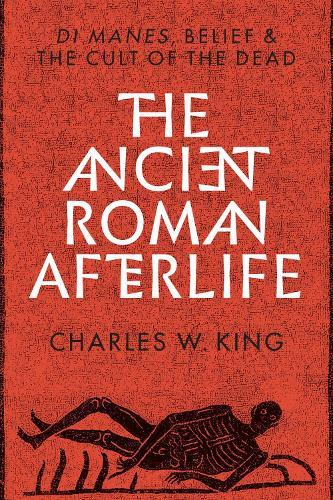
The Ancient Roman Afterlife: Di Manes, Belief, and the Cult of the Dead

Author:   Charles W. King
Publisher:   University of Texas Press
ISBN:  

9781477320204


Pages:   300
Publication Date:   28 April 2020
Format:   Hardback
Availability:   In Print   Availability explained
This item will be ordered in for you from one of our suppliers. Upon receipt, we will promptly dispatch it out to you. For in store availability, please contact us.

Our Price $145.20 Quantity:  
Add to Cart

Share |

The Ancient Roman Afterlife: Di Manes, Belief, and the Cult of the Dead


Overview

Full Product Details

Author:   Charles W. King
Publisher:   University of Texas Press
Imprint:   University of Texas Press
Dimensions:   Width: 15.20cm , Height: 3.00cm , Length: 22.90cm
Weight:   0.594kg
ISBN:  

9781477320204


ISBN 10:   1477320202
Pages:   300
Publication Date:   28 April 2020
Audience:   Professional and scholarly ,  Professional & Vocational
Format:   Hardback
Publisher's Status:   Active
Availability:   In Print   Availability explained
This item will be ordered in for you from one of our suppliers. Upon receipt, we will promptly dispatch it out to you. For in store availability, please contact us.

Table of Contents

Abbreviations of Ancient Authors Abbreviations of Journals and Modern Editions Acknowledgments Preface A) The Afterlife: Interpretive Issues B) The Primacy of the Manes 1: Di Manes: The Godhood of the Dead A) Manes: A General Definition B) The Term Di Manes C) The Manes and Roman Categories of “Gods” 2: Di Manes: The Number of the Gods A) The Plural Form Manes B) The Worship of Individuals C) The Chronology of Worshipping Individuals D) The Manes of Dis Manibus 3: Who Worshipped Whom? A) The Complex Legacy of Fustel de Coulanges B) Inheritance 1. Scaevola’s Rules 2. Coruncanius’ Rules 3. The Digest C) Inheritance Rules and the Diversity of Worship D) Pietas, Affection, and Loyalty 1. Familial Relationships 2. Extensions of One’s Family 3. The Political “Family” E) Contemporary Focus (and Elite Exceptions) F) Inclusiveness 4: The Manes in the Context of Roman Religion: Beliefs and Variations A) Variation: A Challenge to Interpretation B) The Debate over Defining the Word “Belief” C) Roman Implications of Nondogmatic Belief 1. Polymorphism 2. Pietas: Collective and Individual Relationships 3. Orthopraxy D) An Interpretive Model: Belief Clusters 5: The Powers of the Dead A) Power over Life and Death 1. Guardians of the Living—Benefits for Individuals a. The Extension of Life b. Clusters within Clusters 2) Guardians of the Living—Benefits for the Community a. The Mundus b. The Lupercalia 3) Bringers of Death a. Instruments of Vengeance b. Destroyers of Armies and Cities B) The Power to Monitor the Living 1. Guardians of Oaths 2. Voices from Beyond C) Protectors after Death D) Powers and Worshippers 6: The Manes in the Context of the Funeral A) Ritual Conservatism and the Potential for Generalization B) The Funerary Ritual: Early Stages through the Cremation C) The Afterlife in the Early Stages D) At the Grave: Rites of Worship 1. Dis Manibus Sacrum: A Point of Terminology 2. Creating Sacred Space and Offerings to the Manes 3. The Liberation of the Dead 4. After the Sacrifices E) The Manes at the Funeral 7: Festivals, Ceremonies, and Home Shrines A) The Parentalia 1. Ovid as a Source 2. The Ceremony B) The Lemuria 1. The Ritual Form 2. Belief Cluster: Manes and Lemures C) Personal Observances 1. Home Shrines 2. Further Offerings at the Tomb 3. Lifestyle and Nonritual Offerings D) Rituals: Conclusions 8: Conclusion Appendix 1: The Larvae Appendix 2: The Decline of the Lemuria Notes Bibliography General Index Index Locorum

Reviews

[An] excellent monograph...This book is absolutely essential reading for anyone working on ancient afterlife belief or on Roman funerary custom and the cult of the dead...A truly excellent piece of scholarship. * The Classical Review * [A] groundbreaking monograph...It will be an invaluable resource for scholars of religion, funerary practice and afterlife in ancient Rome and more generally...King aims to use his model of variability in Roman belief to show the cult of the dead as inclusive of all Romans, living and deceased. Through extensive literary evidence and select cross-cultural comparisons, he largely succeeds. This stands to become a foundational text. * Antiquity *


[A] groundbreaking monograph...It will be an invaluable resource for scholars of religion, funerary practice and afterlife in ancient Rome and more generally...King aims to use his model of variability in Roman belief to show the cult of the dead as inclusive of all Romans, living and deceased. Through extensive literary evidence and select cross-cultural comparisons, he largely succeeds. This stands to become a foundational text. * Antiquity *


[A] groundbreaking monograph...It will be an invaluable resource for scholars of religion, funerary practice and afterlife in ancient Rome and more generally...King aims to use his model of variability in Roman belief to show the cult of the dead as inclusive of all Romans, living and deceased. Through extensive literary evidence and select cross-cultural comparisons, he largely succeeds. This stands to become a foundational text. * Antiquity * [An] excellent monograph...This book is absolutely essential reading for anyone working on ancient afterlife belief or on Roman funerary custom and the cult of the dead...A truly excellent piece of scholarship. * The Classical Review *


Author Information

Charles W. King is an associate professor of history at the University of Nebraska–Omaha with a PhD in Roman history from the University of Chicago.

Tab Content 6

Author Website:  

Countries Available

All regions
Latest Reading Guide

NOV RG 20252


Shopping Cart
Your cart is empty
Shopping cart
Mailing List