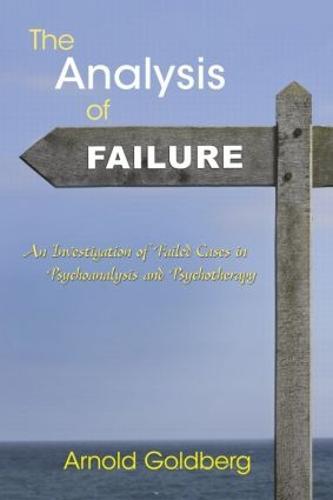
Full Product Details
Author: Arnold Goldberg (Chicago Institute for Psychoanalysis, Illinois, USA)
Publisher: Taylor & Francis Ltd
Imprint: Routledge
Dimensions:
Width: 15.20cm
, Height: 1.50cm
, Length: 22.90cm
Weight: 0.400kg
ISBN: 9780415893039
ISBN 10: 0415893038
Pages: 244
Publication Date: 23 August 2011
Audience:
College/higher education
,
Professional and scholarly
,
Tertiary & Higher Education
,
Professional & Vocational
Format: Paperback
Publisher's Status: Active
Availability: In Print

This item will be ordered in for you from one of our suppliers. Upon receipt, we will promptly dispatch it out to you. For in store availability, please contact us.
Reviews
Arnold Goldberg has succeeded in writing an illuminating account of a study of a very difficult subject: failure. Its organizing principle is that everything matters. It is beautifully written, philosophically sophisticated, and clinically wise. He confronts the unpleasant and the uncomfortable head-on and demands honesty of himself and all the participants in the study. This book is essential reading for every psychotherapist and psychoanalyst. It deserves a place chairside of the novitiate as well as the most experienced practitioner. - Arnold Richards, M.D., Training and Supervising Analyst, New York Psychoanalytic Institute Arnold Goldberg concludes this absorbing new volume on analytic and therapeutic failures by declaring that the book itself is a failure. After all, there is no agreed upon definition of failure or success, so how can one judge which treatments are disappointing? I came to a different conclusion than Goldberg's--I found this exploration of treatment failures to be an impressive success. By entering this heart of darkness, the graveyard of analytic casualties where no clinician really wants to go, the author guides us through the major controversies within psychoanalysis today: the challenge of comparing one approach to another, the disparity between therapist and patient goals, the privileging of theory over outcome, and the impossibility of reaching consensus on what constitutes a success. I found this a riveting discourse on the state of contemporary psychoanalysis, and I recommend it equally to neophytes in the field and to experienced psychoanalysts. - Glen O. Gabbard, M.D., author, Love and Hate in the Analytic Setting (2000) A pioneer can extend a clearing in a forest only by working at the edge of darkness. Beware this book for it will make you think, and think about the dark edges of clinical experience, those places not lit by the flickering light of overgrown theories and those times when analytic inquiry fails. In this essential and liberating work, Goldberg, with his characteristic incisiveness and clarity, demonstrates how relentless inquiry into its clinical dark side can rekindle analytic enlightenment. As analytic work can help an individual overcome the constriction of hidden fears, Goldberg provides a model, one replete with many clinical examples, of how uncompromising examination of failures can help the field of analysis itself grow. Goldberg shows how analysis can restore its progress beyond parochial polemics, how through exploration of its own disappointing experiences it can know its limits and thus better know its strengths. Here be not dragons; here promise lies. - Warren S. Poland, M.D., author, Melting the Darkness (1996)
Arnold Goldberg has succeeded in writing an illuminating account of a study of a very difficult subject: failure. Its organizing principle is that everything matters. It is beautifully written, philosophically sophisticated, and clinically wise. He confronts the unpleasant and the uncomfortable head-on and demands honesty of himself and all the participants in the study. This book is essential reading for every psychotherapist and psychoanalyst. It deserves a place chairside of the novitiate as well as the most experienced practitioner. - Arnold Richards, M.D., Training and Supervising Analyst, New York Psychoanalytic Institute
Arnold Goldberg has succeeded in writing an illuminating account of a study of a very difficult subject: failure. Its organizing principle is that everything matters. It is beautifully written, philosophically sophisticated, and clinically wise. He confronts the unpleasant and the uncomfortable head-on and demands honesty of himself and all the participants in the study. This book is essential reading for every psychotherapist and psychoanalyst. It deserves a place chairside of the novitiate as well as the most experienced practitioner. - Arnold Richards, M.D., Training and Supervising Analyst, New York Psychoanalytic Institute Arnold Goldberg concludes this absorbing new volume on analytic and therapeutic failures by declaring that the book itself is a failure. After all, there is no agreed upon definition of failure or success, so how can one judge which treatments are disappointing? I came to a different conclusion than Goldberg's--I found this exploration of treatment failures to be an impressive success. By entering this heart of darkness, the graveyard of analytic casualties where no clinician really wants to go, the author guides us through the major controversies within psychoanalysis today: the challenge of comparing one approach to another, the disparity between therapist and patient goals, the privileging of theory over outcome, and the impossibility of reaching consensus on what constitutes a success. I found this a riveting discourse on the state of contemporary psychoanalysis, and I recommend it equally to neophytes in the field and to experienced psychoanalysts. - Glen O. Gabbard, M.D., author, Love and Hate in the Analytic Setting (2000)
Author Information
Arnold Goldberg, M.D., is a Training and Supervising Analyst at the Chicago Institute for Psychoanalysis, where he was the Director from 1989-1992, and the Cynthia Oudejans Harris Professor of Psychiatry at Rush Medical College. The author of numerous articles and reviews, he was the editor of The Annual of Psychoanalysis from 1988-1991 and Progress in Self Psychology from 1985-2002, and has written or edited 30 books. He was the recipient of the Sigourney Award in 2006 for distinguished contributions in the field of psychoanalysis.