|
|
|||
|
||||
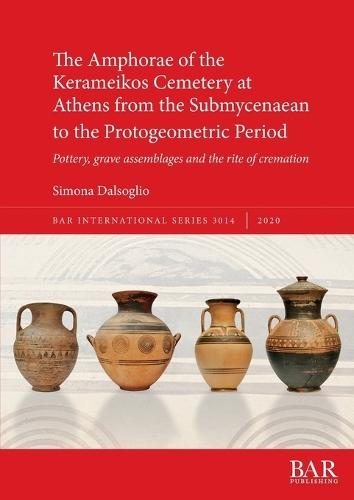
OverviewThe amphorae dating from the Submycenaean to the end of the Protogeometric period, brought to light in the Kerameikos cemetery, represent a high quality sample of Athenian output of the shape; this is due to their belonging to intact, archaeologically significant contexts. These vessels, usually employed as cinerary urns in the 'trench-and-hole' tombs, can be found also as grave goods or among the debris of the pyre offerings. The amphorae in this volume are re-examined with the help of new drawings and by adopting the 'envelope' method for their comparison. It has thus proven possible to recognise several typological groups, and to collect information about the process of standardisation of the vases and the organisation of the production process. Moreover, analytical reviews of the burials containing the amphorae and of the physical placing of the grave and pyre goods within the tomb shed new light on the cremation rite performed and on the connections between Athens and other sites employing a similar ritual. Undertaken with the assistance of the Institute for Aegean Prehistory. Full Product DetailsAuthor: Simona DalsoglioPublisher: BAR Publishing Imprint: BAR Publishing Weight: 0.941kg ISBN: 9781407315676ISBN 10: 1407315676 Pages: 236 Publication Date: 26 November 2020 Audience: Professional and scholarly , Professional & Vocational Format: Paperback Publisher's Status: Active Availability: Available To Order We have confirmation that this item is in stock with the supplier. It will be ordered in for you and dispatched immediately. Table of ContentsList of Plates List of Tables Preface 1. Introduction 1.1. Research methodology 1.2. Chapters 2. The Kerameikos Early Cemetery 2.1. History of research 2.2. Tomb types 2.2.1. Inhumation: cist grave, slab-covered pit, pit grave, shaft grave 2.2.2. Cremation: urn burial and ash pit 2.3. Burial grounds 2.4. The relative sequence of the graves from the Submycenaean to the Protogeometric period: state of research 2.4.1. The cemetery on the north bank of the Eridanos river (Pompeion cemetery) 2.4.2. The cemetery on the south bank of the Eridanos river (Agia Triada cemetery and Sacred Way graves) 2.5. The absolute chronologies 2.5.1. Submycenaean 2.5.2. The length of the Submycenaean and its absolute chronologies 2.5.3. Transitional and Protogeometric 2.5.4. The length of the Transitional and Protogeometric periods and their absolute chronologies 3. The Amphorae 3.1. Amphorae in context: as urn-vase, as grave equipment, in pyre refuse, as grave marker 3.1.1. The amphora-urn and the gender of the dead 3.2. State of research on the typological series 3.2.1. Belly-handled amphorae 3.2.2. Neck-handled amphorae 3.2.3. Rim-handled amphorae 3.2.4. Shoulder-handled amphorae 3.2.5. Methodological problems 3.3. A proposal for a new typology 3.3.1. Belly-handled amphorae 3.3.2. Neck-handled amphorae 3.3.3. Rim-handled amphorae 3.3.4. Shoulder-handled amphorae 3.4. Decorative motifs 3.5. Some observations on the clay 3.6. Concluding remarks 3.7. Catalogue of the amphorae 4. Graves with Amphorae 4.1. Spatial analysis of the objects in the grave 4.2. Osteological data 4.3. Cluster analysis and funerary variability 4.4. The sequence of the burials with amphorae 4.4.1. The amphorae from the Great Mound G 4.4.2. Stray finds 5. Burning the Dead 5.1. The rite of cremation: a re-examination of the archaeological aspects and literary evidence 5.2. Early cremations in Athens: a comparison with the evidence from Perati and Salamis 5.3. On the origin and the diffusion of the cremation burial rite in the Aegean: a reappraisal 6. Conclusions Abbreviations Bibliography Illustrations Sources and Credits PlatesReviewsAuthor InformationSimona Dalsoglio holds a PhD in Archaeology from the Università degli Studi di Napoli 'L'Orientale', in joint supervision with the Georg-August-Universität Göttingen. Her main research interests are in the fields of pottery, funerary archaeology and the supply of water. Tab Content 6Author Website:Countries AvailableAll regions |
||||