Overview
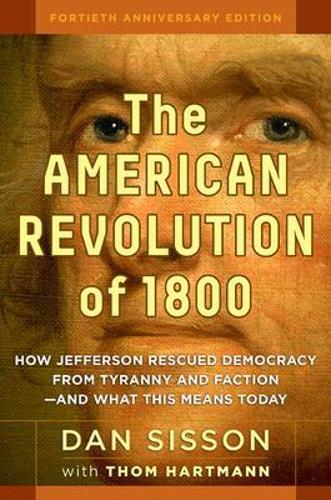
An insightful assessment of Jefferson's defeat of Adams in the 1800 election, and how it represented a blow against elitism and authoritarianism. In this brilliant historical classic, Dan Sisson provides the definitive window into key concepts that have formed the backdrop of our democracy- the nature of revolution, stewardship of power, liberty, and the ever-present danger of factions and tyranny. Most contemporary historians celebrate Jefferson's victory over Adams in 1800 as the beginning of the two-party system, but Sisson believes this reasoning is entirely the wrong lesson. Jefferson saw his election as a peaceful revolution by the American people overturning an elitist faction that was stamping out cherished constitutional rights and trying to transform our young democracy into an authoritarian state. If anything, our current two-party system is a repudiation of Jefferson's theory of revolution and his earnest desire that the people as a whole, not any faction or clique, would triumph in government. Sisson's book makes clear that key ideas of the American Revolution did not reach their full fruition until the ""Revolution of 1800,"" to which we owe the preservation of many of our key rights. With contributions by Thom Hartmann that bring out the book's contemporary relevance, this fortieth anniversary edition contains new insights and reflections on how Jefferson's vision can help us in our own era of polarization, corruption, government overreach, and gridlock.
Full Product Details
Author: Dan Sisson ,
Thom Hartmann
Publisher: Berrett-Koehler
Imprint: Berrett-Koehler
Edition: 40th
Dimensions:
Width: 6.50cm
, Height: 1.10cm
, Length: 9.60cm
Weight: 0.001kg
ISBN: 9781609949853
ISBN 10: 1609949854
Pages: 312
Publication Date: 15 September 2014
Audience:
Professional and scholarly
,
Professional & Vocational
Format: Hardback
Publisher's Status: Active
Availability: In Print

This item will be ordered in for you from one of our suppliers. Upon receipt, we will promptly dispatch it out to you. For in store availability, please contact us.
Reviews
Practical Thomas Jefferson thought big thoughts about periodic revolutions against tyranny and concentrated power to abuse the people. His relevance now, as Dan Sisson s book and Thom Hartmann s commentary inspire, connects with the entrenching deteriorations and deprivations of today s America. To heed Jefferson s wisdom is to call for another mindful revolution at the ballot box and in the civil arena, which can come from the determined hands of we the people. Ralph Nader Since I grew up in Lexington, the birthplace of the Revolution, it s always a thrill to hear retold the story of the ideas that animated our forebears. They are ideas that in the time of the Koch brothers we need held up for all to see. Bill McKibben, President, 350.org, and author of The End of Nature Deepening inequalities economic, political, and cultural drive growing appetites for systemic change. Thinking turns again toward revolution when piecemeal reforms prove too difficult and rare and when those we do achieve prove vulnerable and temporary. Our rethinking of revolution can learn valuable lessons from Dan Sisson s classic about the last time revolution was on America s agenda. Richard D. Wolff, Professor of Economics Emeritus, University of Massachusetts Amherst Through this deep dive into early US history, Hartmann and Sisson draw our attention to a crucial distinction between a politics of ideas in search of liberty and prosperity for all and one centered on a factional competition for power. David Korten, Board Chair, YES! Magazine, and author of When Corporations Rule the World This is a fascinating account of our country s early history that has clear relevance to the politics of today. Dean Baker, Codirector, Center for Economic and Policy Research, and coauthor of Getting Back to Full Employment Practical Thomas Jefferson thought big thoughts about periodic revolutions against tyranny and concentrated power to abuse the people. His relevance now, as Dan Sisson's book and Thom Hartmann's commentary inspire, connects with the entrenching deteriorations and deprivations of today's America. To heed Jefferson's wisdom is to call for another mindful revolution at the ballot box and in the civil arena, which can come from the determined hands of we the people. --Ralph Nader Since I grew up in Lexington, the birthplace of the Revolution, it's always a thrill to hear retold the story of the ideas that animated our forebears. They are ideas that--in the time of the Koch brothers--we need held up for all to see. --Bill McKibben, President, 350.org, and author of The End of Nature Deepening inequalities--economic, political, and cultural--drive growing appetites for systemic change. Thinking turns again toward revolution when piecemeal reforms prove too difficult and rare and when those we do achieve prove vulnerable and temporary. Our rethinking of revolution can learn valuable lessons from Dan Sisson's classic about the last time revolution was on America's agenda. --Richard D. Wolff, Professor of Economics Emeritus, University of Massachusetts Amherst Through this deep dive into early US history, Hartmann and Sisson draw our attention to a crucial distinction between a politics of ideas in search of liberty and prosperity for all and one centered on a factional competition for power. --David Korten, Board Chair, YES! Magazine, and author of When Corporations Rule the World This is a fascinating account of our country's early history that has clear relevance to the politics of today. --Dean Baker, Codirector, Center for Economic and Policy Research, and coauthor of Getting Back to Full Employment
Practical Thomas Jefferson thought big thoughts about periodic revolutions against tyranny and concentrated power to abuse the people. His relevance now, as Dan Sisson's book and Thom Hartmann's commentary inspire, connects with the entrenching deteriorations and deprivations of today's America. To heed Jefferson's wisdom is to call for another mindful revolution at the ballot box and in the civil arena, which can come from the determined hands of we the people. --Ralph Nader Since I grew up in Lexington, the birthplace of the Revolution, it's always a thrill to hear retold the story of the ideas that animated our forebears. They are ideas that--in the time of the Koch brothers--we need held up for all to see. --Bill McKibben, President, 350.org, and author of The End of Nature Deepening inequalities--economic, political, and cultural--drive growing appetites for systemic change. Thinking turns again toward revolution when piecemeal reforms prove too difficult and rare and when those we do achieve prove vulnerable and temporary. Our rethinking of revolution can learn valuable lessons from Dan Sisson's classic about the last time revolution was on America's agenda. --Richard D. Wolff, Professor of Economics Emeritus, University of Massachusetts Amherst Through this deep dive into early US history, Hartmann and Sisson draw our attention to a crucial distinction between a politics of ideas in search of liberty and prosperity for all and one centered on a factional competition for power. --David Korten, Board Chair, YES! Magazine, and author of When Corporations Rule the World This is a fascinating account of our country's early history that has clear relevance to the politics of today. --Dean Baker, Codirector, Center for Economic and Policy Research, and coauthor of Getting Back to Full Employment
Author Information
Dan Sisson is an adjunct faculty member at Eastern Washington University and teaches the history of technology in the Engineering Department. He is currently living in a nearly full-sized replica of Jefferson's Monticello he built himself near Ford, Washington. Thom Hartmann is a progressive talk-show host whose radio and television shows are available in over a half-billion homes. He's a four-time Project Censored award winner and a New York Times bestselling author of twenty-four books, most recently, The Crash of 2016.