Overview
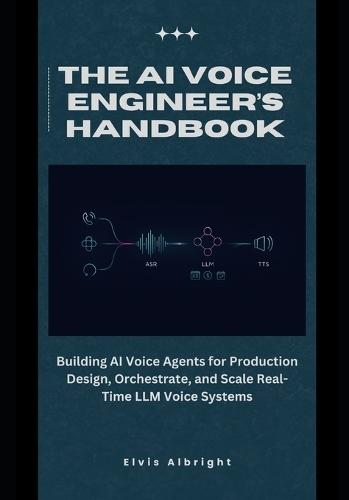
The AI Voice Engineer's Handbook is a practical field guide to designing, building, and operating production-grade AI voice agents. You'll learn how to connect telephony and WebRTC, stream ASR to LLMs, speak naturally with neural TTS, and keep everything fast, safe, and affordable-without hand-waving. It's equal parts architecture, code, and playbooks you can use on Monday. This book is written for practitioners who ship. Every chapter includes runnable snippets, Kubernetes/Compose blueprints, SSML patterns, evaluation suites, cost dashboards, and incident runbooks. You'll see how to set latency budgets, enforce privacy, handle barge-in, and harden guardrails-plus the trade-offs we'd make when money or milliseconds are on the line. About the Technology: You'll work across the modern voice stack: Media & Telephony: SIP, RTP/SRTP, jitter buffers, WebRTC (STUN/TURN), PSTN gateways. AI Core: Streaming ASR, LLM planning with tool/function calling, RAG, structured outputs. Speech Synthesis: Neural TTS with SSML, prosody control, chunked synthesis, and predictive pre-rolls. Platform: Kubernetes autoscaling, tracing (OpenTelemetry), canary rollouts, multi-region failover, cost & compliance controls. What's Inside: Production-ready pipelines: Telephony/WebRTC → ASR → LLM/Tools → TTS Latency engineering: concurrent streaming, backpressure, hedging, graceful degradation Dialog management: prompt orchestration, interruption-aware planning, determinism controls Safety & privacy: consent flows, PII redaction, encryption, auditing, policy gates Tools & RAG: idempotent APIs, caching, grounding, structured enterprise outputs (CRM, ticketing, payments) Ops: CI/CD, rollouts, incident response, SLOs, postmortems, domain playbooks (support, booking, outbound, internal ops) Cost control: unit economics, token/latency trade-offs, budget alerting Appendices packed with templates: prompts, schemas, SSML, Helm/Compose, troubleshooting runbooks Who this book is for: Voice/ML Engineers building real-time agents Backend & Platform Engineers owning infra, scaling, and observability Product Managers & Tech Leads defining requirements and SLAs Solutions & DevOps teams deploying multi-tenant, multi-region stacks Beginner to advanced: if you can deploy a web service and read TypeScript/YAML, you're ready. Voice interactions are moving from novelty to front-door customer experiences. Teams that master real-time LLM voice this quarter will shape expectations-and win the next RFPs-while others play catch-up. One avoided outage, one halved latency curve, or one trimmed token bill can pay for the book many times over. The included templates, prompts, policies, and Helm/Compose files save weeks of trial-and-error and reduce risk on every release. Build the voice agent your customers deserve. Grab your copy of The AI Voice Engineer's Handbook today and ship a fast, safe, and scalable real-time voice system-confidently and on schedule.
Full Product Details
Author: Elvis Albright
Publisher: Independently Published
Imprint: Independently Published
Dimensions:
Width: 17.00cm
, Height: 2.10cm
, Length: 24.40cm
Weight: 0.630kg
ISBN: 9798276389646
Pages: 398
Publication Date: 27 November 2025
Audience:
General/trade
,
General
Format: Paperback
Publisher's Status: Active
Availability: Available To Order

We have confirmation that this item is in stock with the supplier. It will be ordered in for you and dispatched immediately.