Overview
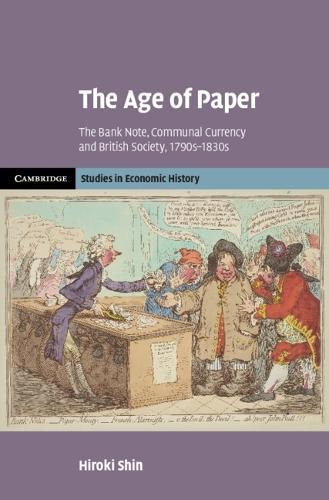
In the first detailed examination of Britain's transition to paper currency, Hiroki Shin explores how state, nation and community each played their respective role in its introduction. By examining archival materials and personal accounts, Shin's work sheds fresh light on societal, institutional, communal and individual responses to the transformation. The dominance of communal currency during the Bank Restriction period (1797–1821) demonstrates how paper currency derived its value from the community of users rather than the state or the intrinsic value of precious metal. Shin traces the expanded use of the Bank of England note – both geographically and socially – in this period, revealing the economic and social factors that accelerated this shift and the cultural manifestations of the paper-based monetary regime, from everyday politics to bank-note forgeries. This book serves as an essential resource for those interested in understanding the modern monetary system's historical origins.
Full Product Details
Author: Hiroki Shin (University of Birmingham)
Publisher: Cambridge University Press
Imprint: Cambridge University Press
ISBN: 9781009503273
ISBN 10: 1009503278
Pages: 332
Publication Date: 02 January 2025
Audience:
General/trade
,
General
Format: Hardback
Publisher's Status: Active
Availability: Manufactured on demand

We will order this item for you from a manufactured on demand supplier.
Reviews
'Technically assured and intellectually ambitious, Hiroki Shin has given us in The Age of Paper a fascinating account of a unique era in British financial history – an account that, to his book's huge benefit, embraces the broader political, social and cultural dimensions as well as the more narrowly economic.' David Kynaston, author of 'Till Time's Last Sand: A History of the Bank of England, 1694–2013' 'A fascinatingly written account of how the Bank of England note became Britain's most important currency. Erudite and thought-provoking, Shin opens up, and challenges, key debates about the experience and acceptance of paper money. A 'must read' for all scholars of the long eighteenth century.' Anne Murphy, author of 'Virtuous Bankers' 'The author eloquently communicates and cogently analyses everything there is to learn about this seminal episode in British monetary history and theory.' Patrick Karl O'Brien, author of 'The Economies of Imperial China and Western Europe: Debating the Great Divergence' 'This book offers valuable insights into the transformative forces shaping the history of Britain during the Bank Restriction period and beyond, shedding light on the transition to paper currency and its enduring impact. I highly recommend it.' Nuno Palma, University of Manchester
Author Information
Hiroki Shin is Associate Professor in the School of History and Cultures at the University of Birmingham. His research focuses on the evolution of the modern economic system.