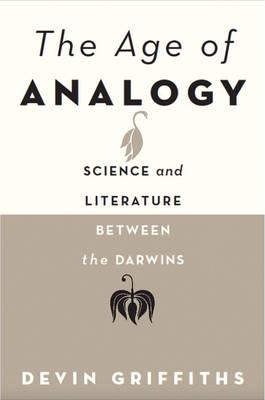
Full Product Details
Author: Devin Griffiths (University of Southern California)
Publisher: Johns Hopkins University Press
Imprint: Johns Hopkins University Press
Dimensions:
Width: 15.20cm
, Height: 2.90cm
, Length: 22.90cm
Weight: 0.612kg
ISBN: 9781421420769
ISBN 10: 1421420767
Pages: 352
Publication Date: 23 December 2016
Audience:
Professional and scholarly
,
Professional & Vocational
Format: Hardback
Publisher's Status: Active
Availability: Out of stock

The supplier is temporarily out of stock of this item. It will be ordered for you on backorder and shipped when it becomes available.
Reviews
This is a serious, detailed, and convincing account with few unexplored avenues... Recommended. All academic levels/libraries. Choice Recommended. Choice The Age of Analogy represents a valuable contribution to scholarship on literature and science. Building on the established models of new historicism and of Gillian Beer's foundational work on Darwinism, it nonetheless offers something new by asking researchers in this field to think more carefully about the kinds of historicism that operate both in their own work and in nineteenth-century literary and scientific writing Review of English Studies For those interested in either of the intertwined histories of literature and science -- or in what we might more generously call the intellectual culture of the 1780s through the 1850s -- Griffiths' book is both readable and richly rewarding. Review 19 This ambitious work should shape future thinking about historicism, science and literature in the nineteenth century and beyond in new and significant ways. Griffiths deserves to be congratulated on having achieved this and, in the process, on having written some of the best recent criticism on Charles Darwin and George Eliot in particular, which is no mean feat in itself. British Society for Literature and Science
This is a serious, detailed, and convincing account with few unexplored avenues... Recommended. All academic levels/libraries. Choice Recommended. Choice The Age of Analogy represents a valuable contribution to scholarship on literature and science. Building on the established models of new historicism and of Gillian Beer's foundational work on Darwinism, it nonetheless offers something new by asking researchers in this field to think more carefully about the kinds of historicism that operate both in their own work and in nineteenth-century literary and scientific writing Review of English Studies
This is a serious, detailed, and convincing account with few unexplored avenues... Recommended. All academic levels/libraries. Choice
Author Information
Devin Griffiths, a former biologist who studied artificial evolution, is an assistant professor of English at the University of Southern California.