Overview
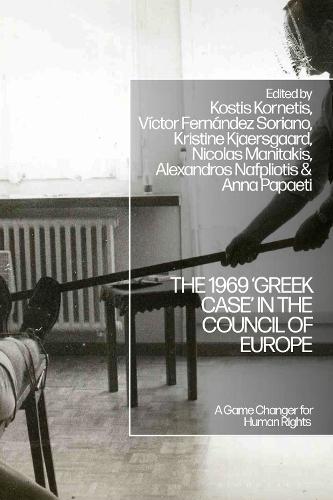
In 1969 Greece withdrew from the Council of Europe (CoE), following pressure exercised by various European countries, organisations, social movements and individuals in response to the brutal conduct of the military junta that had taken power by force on 21 April 1967. This volume brings together an international cast of noted historians, oral historians, political scientists, and legal scholars to investigate the perceptions, policies and roles of the key actors involved. These figures range from international organizations, states, and social movements to NGOs and individuals, critically demonstrating the extent of the legacy and long-term impact of the ‘Greek Case’ on international human rights. The 1969 ‘Greek Case’ in the Council of Europe reveals how the pressure applied by the Council of Europe proved to be crucial for the international condemnation of the Colonels’ regime, setting a precedent in international human rights cases for the significance of the collection of evidence on the use of torture.
Full Product Details
Author: Dr Kostis Kornetis (utonomous University of Madrid, Spain) , Dr Víctor Fernández Soriano (Université Libre de Bruxelles, Belgium) , Associate Professor Kristine Kjaersgaard (University of Southern Denmark, Denmark) , Associate Professor Nicolas Manitakis (University of Athens, Greece)
Publisher: Bloomsbury Publishing PLC
Imprint: Bloomsbury Academic
Dimensions:
Width: 15.60cm
, Height: 2.50cm
, Length: 23.40cm
Weight: 0.454kg
ISBN: 9781350296572
ISBN 10: 1350296570
Pages: 312
Publication Date: 19 March 2026
Audience:
Professional and scholarly
,
College/higher education
,
Professional & Vocational
,
Tertiary & Higher Education
Format: Paperback
Publisher's Status: Forthcoming
Availability: Manufactured on demand 
Table of Contents
Introduction Part 1 - The Applicant States versus the Greek Junta 1. The Scandinavian Complaints, Hanne Hagtvedt Vik (University of Oslo, Norway) and Kristine Kjærsgaard (University of Southern Denmark, Denmark) 2. From Reluctance to Acceptance: The Netherlands, the Greek Case, and the Boomerang Effect of the Convention, Wiebe Hommes (Amsterdam Centre for European Law and Governance, The Netherlands) 3. Greece as Cause in Danish Public Opinion and Politics, Mogens Pelt (University of Copenhagen, Denmark) Part 2 - The International Impact of the Greek Case 4. The Greek Case in the Council of Europe and the Role of West, Germany Dimitrios K. Apostolopoulos (Academy of Athens, Greece) 5. Human Rights and Colonels Lies. The Italian Perspective, Rigas Raftopoulos (Roma Tre University, Italy) 6. The Impact of the Greek Case on Francoist Spain, Magda Fytili (Hellenic Open University, Greece) 7. The European Community and the Greek Case, Ronald Janse (Open University of the Netherlands) Part 3 - Anti-Junta Resistance and the Greek Case 8. The Greek Case in the Context of the Cold War, Stan Draenos (Independent Scholar, Greece) 9. The Greek Case at Strasbourg: The Battle for Witnesses, Nicolas Manitakis (University of Athens, Greece) 10. Reconstituting the Networks: Anti-Dictatorial Correspondence on the Greek Case through the ASKI Collections, Antonis Sarantidis (University of Athens, Greece) Part 4 - International Institutions and Solidarity Movements 11. Amnesty International and the Greek Crisis of 1967-8, Tom Buchanan (University of Oxford, UK) 12. Europe’s Vietnam? International Solidarity Movements against the Greek Junta from a Global Perspective, Kim Christiaens (University of Leuven, Belgium) 13. The Greek Case from Inside, Janis Nalbadidacis (Humboldt University, Germany) 14. Activists without Borders: Transnational Campaigning during the ‘Greek Case’, 1967-69, Konstantina Maragkou (London School of Economics, UK) 15. From Greece to Argentina: Transnational Circulations of Torture and Anti-Torture in the Long Seventies, Víctor Fernández Soriano (Université Libre de Bruxelles, Belgium) & Kostis Kornetis (Autonomous University of Madrid, Spain) Part 5 - Torture, Terror, Testimony 16. The Greek Military Dictatorship and the Poisonous Knowledge of Torture and Trauma, Katerina Stefatos (Kalamazoo College, USA) & Georgia Sarigianidou-Papadopoulou (Former Junta Political Detainee) 17. The 'Greek Case' and its Legacy on the Definition of Torture, Anna Papaeti (National Hellenic Research Foundation, Greece) 18. The Lasting Impact of the “EAT/ESA” (Military Police Special Investigative Department) Trials upon the Jurisprudence of the Greek (Civil and Military) Criminal Courts, Sotiris Kyrkos (President of the Athens Military Court, Greece) 19. 'Maria's Story', James Becket (‘Greek Case’ Witness, Amnesty International Lawyer, and Author of Barbarism in Greece) 20. 'Except you don't know how I felt about it', Kostis Kornetis and Anna Papaeti Conclusion Index
Reviews
The volume’s significance lies in its publication in an era of increased democratic backsliding. A new generation could be attracted by and learn from the battles of previous generations. * CEU Review of Books * [A] game-changer … Contributions in this volume, focussing on the notable jurists and surviving victims as well as the critical perspectives presented countering an all-out celebration of the case, make it essential reading for activists, academics and adjudicators working at the nexus of ‘law and torture’. * Nordic Journal of International Law * This is a thought provoking, well researched, and exhaustive collection of a landmark case regarding human rights, the use of torture, and the development of European institutions and legal concepts as they emerged from the investigation and eventual withdrawal of Greece from the Council of Europe following the coup d’ etat of 1967 and the establishment of a military dictatorship. This is an essential volume for anyone interested in human rights and the campaign against the use of torture by state agents. * Evdoxios Doxiadis, Associate Professor, Simon Fraser University, Canada *
""The 1969 'Greek Case' in the Council of Europe is itself a game-changer - it sets a template for a multi-layered, personal and political, analysis and commentary on a legal decision ... Contributions in this volume, focussing on the notable jurists and surviving victims as well as the critical perspectives presented countering an all-out celebration of the case, make it essential reading for activists, academics and adjudicators working at the nexus of 'law and torture'."" --Nordic Journal of International Law
Author Information
Konstantinos (Kostis) Kornetis is Assistant Professor of Contemporary History at Autonomous University of Madrid, Spain. He is the author of Children of the Dictatorship (2013, winner of the Edmund Keeley Book Award) and co-editor of Rethinking Democratization in Spain, Greece and Portugal (2019). Víctor Fernández Soriano teaches global and contemporary history at the Université Libre de Bruxelles and ESPOL Lille. He has been an associate researcher at the University of Luxembourg and Humboldt University Berlin. He is the author of Le fusil et l'olivier. Les droits de l'Homme face aux dictatures méditerranéennes (2013). Kristine Kjaersgaard is Associate Professor in Contemporary History at University of Southern Denmark, Denmark. She has written books and articles on Denmark in international organisations. Nicolas Manitakis is Associate Professor in History at the University of Athens, Greece. He has co-edited a volume on the history of postwar Greek student migration to France. Alexandros Nafpliotis holds a PhD in International History from the London School of Economics and Political Science, UK, and has been a Research Associate at the Hellenic Foundation for European & Foreign Policy and the National Hellenic Research Foundation, as well as Maastricht University and the University of Luxembourg. He is the author of Britain and the Greek Colonels (2012). Anna Papaeti is a musicologist and researcher who has held a Marie Curie Fellowship at the University of Goettingen, Germany.
Tab Content 6
Author Website:
Countries Available
All regions
|