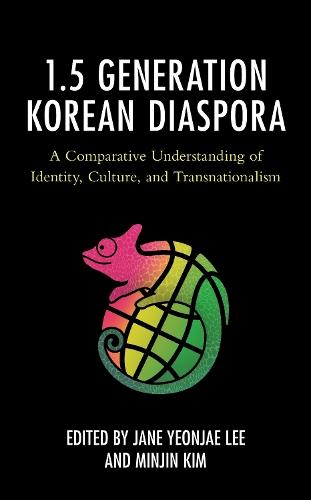
Full Product Details
Author: Jane Yeonjae Lee ,
Minjin Kim ,
Su Choe ,
Alicia Corts
Publisher: Bloomsbury Publishing Plc
Imprint: Lexington Books
Dimensions:
Width: 15.40cm
, Height: 1.60cm
, Length: 22.40cm
Weight: 0.322kg
ISBN: 9781793621139
ISBN 10: 1793621136
Pages: 210
Publication Date: 05 April 2023
Audience:
Professional and scholarly
,
Professional & Vocational
Format: Paperback
Publisher's Status: Active
Availability: Manufactured on demand

We will order this item for you from a manufactured on demand supplier.
Reviews
Editors Lee and Kim bring together research on 1.5 generation Koreans who immigrated to the US, New Zealand, Canada, and Argentina as children. Recognizing that there is no universal definition of the 1.5 generation, the editors broadly describe this group as children born in their home country who immigrated to another country with their first-generation parents, making them not quite first- or second-generation Korean. Chapters analyze the unique and complex diversity of 1.5 generation Koreans by exploring multiple components of this group through interviews and ethnographic research. Some themes include ethnic identity negotiations, love and marriage, parenthood, health care, and Korean churches.... This volume fills a significant gap in the research on the 1.5 generation Korean diaspora and paves the way for further research on this topic. It will be a valuable resource for readers studying sociology and migration, particularly within the Korean diaspora. Highly recommended. * Choice Reviews * An excellent, first of its kind collection of studies of the 1.5 generation Korean immigrants. Transnational Communities explores their cultural and identity clashes, as well as their struggles to become empowered as the “middle migrants” caught between their first generation immigrant parents and the mainstream society, and as the “transnational bridges” between Korea and their countries of residency. A well-organized, stimulating volume based on cutting-edge scholarship in the field, this is a must-read for anyone interested in Korean immigration. -- Gi-Wook Shin, Stanford University The authors of this edited book, mostly of the 1.5-generation Korean background, explore ethnic identity, Korean culture, and transnational ties to their homeland among 1.5-generation Koreans, respectively settled in the United States, Canada, New Zealand, and Argentina. Specializing in several different disciplines, they discuss these issues in connection with their disciplines, mother-daughter relationships, love and marriage, Korean churches, and health care. Almost all chapters, based on personal interviews and/or ethnographic research, provide readers with fascinating stories. This book is in no doubt an extremely significant contribution to studies of 1.5 generation Koreans. -- Pyong Gap Min, CUNY/Queens College
Editors Lee and Kim bring together research on 1.5 generation Koreans who immigrated to the US, New Zealand, Canada, and Argentina as children. Recognizing that there is no universal definition of the 1.5 generation, the editors broadly describe this group as children born in their home country who immigrated to another country with their first-generation parents, making them not quite first- or second-generation Korean. Chapters analyze the unique and complex diversity of 1.5 generation Koreans by exploring multiple components of this group through interviews and ethnographic research. Some themes include ethnic identity negotiations, love and marriage, parenthood, health care, and Korean churches.... This volume fills a significant gap in the research on the 1.5 generation Korean diaspora and paves the way for further research on this topic. It will be a valuable resource for readers studying sociology and migration, particularly within the Korean diaspora. Highly recommended. * Choice Reviews * An excellent, first of its kind collection of studies of the 1.5 generation Korean immigrants. Transnational Communities explores their cultural and identity clashes, as well as their struggles to become empowered as the middle migrants caught between their first generation immigrant parents and the mainstream society, and as the transnational bridges between Korea and their countries of residency. A well-organized, stimulating volume based on cutting-edge scholarship in the field, this is a must-read for anyone interested in Korean immigration. -- Gi-Wook Shin, Stanford University The authors of this edited book, mostly of the 1.5-generation Korean background, explore ethnic identity, Korean culture, and transnational ties to their homeland among 1.5-generation Koreans, respectively settled in the United States, Canada, New Zealand, and Argentina. Specializing in several different disciplines, they discuss these issues in connection with their disciplines, mother-daughter relationships, love and marriage, Korean churches, and health care. Almost all chapters, based on personal interviews and/or ethnographic research, provide readers with fascinating stories. This book is in no doubt an extremely significant contribution to studies of 1.5 generation Koreans. -- Pyong Gap Min, CUNY/Queens College
Author Information
Jane Yeonjae Lee is research associate in the Department of Geography at Kyung Hee University. Minjin Kim is assistant professor in the College of Nursing at University of Cincinnati.