Overview
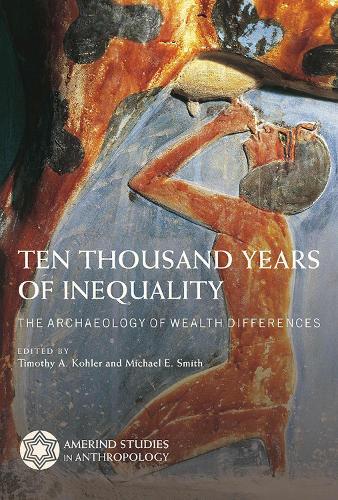
Is wealth inequality a universal feature of human societies, or did early peoples live an egalitarian existence? How did inequality develop before the modern era? Did inequalities in wealth increase as people settled into a way of life dominated by farming and herding? Why in general do such disparities increase, and how recent are the high levels of wealth inequality now experienced in many developed nations? How can archaeologists tell? Ten Thousand Years of Inequality addresses these and other questions by presenting the first set of consistent quantitative measurements of ancient wealth inequality. The authors are archaeologists who have adapted the Gini index, a statistical measure of wealth distribution often used by economists to measure contemporary inequality, and applied it to house-size distributions over time and around the world. Clear descriptions of methods and assumptions serve as a model for other archaeologists and historians who want to document past patterns of wealth disparity. The chapters cover a variety of ancient cases, including early hunter-gatherers, farmer villages, and agrarian states and empires. The final chapter synthesizes and compares the results. Among the new and notable outcomes, the authors report a systematic difference between higher levels of inequality in ancient Old World societies and lower levels in their New World counterparts. For the first time, archaeology allows humanity's deep past to provide an account of the early manifestations of wealth inequality around the world. Contributors: Nicholas Ames, Alleen Betzenhauser, Amy Bogaard, Samuel Bowles, Meredith S. Chesson, Abhijit Dandekar, Timothy J. Dennehy, Robert D. Drennan, Laura J. Ellyson, Deniz Enverova, Ronald K. Faulseit, Gary M. Feinman, Mattia Fochesato, Thomas A. Foor, Vishwas D. Gogte, Timothy A. Kohler, Ian Kuijt, Chapurukha M. Kusimba, Mary-Margaret Murphy, Linda M. Nicholas, Rahul C. Oka, Matthew Pailes, Christian E. Peterson, Anna Marie Prentiss, Michael E. Smith, Elizabeth C. Stone, Amy Styring, Jade Whitlam.
Full Product Details
Author: Timothy A. Kohler ,
Michael E. Smith
Publisher: University of Arizona Press
Imprint: University of Arizona Press
Dimensions:
Width: 15.20cm
, Height: 2.20cm
, Length: 22.80cm
Weight: 0.498kg
ISBN: 9780816539444
ISBN 10: 0816539448
Pages: 352
Publication Date: 28 February 2019
Audience:
Professional and scholarly
,
Professional & Vocational
Format: Paperback
Publisher's Status: Active
Availability: In Print

This item will be ordered in for you from one of our suppliers. Upon receipt, we will promptly dispatch it out to you. For in store availability, please contact us.
Reviews
The findings add to our knowledge of history's haves and have-nots, an urgent concern as the gulf between the one percent of ultra-rich and the rest of us continues to grow. --Archaeology of Wealth A rigorous and highly original contribution to the heated debates, both inside and outside the academy, on inequality, showing that archaeology can extend analysis across the entire planet and back through thousands of years. --Ian Morris, author of Foragers, Farmers, and Fossil Fuels: How Human Values Evolve
The findings add to our knowledge of history's haves and have-nots, an urgent concern as the gulf between the one percent of ultra-rich and the rest of us continues to grow. - Archaeology of Wealth A rigorous and highly original contribution to the heated debates, both inside and outside the academy, on inequality, showing that archaeology can extend analysis across the entire planet and back through thousands of years. - Ian Morris, author of Foragers, Farmers, and Fossil Fuels: How Human Values Evolve
The findings add to our knowledge of history's haves and have-nots, an urgent concern as the gulf between the one percent of ultra-rich and the rest of us continues to grow."""" - Archaeology of Wealth """"A rigorous and highly original contribution to the heated debates, both inside and outside the academy, on inequality, showing that archaeology can extend analysis across the entire planet and back through thousands of years."""" - Ian Morris, author of Foragers, Farmers, and Fossil Fuels: How Human Values Evolve
Author Information
Timothy A. Kohler is a regents professor of anthropology at Washington State University. His most recent book, edited with Mark D. Varien, is Emergence and Collapse of Early Villages: Models of Central Mesa Verde Archaeology. Michael E. Smith is a professor of archaeology at Arizona State University. His latest book is the prize-winning At Home with the Aztecs: An Archaeologist Uncovers Their Daily Life.