Overview
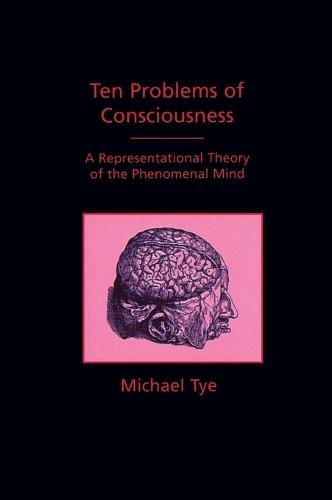
Can neurophysiology ever reveal to us what it is like to smell a skunk or to experience pain? In what does the feeling of happiness consist? How is it that changes in the white and gray matter composing our brains generate subjective sensations and feelings? These are several of the questions that Michael Tye addresses, while formulating a new and enlightening theory about the phenomenal ""what it feels like"" aspect of consciousness. The test of any such theory, according to Tye, lies in how well it handles ten critical problems of consciousness.Tye argues that all experiences and all feelings represent things, and that their phenomenal aspects are to be understood in terms of what they represent. He develops this representational approach to consciousness in detail with great ingenuity and originality. In the book's first part Tye lays out the domain, the ten problems and an associated paradox, along with all the theories currently available and the difficulties they face. In part two, he develops his intentionalist approach to consciousness. Special summaries are provided in boxes and the ten problems are illustrated with cartoons. A Bradford Book Representation and Mind series
Full Product Details
Author: Michael Tye (University of Texas) , Ned Block (New York University) , Hilary Putnam (Harvard University)
Publisher: MIT Press Ltd
Imprint: MIT Press
Edition: New edition
Dimensions:
Width: 15.00cm
, Height: 1.50cm
, Length: 22.60cm
Weight: 0.431kg
ISBN: 9780262700641
ISBN 10: 0262700646
Pages: 264
Publication Date: 22 January 1997
Recommended Age: From 18 years
Audience:
College/higher education
,
Professional and scholarly
,
Undergraduate
,
Postgraduate, Research & Scholarly
Format: Paperback
Publisher's Status: Inactive
Availability: Awaiting stock 
Table of Contents
Part 1 The ten problems - phenomenal consciousness introduced, the problem of ownership, the problem of perspectival subjectivity, the problem of mechanism, the problem of phenomenal causation, the problem of super blindsight, the problem of duplicates, the problem of the inverted spectrum, the problem of transparency, the problem of felt location and phenomenal vocabulary, the problem of the alien limb; why the problem run so deep - must the physical be objective? perspectival subjectivity and the explanatory gap, physicalism and phenomenal causation, on the denial of perspectival subjectivity, the paradox of phenomenal consciousness, the available strategies, the way ahead. Part 2 Can anyone else feel my pains? - the repudiation of phenomenal objects, publicising the phenomenal: split brains, phenomenal objects as events, a closer look at events; the intentionality of feelings and experiences - intentional states and intentional content, how perceptual sensations represent, afterimages, the problem of ownership revisited, pains, other bodily sensations, the format of sensory representations, background feelings, emotions, moods; what what it's like is really like - why be an intentionalist? phenomenal content: the PANIC theory, colours and other 'secondary qualities', can duplicate brains differ phenomenally? some putative counterexamples; the tale of Mary and mechanism - a theory of perspectival subjectivity - the real nature of the phenomenal, perspectival subjectivity and the paradox, Mary's room, some of Mary's philosophical relatives, the explanatory gap; can you really imagine what you think you can? - the status of the PANIC theory, imaginability of perceptions - a parallel, troublesome possibilities? zombie replicas and other duplicates, inverted experiences, inverted Earth. Appendices: blindsight - three sorts of visual agnosia; an empirical proposal.
Reviews
A fascinating account of the phenomenal aspects of consciousness. Clearly written, philosophically sophisticated, and scientifically informed..Tye's book develops a persuasive and, in many respects, original argument for the view that the qualitative side of our mental life is representational in nature. --Fred Dretske, Stanford University
""A fascinating account of the phenomenal aspects of consciousness.Clearly written, philosophically sophisticated, and scientificallyinformed..Tye's book develops a persuasive and, in many respects,original argument for the view that the qualitative side of ourmental life is representational in nature."" Fred Dretske, Stanford University
Author Information
Michael Tye is Professor of Philosophy at the University of Texas at Austin. He is the author of Ten Problems of Consciousness (1995), Consciousness, Color, and Content (2000), and Consciousness and Persons (2003), all published by the MIT Press.
Tab Content 6
Author Website:
Countries Available
All regions
|