Overview
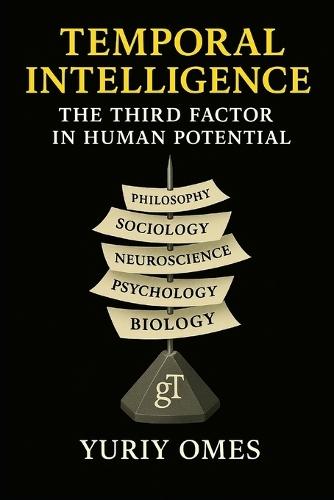
What if intelligence was never just about how smart you are in the moment - but about how far, and how coherently, you can think across time? Temporal Intelligence: The Third Factor in Human Potential argues that our usual story about intelligence is missing its most important dimension. We know how to measure fluid intelligence (gF) - pattern-finding and problem solving - and crystallized intelligence (gC) - what you have learned. Yet lives and institutions with similar gF and gC often diverge dramatically. Some build a coherent long arc; others cycle through crises and resets. This book proposes temporal intelligence (gT) as the ""third factor"" the operator that routes existing abilities through time. gT is not another motivational slogan or personality type. It is the architecture that: - manages rupture-reflection-synthesis (Δ-R-Σ) cycles; - tunes how far ahead we project consequences and care about them; - allocates trust between present comfort and future payoffs; - balances open revision of our models with the need for stable commitments. Drawing on predictive processing and active inference, the book treats the brain as a time machine that must constantly decide which signals to trust, which errors to ignore, and when to rethink its own models. Within this frame, it introduces: - the R₀-R₅ ladder as a compact map of how deeply we can reflect on our own minds and systems; - the I-You-We axis as the social architecture of gT, from individual trajectories to families, teams, and institutions; - Basic Calibration of Trust (BCT) as the slow, embodied prior that sets our real time horizon - how much we expect the world to ""hold"" if we invest in the future; - the ""warm default"" as the everyday state in which gT is quietly trained, in idle moments, sleep, and background simulation; - the Temporal Coherence Index (TCI) as a research program for measuring temporal intelligence without reducing it to a single score. Along the way, the book reframes familiar topics - time perspective, self-control, conscientiousness, delay of gratification, ""grit,"" anxiety, burnout, even genius - as different projections of gT and BCT. It offers a rigorous language for questions like: - Why do some high-IQ people still ruin their long-term prospects? - When does grit help, and when does it lock us into dead projects? - How do broken trust and chronic uncertainty compress our sense of the future? - What does it mean for therapy, education, leadership, or AI alignment to ""repair time"" instead of just changing thoughts or behaviors? Written in a clear, technically grounded register, Temporal Intelligence is the conceptual backbone of the broader ""Intelligence of Time"" series, which extends this framework to psychotherapy, education, ethics, civilization, and AI. It is aimed at readers who are comfortable with psychology and neuroscience, and who want a deeper, non-sentimental account of why ""being smart"" is not the same as building a life - or a system - that can stay coherent in time.
Full Product Details
Author: Omes Yuriy
Publisher: Independently Published
Imprint: Independently Published
Dimensions:
Width: 15.20cm
, Height: 1.10cm
, Length: 22.90cm
Weight: 0.290kg
ISBN: 9798276442310
Pages: 212
Publication Date: 27 November 2025
Audience:
General/trade
,
General
Format: Paperback
Publisher's Status: Active
Availability: Available To Order

We have confirmation that this item is in stock with the supplier. It will be ordered in for you and dispatched immediately.