Overview
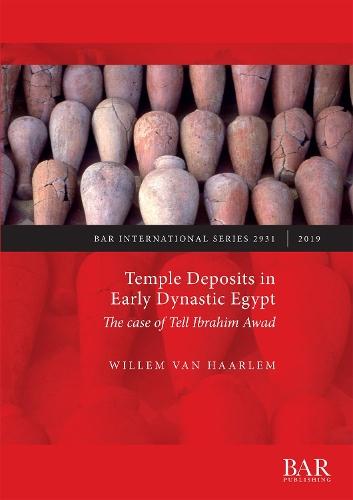
This book offers an extensive discussion of the several types of deposits (mainly consisting of votive objects like human and animal figures, model boats and shrines, mace heads and jewellery) found in the Early Dynastic temple of Tell Ibrahim Awad, in the Eastern Nile Delta of Egypt. The introduction presents a general description of the site, its geographical and historical context and a specific description of the successive temple layers (between 3300 and 1950 BC). This is followed by a detailed discussion of the votives themselves (material, production, meaning, ritual presentation) and other objects (ceramics, animal bones, lithic tools and temple decorations) found in the deposits, the rituals with which they were associated and comparisons with finds from other sites in Egypt and abroad (Syria/Palestine and Mesopotamia). Images and a detailed catalogue of the objects are also included in the volume.
Full Product Details
Author: Willem van Haarlem
Publisher: BAR Publishing
Imprint: BAR Publishing
Weight: 0.905kg
ISBN: 9781407353678
ISBN 10: 1407353675
Pages: 227
Publication Date: 31 May 2019
Audience:
Professional and scholarly
,
Professional & Vocational
Format: Paperback
Publisher's Status: Active
Availability: Available To Order 
We have confirmation that this item is in stock with the supplier. It will be ordered in for you and dispatched immediately.
Table of Contents
List of Figures List of Plates List of Tables Foreword Abbreviations Abstract Chapter 1. The Archaeological Framework and the Research Questions 1.1. Research Questions and Aims 1.2. Research Problems 1.3. Introduction to the Site 1.4. Research Context 1.4.1. Palaeo-ecology of the Region 1.4.2. Surveys and Excavations 1.5. The Structure of This Study Chapter 2. Excavations, Stratigraphy and Chronology 2.1. Introduction 2.2. The Physical Context 2.2.1. The Palaeogeography of the Region around Tell Ibrahim Awad 2.2.1.1. Nile Branches and Archaeological Sites of the Late Predynastic and Early Dynastic Periods (3200-2550 BC) 2.2.1.2. Nile Branches and Archaeological Sites of the Old Kingdom and the First Intermediate Period 2.2.1.3. Nile Branches and Archaeological Sites of the Middle Kingdom 2.3. The Excavations (see Figure 2.4) 2.3.1. Stratigraphy and Architecture 2.3.2. Identification of the Largest Construction in Area A as a Temple 2.3.3. The Cemetery and Settlement in Area A 2.3.3.1. The Cemetery in Area A 2.3.3.2. The Settlement in Area A 2.3.4. The Cemetery and Settlement in Area B 2.3.4.1. The Settlement in Area B 2.3.4.2. The Cemetery in Area B 2.3.5. Excursus: The Excavation Methods 2.3.5.1. Actual excavation 2.3.5.2. Recording Chapter 3. The Deposits 3.1. Introduction 3.2. Definitions 3.3. The Function of Offerings in General 3.3.1. Foundation Deposits 3.3.2. Offering Deposits (or Remains) 3.3.3. Votive Deposits 3.3.3.1. The Specific Function of Votive Offerings: Definitions 3.3.3.2. Function and Meaning 3.3.3.3. Appearance 3.4. Other General Aspects 3.4.1. The Donor 3.4.2. Presentation 3.4.3. The Recipient 3.5. The Deposits at Tell Ibrahim Awad 3.5.1. Descriptions of the Individual Deposits 3.5.2. Stray Objects (= Objects Found Outside a Deposit Context) 3.6. Summary 3.7. Chronological Considerations Chapter 4. The Votive Offerings 4.1. Introduction: 'Preformal' Temples and Culture 4.2. Identification of the Objects in the Deposits at Tell Ibrahim Awad as Votives 4.3. Categories 4.4. The Tell Ibrahim Awad Votive Offering Objects: Manufacture, Production and Distribution 4.4.1. Raw Materials and Manufacture 4.4.2. Production and Distribution 4.5. Other Specific Aspects: Storage and Eventual Disposal 4.5.1. Storage 4.5.2. Disposal 4.6. The Categories of Votive Offerings Found and Their Meaning 4.6.1. Human Figures (Cat. nos. 1-85, Plate 1-2 of the Catalogue) 4.6.2. Baboons (Cat. nos. 86-202; Figure 4.6) 4.6.3. Hippopotami (Cat. nos. 203-18, Plate 7) 4.6.4. Lions (Cat. nos. 219-26, Plate 8) 4.6.5. Antelopes (Cat. nos. 227-28, Plate 8) 4.6.6. Birds (Cat. nos. 232-41, Plate 9) 4.6.7. Crocodiles (Cat. nos. 242-74, Plate 10) 4.6.8. Frogs (Cat. nos. 275-276, Plate 9) 4.6.9. Boats (Cat. nos. 278-86, Plate 11) 4.6.10. Shrines (Cat. nos.287-96, Plates 12-13) 4.6.11. Gaming Pieces (Cat. nos. 297-321, Plate 14) 4.6.12. Natural Stones (Cat. nos. 393-418, Plate 18) 4.6.13. Jewellery (Cat. nos. 419-50, Plate 19) 4.6.14. Vessels (Cat. nos. 452-545, Plates 20-21) 4.7. Summary of the Chronological Considerations 4.8. The Recipient of Votive Offerings at Tell Ibrahim Awad 4.9. Comparisons with Other Sites: Egypt 4.9.1. Elephantine (Figure 4.9a-b) 4.9.2. Abydos (Figures 4.10-4.11) 4.9.3. Hierakonpolis (Figures 4.12-4.13) 4.9.4. Kofler-Truniger 'Site' (Figure 4.14) 4.9.5. Dahshûr 4.9.6. Saqqara 4.9.7. Armant 4.10. Comparisons with Other Sites: Syria / Palestine, Mesopotamia (Figure 4.15) 4.10.1. Byblos (Figure 4.16) 4.10.2. Ai (et-Tell) (Figure 7.6) 4.10.3. Nahariya (Figure 4.17) 4.10.4. 'En Besor 4.10.5. Tell Brak 4.10.6. Lachish 4.10.7. Other Sites with Temple Deposits 4.11. Summary 4.11.1. The Votive Objects: Egypt 4.11.1.1. Tell Ibrahim Awad 4.11.1.2. Other Sites 4.11.2. The Votive Objects: Abroad Chapter 5. Elements used in the Temple Ritual 5.1. Introduction 5.1.1. Mace Heads (Cat. nos. 349-392, Plates 16-17) 5.1.2. Flint Tools (Figures 5.1-5.2; van Haarlem/ Hikade 2006) 5.1.3. Pottery (Figure 5.4a-b) 5.1.3.1. Offering Stands (Cat. nos. 707-47, Plates 28-30) 5.1.3.2. Hes- (Libation) Vases (Cat. nos. 835-930, Plates 34-37) 5.1.3.3. Bowls (Cat. nos. 748-67, Plate 31) 5.1.3.4. 'Beer' Jars (Cat. nos. 768-91, Plate 38) 5.1.3.5. Other Vessels (Cat. nos. 792-834 and 931-55, Plates 32-33 / 38-39) 5.1.4. Animal Remains 5.2. Tentative Reconstruction of the Temple Ritual Chapter 6. Tiles and Inlays 6.1. Introduction 6.1.1. Tiles and Inlays at Tell Ibrahim Awad 6.1.2. Tile Marks 6.2. Parallels from Other Sites (Figure 6.1 and Table 6.2) 6.2.1. Abydos 6.2.2. Hierakonpolis (Quibell and Petrie 1900; Quibell and Green 1902; Adams 1999) 6.2.3. Elephantine (Dreyer 1986: 11-12) 6.3. Tentative Reconstruction of the Shrine at Tell Ibrahim Awad Chapter 7. Temple Deposits: Synthesis and Conclusions 7.1. Research Questions 7.1.1. The physical context of the deposits: the temple at Tell Ibrahim Awad (chapter two) 7.1.2. The deposits: formation process and spatial distribution (chapter three) 7.2. The deposit objects: functions 7.2.1. Votive objects (section 4.6) 7.2.2. Objects specifically used in the ritual (as a separate category, see chapter five and section 7.7.3) 7.2.3. Tiles and Inlays (chapter six) 7.3. The deposit objects in connection with ritual(s) 7.3.1. Votive objects 7.3.2. Ritual objects 7.3.3. Constructional elements (mainly tiles) 7.4. Wider context of the temple at Tell Ibrahim Awad 7.4.1. In Egypt 7.4.2. Outside Egypt 7.5. The Nature and Function of the temple at Tell Ibrahim Awad 7.6. Further implications of the results of this study 7.7. Future Research: an Outlook The Catalogue Concordance Excavation Numbers-Catalogue Numbers Bibliography Index
Reviews
The vast majority of the data presented is new, and it is all of the highest possible value to the subject area. '85 The book represents a very important contribution to knowledge in the field of Egyptology/Egyptian archaeology, as well as to the understanding of ancient complex societies in the broader sense. Prof. Mary-Ann Pouls Wegner, University of Toronto [This] material is of importance for Delta research and for provincial temples. It '85 [will] make a nice contribution for specialists in the field, but also for people interested in general votive activities in Egypt. Prof. Dr. Julia Budka, Ludwig Maximilian University of Munich
Author Information
Willem van Haarlem studied Egyptology at the University of Amsterdam. In 1989, he became Curator of the Egyptian Department of the Allard Pierson Museum in Amsterdam. From 1991 to 2014, he was director of the excavations at Tell Ibrahim Awad in Egypt. In 2014, he earned a PhD from the University of Leiden.
Tab Content 6
Author Website:
Countries Available
All regions
|