Overview
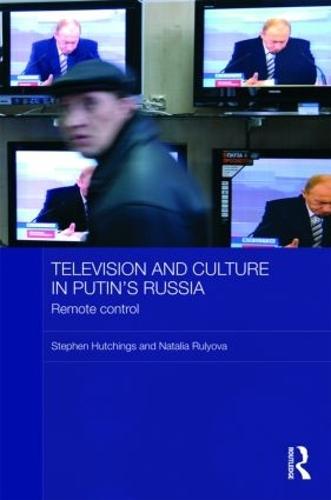
This book examines television culture in Russia under the government of Vladimir Putin. In recent years, the growing influx into Russian television of globally mediated genres and formats has coincided with a decline in media freedom and a ratcheting up of government control over the content style of television programmes. All three national channels (First, Russia, NTV) have fallen victim to Putin's power-obsessed regime. Journalists critical of his Chechnya policy have been subject to harassment and arrest; programmes courting political controversy, such as Savik Shuster's Freedom of Speech (Svoboda slova) have been taken off the air; coverage of national holidays like Victory Day has witnessed a return of Soviet-style bombast; and reporting on crises, such as the Beslan tragedy, is severely curtailed. The book demonstrates how broadcasters have been enlisted in support of a transparent effort to install a latter-day version of imperial pride in Russian military achievements at the centre of a national identity project over which, from the depths of the Kremlin, Putin's government exerts a form of remote control.However, central to the book's argument is the notion that because of the changes wrought upon Russian society after 1985, a blanket return to the totalitarianism of the Soviet media has, notwithstanding the tenor of much western reporting on the issue, not occurred. Despite the fact that television is nominally under state control, that control remains remote and less than wholly effective, as amply demonstrated in the audience research conducted for the book, and in analysis of contradictions at the textual level. Overall, this book provides a fascinating account of the role of television under President Putin, and will be of interest to all those wishing to understand contemporary Russian society.
Full Product Details
Author: Stephen Hutchings (University of Manchester, UK) ,
Natalia Rulyova (University of Birmingham, UK)
Publisher: Taylor & Francis Ltd
Imprint: Routledge
Weight: 0.660kg
ISBN: 9780415419079
ISBN 10: 0415419077
Pages: 272
Publication Date: 26 March 2009
Audience:
College/higher education
,
Undergraduate
,
Postgraduate, Research & Scholarly
Format: Hardback
Publisher's Status: Active
Availability: In Print

This item will be ordered in for you from one of our suppliers. Upon receipt, we will promptly dispatch it out to you. For in store availability, please contact us.
Reviews
'The most unconventional aspect of the book is that it addresses television not through the filter of the political, as is the case with analogous works, but from the standpoint of cultural studies and theories of cultural meaning. Hutchings and Rulyova also provide meticulous statistics on television programming in provincial cities as well as Moscow and St. Petersburg. Recommended.' - CHOICE, November 2009
Author Information
Stephen Hutchings is Chair in Russian Studies in the Department of Russian Studies, University of Manchester, UK. He is the author of Russian Literary Culture in the Camera Age: The World as Image (2004), and co-editor of Soviet and Post-Soviet Screen Adaptations of Literature: Screening the World (co-edited with Anat Vernistki, 2004), both published by Routledge. Natalia Rulyova is Lecturer in Russian at the Centre for Russian and East European Studies, University of Birmingham, UK.