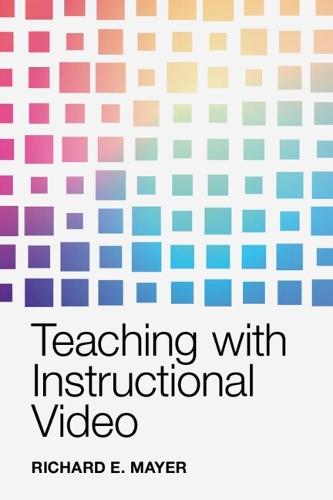
Teaching with Instructional Video

Author:   Richard E. Mayer (University of California, Santa Barbara)
Publisher:   Cambridge University Press
ISBN:  

9781009776684


Pages:   304
Publication Date:   21 May 2026
Format:   Hardback
Availability:   Not yet available, will be POD   Availability explained
This item is yet to be released. You can pre-order this item and we will dispatch it to you upon it's release. This is a print on demand item which is still yet to be released.

Our Price $98.32 Quantity:  
Pre-Order

Share |

Teaching with Instructional Video


Overview

Given the widespread usage of instructional video in both formal and informal education and training, there is a need to ensure what people are viewing can actually help them to learn. To address this gap, Teaching with Instructional Video takes an evidence-based approach that examines techniques that have been shown to improve learning from instructional videos. Featuring rich research evidence gleaned from rigorous scientific experiments alongside key theoretical contributions for cognitive and educational science, Richard E. Mayer describes practice-inspired methods to design effective instructional videos that enhance student learning. Written for educators and instructional designers as well as students and researchers across cognitive science, media communication, and educational theory, this book marks the latest example of the advances we are making in applying the science of learning to education.

Full Product Details

Author:   Richard E. Mayer (University of California, Santa Barbara)
Publisher:   Cambridge University Press
Imprint:   Cambridge University Press
Dimensions:   Width: 16.20cm , Height: 1.90cm , Length: 23.00cm
Weight:   0.640kg
ISBN:  

9781009776684


ISBN 10:   1009776681
Pages:   304
Publication Date:   21 May 2026
Audience:   General/trade ,  General
Format:   Hardback
Publisher's Status:   Forthcoming
Availability:   Not yet available, will be POD   Availability explained
This item is yet to be released. You can pre-order this item and we will dispatch it to you upon it's release. This is a print on demand item which is still yet to be released.

Table of Contents

About the author; Preface; Acknowledgements; Part I. Introduction: 1. Introduction to instructional video; 2. Historical foundations of instructional video; 3. Research methods for studying teaching with instructional video; 4. Theories of teaching with instructional video; Part II. Engage: Principles to Motivate Learners to Exert Effort to Learn: 5. Personalization principle: instructor uses conversational wording; 6. Voice principle: off-screen instructor speaks in an appealing human-sounding voice; 7. Embodiment principle: on-screen instructor draws while lecturing; 8. Perspective principle: demonstrations are recorded from a first-person perspective; 9. Positivity principle: on-screen instructor displays positive gestures and voice while lecturing; 10. Eye contact principle: on-screen instructor makes eye contact with the audience while lecturing; 11. Emotional design principle: key on-screen elements are visually appealing; Part III. Focus: Principles to Help Learners Focus on Relevant Information: 12. Simplicity principle: extraneous words and graphics are weeded out; 13. Visual signaling principle: instructor points to key visual elements while lecturing; 14. Caption principle: captions are added to a narrated video only under special circumstances; Part IV. Manage: Principles to Help Learners Manage the Flow of Relevant Information: 15. Segmenting principle: complex slides are presented by progressively adding parts; 16. Pretraining principle: names and characteristics of key terms are provided before the video; 17. Modality principle: words are spoken rather than printed; Part V. Connect: Principles to Help Learners Build Connections Between Corresponding Verbal and Visual Information: 18. Multimedia principle: video and narration are presented rather than narration alone; 19. Contiguity principle: printed text is placed next to the corresponding visual element; 20. Synchrony principle: attention is drawn to the visual element that the instructor's voice is talking about; Part VI. Assimilate: Principles to Help Learners Actively Make Sense of Incoming Information: 21. Notetaking principle: learners are prompted to take summary notes while viewing an instructional video; 22. Explaining principle: learners are prompted to generate verbal explanations during pauses in an instructional video; Part VII. Conclusion: 23. Summary of design principles for teaching with instructional video.

Reviews

Author Information

Richard E. Mayer is Distinguished Professor of Psychological and Brain Sciences at the University of California, Santa Barbara. Recognized as the world's most productive educational psychologist in Contemporary Educational Psychology, he is a recipient of the E. L. Thorndike Award for career achievement and the Scribner Award for outstanding research in learning and instruction.

Tab Content 6

Author Website:  

Countries Available

All regions
Latest Reading Guide

April RG 26_2


Shopping Cart
Your cart is empty
Shopping cart
Mailing List