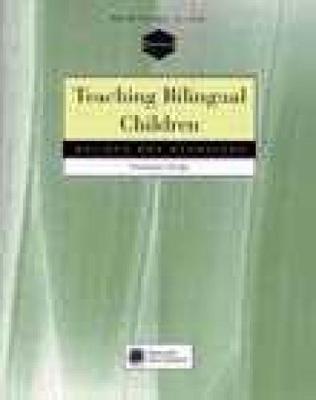
Teaching Bilingual Children: Beliefs and Behaviors

Author:   Suzanne Irujo (Boston University, Emeritus)
Publisher:   Cengage Learning, Inc
Edition:   New edition
ISBN:  

9780838460986


Pages:   134
Publication Date:   01 September 1997
Format:   Paperback
Availability:   Out of stock   Availability explained
The supplier is temporarily out of stock of this item. It will be ordered for you on backorder and shipped when it becomes available.

Our Price $108.11 Quantity:  
Add to Cart

Share |

Teaching Bilingual Children: Beliefs and Behaviors


Overview

Teaching Bilingual Children is one volume of the authoritative 13-title TeacherSource series. The author examines the issue of bilingual education from three distinct perspectives: Teachers' Voices, which are authentic accounts of teachers' experiences; Frameworks, which are comprehensive discussions of theoretical issues; and Investigations, which are inquiry-based activities.

Full Product Details

Author:   Suzanne Irujo (Boston University, Emeritus)
Publisher:   Cengage Learning, Inc
Imprint:   Heinle-Cengage ELT
Edition:   New edition
Dimensions:   Width: 18.70cm , Height: 23.30cm , Length: 0.60cm
Weight:   0.230kg
ISBN:  

9780838460986


ISBN 10:   0838460984
Pages:   134
Publication Date:   01 September 1997
Audience:   ELT/ESL ,  ELT General
Format:   Paperback
Publisher's Status:   Active
Availability:   Out of stock   Availability explained
The supplier is temporarily out of stock of this item. It will be ordered for you on backorder and shipped when it becomes available.

Table of Contents

Reviews

1. Bilingual children learn in the same ways as other children 2. Children learn when they are doing something that has an authentic purpose 3. Children learn by doing 4. Children learn when their teachers believe in them, in themselves, and in what they are doing 5. Children learn when they are involved in determining what and how they will learn 6. Children learn when they have control over the technology used to help them learn 7. The amount of use of each language, and the ways in which each is used, should be consciously determined 8. Children must be assessed in ways that reflect natural language use and the ways in which they learn 9. Culture is an integral part of the curriculum and of classroom organization


Author Information

Tab Content 6

Author Website:  

Countries Available

All regions
Latest Reading Guide

MRGC26


Shopping Cart
Your cart is empty
Shopping cart
Mailing List