Awards
- Commended for IndieFab awards (Political Science) 2012
Overview
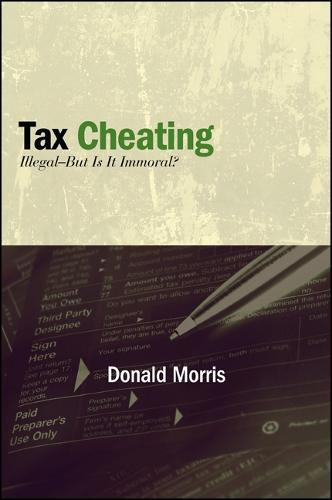
This title provides an examination of the ethical issues surrounding tax cheating and implications for public policy.
Full Product Details
Author: Donald Morris
Publisher: State University of New York Press
Imprint: Excelsior Editions
Dimensions:
Width: 15.20cm
, Height: 2.50cm
, Length: 22.90cm
Weight: 0.408kg
ISBN: 9781438442709
ISBN 10: 143844270
Pages: 290
Publication Date: 01 June 2012
Audience:
College/higher education
,
Tertiary & Higher Education
Format: Paperback
Publisher's Status: Active
Availability: In Print

This item will be ordered in for you from one of our suppliers. Upon receipt, we will promptly dispatch it out to you. For in store availability, please contact us.
Reviews
"""...a unique perspective on the federal tax system in the US ... While many readers will disagree with [Morris's] conclusion ... the value of the book lies in the journey."" - CHOICE ""This is not a how-to guide for tax cheaters, nor is it a green light to cheat. The author defines tax cheating as paying less than the law says we owe, whether this is done deliberately or not. His point is that Congress has the obligation to revise the Tax Code to make it simple, transparent, and equitable, so that all taxpayers should know what constitutes their fair share. Morris draws on a large pool of tax cases, experts, and moral philosophers to make his case, and he is grounded in the experience of ten years as a small business owner and tax preparer."" - Richard P. Mullin, author of The Soul of Classical American Philosophy: The Ethical and Spiritual Insights of William James, Josiah Royce, and Charles Sanders Pierce ""Morris gives us a thorough collection of thoughts and quotations about a sensitive subject-how do morals and ethics affect the completion of a tax return? Who is more unethical, Congress in writing the current tax law or the taxpayer in paying 'too little' tax? What motivates a citizen to 'volunteer' to pay a tax bill? Does Congress really want to close the tax gap? Should a court apply only the letter of the law in a tax case, or should a higher moral principle also apply? By approaching the term 'cheating' in a morally neutral manner, Morris removes much of the baggage that restricts the usual talk about taxes-the book allows for a more fruitful review of the economics of the deal between the citizen and the government, that we call taxation. Intriguing, fresh, accessible, up to date."" - William A. Raabe, coauthor of Federal Tax Research, Ninth Edition"
...a unique perspective on the federal tax system in the US ... While many readers will disagree with [Morris's] conclusion ... the value of the book lies in the journey. - CHOICE This is not a how-to guide for tax cheaters, nor is it a green light to cheat. The author defines tax cheating as paying less than the law says we owe, whether this is done deliberately or not. His point is that Congress has the obligation to revise the Tax Code to make it simple, transparent, and equitable, so that all taxpayers should know what constitutes their fair share. Morris draws on a large pool of tax cases, experts, and moral philosophers to make his case, and he is grounded in the experience of ten years as a small business owner and tax preparer. - Richard P. Mullin, author of The Soul of Classical American Philosophy: The Ethical and Spiritual Insights of William James, Josiah Royce, and Charles Sanders Pierce Morris gives us a thorough collection of thoughts and quotations about a sensitive subject-how do morals and ethics affect the completion of a tax return? Who is more unethical, Congress in writing the current tax law or the taxpayer in paying 'too little' tax? What motivates a citizen to 'volunteer' to pay a tax bill? Does Congress really want to close the tax gap? Should a court apply only the letter of the law in a tax case, or should a higher moral principle also apply? By approaching the term 'cheating' in a morally neutral manner, Morris removes much of the baggage that restricts the usual talk about taxes-the book allows for a more fruitful review of the economics of the deal between the citizen and the government, that we call taxation. Intriguing, fresh, accessible, up to date. - William A. Raabe, coauthor of Federal Tax Research, Ninth Edition
""...a unique perspective on the federal tax system in the US ... While many readers will disagree with [Morris's] conclusion ... the value of the book lies in the journey."" - CHOICE ""This is not a how-to guide for tax cheaters, nor is it a green light to cheat. The author defines tax cheating as paying less than the law says we owe, whether this is done deliberately or not. His point is that Congress has the obligation to revise the Tax Code to make it simple, transparent, and equitable, so that all taxpayers should know what constitutes their fair share. Morris draws on a large pool of tax cases, experts, and moral philosophers to make his case, and he is grounded in the experience of ten years as a small business owner and tax preparer."" - Richard P. Mullin, author of The Soul of Classical American Philosophy: The Ethical and Spiritual Insights of William James, Josiah Royce, and Charles Sanders Pierce ""Morris gives us a thorough collection of thoughts and quotations about a sensitive subject-how do morals and ethics affect the completion of a tax return? Who is more unethical, Congress in writing the current tax law or the taxpayer in paying 'too little' tax? What motivates a citizen to 'volunteer' to pay a tax bill? Does Congress really want to close the tax gap? Should a court apply only the letter of the law in a tax case, or should a higher moral principle also apply? By approaching the term 'cheating' in a morally neutral manner, Morris removes much of the baggage that restricts the usual talk about taxes-the book allows for a more fruitful review of the economics of the deal between the citizen and the government, that we call taxation. Intriguing, fresh, accessible, up to date."" - William A. Raabe, coauthor of Federal Tax Research, Ninth Edition
Author Information
Donald Morris is Associate Professor of Accounting at the University of Illinois Springfield. He is a CPA, Certified Fraud Examiner, and a former tax practitioner with eighteen years of experience, including ten years as owner of his own firm in the Chicago area. He is the coauthor (with Lois Ruffner Plank, Bryan R. Plank, and Christie Plank Ciraulo) of Accounting Desk Book: The Accountant's Everyday Instant Answer Book, 2011 Edition, and the author of Opportunity: Optimizing Life's Chances and Dewey and the Behavioristic Context of Ethics.