Overview
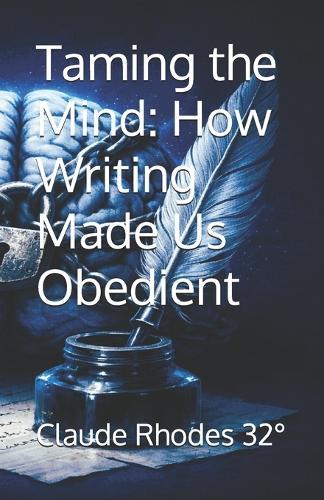
Taming the Mind: How Writing Made Us ObedientWe are taught that writing was humanity's greatest breakthrough. It gave us history, science, law, literature, democracy. It separated us from chaos. It made us civilized. But what if writing did something else, too? In Taming the Mind: How Writing Made Us Obedient, this provocative and deeply researched book challenges one of the most sacred assumptions of modern society: that literacy is purely liberating. Drawing on anthropology, history, political theory, and media studies - including the foundational work of Jack Goody - this book argues that writing did not merely record the world. It reorganized it. More radically, it reorganized us. From the first clay tablets used to track grain and debt, to the printing press that standardized belief and built nations, to the digital databases and predictive algorithms that now anticipate our behavior, writing has functioned not only as communication - but as infrastructure. It has enabled categorization, bureaucratic expansion, documentation, and surveillance at unprecedented scale. Writing made large states possible. It made law permanent. It made identity documentable. It made populations legible. And once populations became legible, they became governable. This book traces how literacy reshaped cognition itself - training us to think in categories, trust documents over memory, and equate written rules with truth. It examines how schools format obedience, how bureaucracies convert people into files, how algorithms transform past behavior into future prediction, and how constant digital inscription has turned expression into exposure. We now live inside an architecture built from text. Birth certificates define existence. Credit scores define trustworthiness. Medical records define health. Criminal files define character. Profiles define opportunity. In the modern world, the written version of you often carries more authority than the living one. Yet this is not a nostalgic attack on literacy. Writing has preserved wisdom, connected continents, and fueled revolutions. Instead, Taming the Mind asks a more unsettling question: What are the psychological and political costs of living inside permanent documentation? What happens when identity must always be legible? When memory is externalized? When deviation becomes data? When prediction replaces judgment? At its core, this book argues that obedience today is not enforced primarily through violence - but through formatting. Through forms, metrics, categories, and scripts we have learned to internalize. We perform roles written before we arrived. We translate ourselves into resumes, profiles, and scores. We police our own legibility. The system survives because we believe it is natural. It is not. It is written. Bold, unsettling, and deeply relevant in the age of surveillance capitalism and algorithmic governance, Taming the Mind invites readers to see literacy not as innocence, but as architecture. It explores the possibility of reclaiming what the author calls the ""wild mind"" - a mode of thinking that resists total categorization, refuses complete legibility, and remembers that writing is a tool, not a destiny. For readers of Michel Foucault, James C. Scott, Shoshana Zuboff, and Yuval Noah Harari, this book offers a sweeping yet intimate examination of how a simple human invention reshaped power, identity, and obedience - and what it might take to loosen its grip. Because what was written can be revised. And what shaped the mind can be reshaped.
Full Product Details
Author: Claude Dale Rhodes
Publisher: Independently Published
Imprint: Independently Published
Dimensions:
Width: 14.00cm
, Height: 1.30cm
, Length: 21.60cm
Weight: 0.281kg
ISBN: 9798248505821
Pages: 238
Publication Date: 15 February 2026
Audience:
General/trade
,
General
Format: Paperback
Publisher's Status: Active
Availability: Available To Order

We have confirmation that this item is in stock with the supplier. It will be ordered in for you and dispatched immediately.