Overview
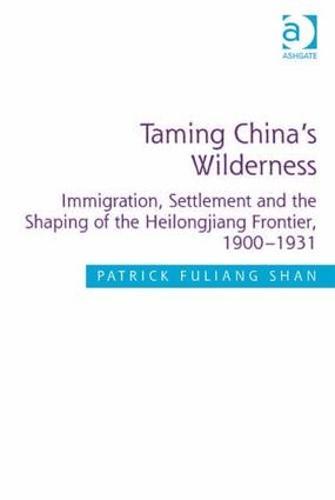
Until the beginning of the twentieth century, the Chinese province of Heilongjiang, historically known as Northern Manchuria, remained a sparsely populated territory on the northeastern frontier. For about two centuries, the rulers of the Qing dynasty (1644-1912) - whose historical homeland was in Manchuria - enforced a policy that prohibited Chinese immigration and settlement and maintained the region’s reputation as the Great Northern Wilderness. Yet, as this new study demonstrates, by the early 20th century the Chinese government reversed its previous policy and began to encourage immigration into Heilongjiang, turning a backwater into a thriving frontier region. Covering the period between the reversal of the anti-immigration policy around 1900 and the Japanese occupation of Heilongjiang in 1931, this book investigates this distinctive frontier and the impact upon it of the settlement of four million Chinese settlers during a thirty-one year period. Following an introduction providing a background to the period covered, the study is divided into five chapters. The first chapter looks at patterns of immigrations, settlement and the features of the newly developing frontier society. Chapter two then deals with land possession, tenure and relations amongst the newly arrived settlers. The third chapter discusses the transformation of the ethnic make-up of the region, and the move from a largely nomadic culture to one of settled farmers. Chapter four probes the social problems these changes caused, particularly banditry. The final chapter revises commonly held notions about Russian dominance of the region, arguing that Russia’s influence was limited to the railway zone. Taken together, these chapters not only provide an overview of a territory undergoing rapid and sustained change, but also provide insights into wider Chinese history, as well as adding to the on-going scholarly interest in border and frontier studies.
Full Product Details
Author: Patrick Fuliang Shan
Publisher: Taylor & Francis Ltd
Imprint: Routledge
Edition: New edition
Dimensions:
Width: 15.60cm
, Height: 1.40cm
, Length: 23.40cm
Weight: 0.566kg
ISBN: 9781409463894
ISBN 10: 1409463893
Pages: 240
Publication Date: 28 April 2014
Audience:
College/higher education
,
General/trade
,
Tertiary & Higher Education
,
General
Format: Hardback
Publisher's Status: Active
Availability: In Print

This item will be ordered in for you from one of our suppliers. Upon receipt, we will promptly dispatch it out to you. For in store availability, please contact us.
Reviews
Patrick Fuliang Shan offers an outstanding study of Heilongjiang as a developing frontier during an important historical era. This unique monograph not only reveals the distinctive features of the northeasternmost frontier but also exposes the historical trajectory of modern China. The book is the crystallization of the author's decade long diligence and must be viewed as a significant contribution to Chinese studies.'Xiaobing Li, University of Central Oklahoma, USA'I was very impressed with the depth and breadth of primary sources. I know of no other book that examines this frontier region in this sort of detail. We can often gain insights into the formation of modern states by studying their margins. Taming China's Wilderness gives a unique perspective on the fall of the Qing Dynasty and the formation of the Republic from the periphery. With an unparalleled command of the relevant archival sources, Patrick Fuliang Shan has shown how this remote, beautiful region has much to say about the process of making the modern Chinese state.'James Carter, Saint Joseph's University, USA'Patrick Fuliang Shan's new book on the Heilongjiang frontier in the early twentieth century is a wonderful addition to the field of Chinese history and of borderland studies. Combining careful research with theoretical sophistication, it brings China's periphery to the centre of the debate over nation-formation and state-building.'Rana Mitter, University of Oxford, UK
Author Information
Patrick Fuliang Shan, Ph.D, is an associate professor of history at Grand Valley State University where he teaches Chinese history, East Asian history and world history. He has served as the president of the Chinese Historians in the United States (2009-2011), a member of the board of the Historical Society for Twentieth Century China (2010-2014), and an associate editor of American Review of China Studies (since 2012). Currently, he is the coordinator of the East Asian Studies Program at Grand Valley State University.