Overview
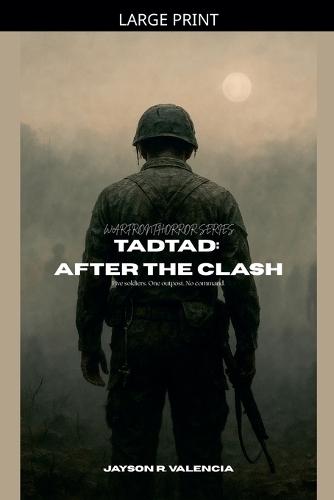
Every four seconds, the dead breathe. At an isolated barangay hall in the Philippine uplands, Sergeant Antonio Dumlao and his squad are sent to perform the simplest, ugliest task in war: recover bodies, log them, move on. But the ravine below the outpost does not keep the dead. Heat films the skin like resin. Blades go soft against flesh. Flies refuse to land. And when a prayer is whispered on a four-count, the corpses answer in time. What begins as procedure (notes, temperatures, range cards) slides into a siege measured by breath. Radios speak with no power. Nails sink themselves deeper into wood. Salt breaks a rhythm for a heartbeat and then fails. The battalion says hold position. Faith says pray. The count says obey. Dumlao fights to keep his men inside the only things that still feel solid: doctrine, language, the logbook's square handwriting. Valencia, young and stubborn, wants the truth on paper. Fadriquela, a medic with shaking hands, will risk anything to miss the beat that has taken root in his chest. Nicasio, who knows the old rites, hears something inside the cadence calling itself mercy. And Corporal Todio, mouthy, loyal, and running out of jokes, decides the only order left to him is how to go. The phenomenon spreads like a song you cannot stop humming. The outpost itself begins to breathe; walls flex, floorboards seal, windows turn to wood. Cadence infects machines, prayers, and men. Every ritual, whether military or holy, becomes a door. To step through, you have to count. When the fog finally swallows the field, the enemy that advances looks unnervingly familiar: formations drilled to Dumlao's voice, uniforms he signed off as KIA, weapons lifted by hands that move on someone else's inhale. Is it contagion, faith, physics, or command itself wearing a new face? The only instruction that comes through clean is the oldest: hold the line. Told in crackling, field-report prose that keeps tightening around the throat, HOLD POSITION fuses supernatural horror and military realism into a terrifying study of obedience. The novel moves like a metronome, shifting from four seconds to six, until breath, prayer, and trigger squeeze are indistinguishable. It is about the orders we believe, the rituals we inherit, and the moment a soldier realizes the thing giving commands might be listening from the other side of the radio. Fans of Jeff VanderMeer's Annihilation, Tim O'Brien's The Things They Carried, and the dread-driven precision of A24 horror will find a new obsession here. Once the cadence catches you, you will not read; you will march.
Full Product Details
Author: Jayson Valencia
Publisher: Jayson Valencia
Imprint: Jayson Valencia
Edition: Large type / large print edition
Volume: 1
Dimensions:
Width: 15.20cm
, Height: 1.30cm
, Length: 22.90cm
Weight: 0.318kg
ISBN: 9798233131141
Pages: 232
Publication Date: 28 October 2025
Audience:
General/trade
,
General
Format: Paperback
Publisher's Status: Active
Availability: Available To Order

We have confirmation that this item is in stock with the supplier. It will be ordered in for you and dispatched immediately.
Author Information
Jayson R. Valencia is a Senior Software Engineer who trades logic for nightmares after hours. A pioneer of the New Asian Gothic, he is the mind behind Tales of Haunted Japan, Tales of Filipino Terror, and the atmospheric novel Malipayon. His narrative architecture is so expansive it requires multiple masks: he also publishes visceral, experimental horror under the aliases Li Mei Tan (The Orchard That Eats Its Own) and the mononym Rodrigo (The First Carving). Whether crafting clean code or dark tales, Jayson builds systems you cannot escape.